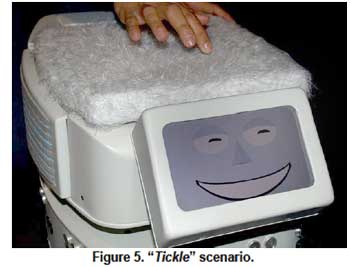
“Under what conditions can we engage in a meaningful, expressive interaction with an electronic device?” Say, for example, by ‘tickling’ a robot?
This question is examined in a recent article by Patrizia Marti, assistant professor and senior lecturer at the Department of Communication Science, University of Siena, Siena, Italy, which features in the International Journal of Design.
Sometimes you put things in the platform of a political party because it's a lot of drama to exclude them even if you don't really believe. So we get hilarity like last week, with Republican candidate Mitt Romney disavowing some of his own platform (he doesn't believe it all personally, he said) and then this week the Democrats had the same problem; the official platform of the Democratic National Convention decided Jerusalem was no longer the capitol of Israel and they removed any mention of God.
If you've been in science media for any length of time, there are two arguments you will hear invoked to support almost any questionable position; that Einstein did his best work while he was a patent clerk and that Galileo was oppressed by the Catholic Church.
One of those is wrong; Galileo was not actually oppressed by a Church, he was really oppressed by fellow scientists(1) , the Pope was actually quite supportive of Galileo but fellow scientists were looking for ways to torpedo him. Yet colloquially, Galileo is held up as this sort of 'religion against science' example in a way that shows many people believe it was some sort of unscientific Dark Age prior to his arrival. Not true at all.
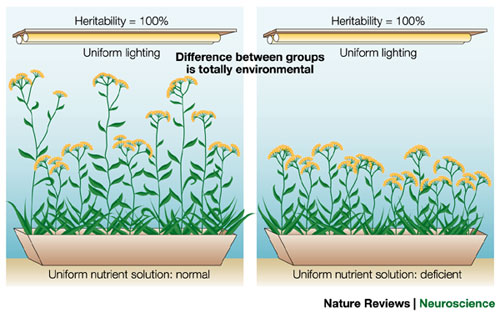
"Heritability" is a term used in many articles and through much of the scientific literature and invariably promotes the idea that it relates specifically to inherited traits. As a result, it is often assumed that the heritability of a particular trait relates to how much influence genetics has on the trait manifesting in an individual.
However, that isn't what it means.
Heritability attempts to address the relationship between nature (genetics) and nurture (environment), so that as each changes, the variation between individuals within a population can be estimated based on these influences. In this context, "environment" simply represents everything external to the genome that could effect expression.
Want to avoid a baby mama without getting surgery or enduring condoms that are too small? Men may soon have the same choice as women when it comes to birth control.
A male contraceptive pill has been talked about for decades, but so far none has been successfully created despite strong demand. Recent surveys found that about 70 percent of men would be willing to take a birth control pill if it were available.
A new study says such a birth control pill for men, without side effects, may soon be ready. Working on mice, the team found that a compound called JQ1 acts as an inhibitor to sperm production and also sperm mobility.
The Quest project, the first carbon capture and storage (CCS) project for an oil sands operation in Canada, has gotten support from the Governments of Canada and Alberta and will soon be underway, Shell announced.
Drought across the United States has reduced substantially the expected yield of corn and soybean fields for the fall 2012 U.S. harvests. With reduced yield, prices have risen rapidly for these crops that are widely-used food and feed ingredients, huge international agricultural trade commodities, and important food aid essentials.
Since the early 1970s, all aspects of academia have skewed left. With that political shift, the confidence that scientists are neutral arbiters for the public good has also declined on both sides.
More Republicans than Democrats think the fix is in regarding a green 'agenda' and global warming whereas more Democrats than Republicans think scientists are shills for Big Ag, Big Pharm, etc. regarding food and vaccines. Basically, science can't win but there was a time when being an academic, and certainly a scientist, was impressive and not a presumption about a political world view. Getting into the political muck - and plenty of advocates for science recommend doing more of it, not less - has been a bad thing for credibility.
If you are flying an airplane and detect an unusual odor in a confined space 5 miles up in the air, what can it be? Burritos for lunch?
Not this time. The foul smell with traces of sulfur in the cockpit came from none other than the Grímsvötn volcano that was spewing gas and ash from southeast Iceland. Sulfur dioxide often indicates volcanic ash, and the presence of ash in the atmosphere can endanger jet engines. Once landed, Captain Klaus Sievers used data from the MetOp satellite via the Support to Aviation Control Service – SACS – to confirm that it was high-altitude sulfur dioxide.
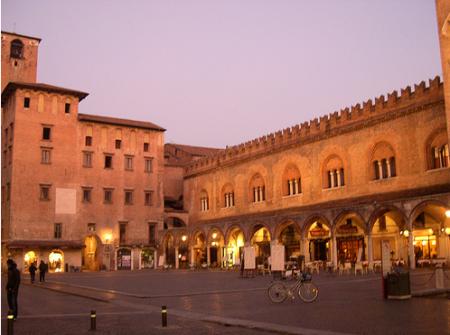
On Friday evening I will be talking in the wonderful Piazza Mantegna, in downtown Mantova (see picture below). It is an event organized by Festivaletteratura (literature festival), where I will be armed with blackboard and chalks, plus a mike, and where I will explain the way a discovery of a new particle comes about.
On Saturday instead I will be at the aula magna of the Mantova University, where in company with Gian Francesco Giudice (a CERN theorist) I will discuss the Higgs boson discovery and the aftermath. That is a more "serious" event and we will be discussing in front of a paying audience. I hear that the event is already sold out, so it will (should) be interesting!