





Life-threatening allergic reactions in children, such as anaphylaxis, have increased 7-fold in the last decade and a third of all allergic shocks in children occur for the first time at school with teachers largely unprepared.

Two studies in Nature applied DNA blood testing using the BEAMing technology to detect drug resistance mediated by KRAS mutations in colorectal cancer patients months before treatment failure was observed. 

 The group led by Alberto Bardelli, Ph.D., of the University of Torino, Italy describes the development of secondary resistance mutations to the anti-EGFR monoclonal antibody cetuximab (Erbitux(R)) in patients with metastatic colorectal cancer (mCRC) [Misale S. et al., Nature Epub 13 June 2012].The second group led by Luis Diaz, MD and Bert Vogelstein, M.D. from Johns Hopkins University reached similar conclusions after studying mCRC patients treated with a monotherapy of panitumumab (Vectibix(R)) [Diaz Jr LA et al., Nature Epub 13 June 2012]. 

Heliatek GmbH, a technology company in the field of organic photovoltaics, has announced that its transparent solar films could be used to be integrated between the glass sheets of double glazed windows. These windows would look like tinted glass as the unique vapor deposition technology for the solar films allows for a homogeneous coating of the solar layer without any distracting patterns or irregularities.  

Results Presented at the 17th Congress of the European Hematology Association by Bristol-Myers Squibb Company and Otsuka Pharmaceutical Europe Ltd., said six-year follow-up results from a Phase 3 randomized, open-label, dose-optimisation study of SPRYCEL(R) (dasatinib) in Philadelphia chromosome-positive (Ph+) chronic-phase chronic myeloid leukaemia (CP-CML) adult patients resistant or intolerant to Glivec(R) (imatinib). 

The six-year data shows progression-free survival of 49.3% and an overall survival of 71% for patients randomized to dasatinib 100 mg once daily (n=167), with 6% of patients (n=10) progressing to accelerated or blast phase on study at six years of follow-up.[1] 

Higgs News ?!

Higgs News ?!

Jun 17 2012 | comment(s)

While Higgs rumors are appearing in blogs of the usual suspects, I cannot comment on those -and I decided it is better if I do not even link them here (I have grown wary of oversensitive reactions in my colleagues).

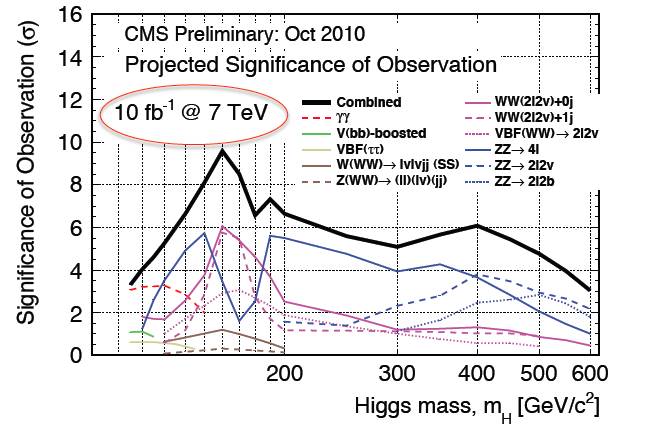
The only thing I think I can discuss with you here now is the predictions on the Higgs boson significance level produced by CMS in October 2010 - a couple of geological eras ago, that is. Those predictions can be trusted because 2011 data showed to be perfectly in line with them, both for the 95% CL limits and for the significance -of course the former are valid in the full mass range and provide more verification power than the single significance number, which is only valid if the Higgs boson exists and has a particular mass.
With the approach of Summer conferences -most notably, ICHEP, which alone has set a make-or-die deadline for the LHC experiments- physicists in ATLAS and CMS are frantically producing their results with data collected in 2012.
Honestly, media. *polishes obnoxious academic spectacles* Is it really that difficult to comprehend the difference between "inseminate" and "impregnate"?

On Thursday I reported that a woman's mouth had been inseminated by a squid she was eating. To be specific, squid spermatophores (packages of sperm) implanted themselves into her mucus membranes, and had to be removed by a doctor.
For about a day I had been trying to read Real Clear Science, particularly the article linked Evolution Debate: Blame Atheists.  Alas, every time I visited the site I got a message:
This site is temporarily down and we are working on restoring service. Sorry for the inconvenience.
It’s now back up, but in the interim I have taken the opportunity, since I run on OScar from Sesame Street Systems, to have a Grouch.  Fear not, North Americans, it is directed at my fellow Brits.

This November, Californians will vote on an initiative that would require any food containing ingredients derived from genetically modified crops to be labeled as such.

Backers of the “California Right To Know Genetically Engineered Food Act” are pitching it as a matter of providing information to consumers, who, they argue, “have a right to know what’s in the food we buy and eat and feed our children, just as we have the right to know how many calories are in our food, or whether food comes from other countries like Mexico or China.”

Too often we see the "anti-science" label being tossed around and invariably we get behind our respective barricades and prepare for the barrage of arguments thrown at each side.

However, the question we should be asking is why a different point of view should automatically be considered "anti-science".  After all, how is "anti-science" even manifest?  Is it simply the denial of facts?  Is it simply the denial of research?

I suppose that any of those might be sufficient to consider someone anti-science, yet for people to have an opposing opinion, doesn't it suggest that exactly the opposite has occurred?  That they have facts and research.  They simply don't agree with each other.

