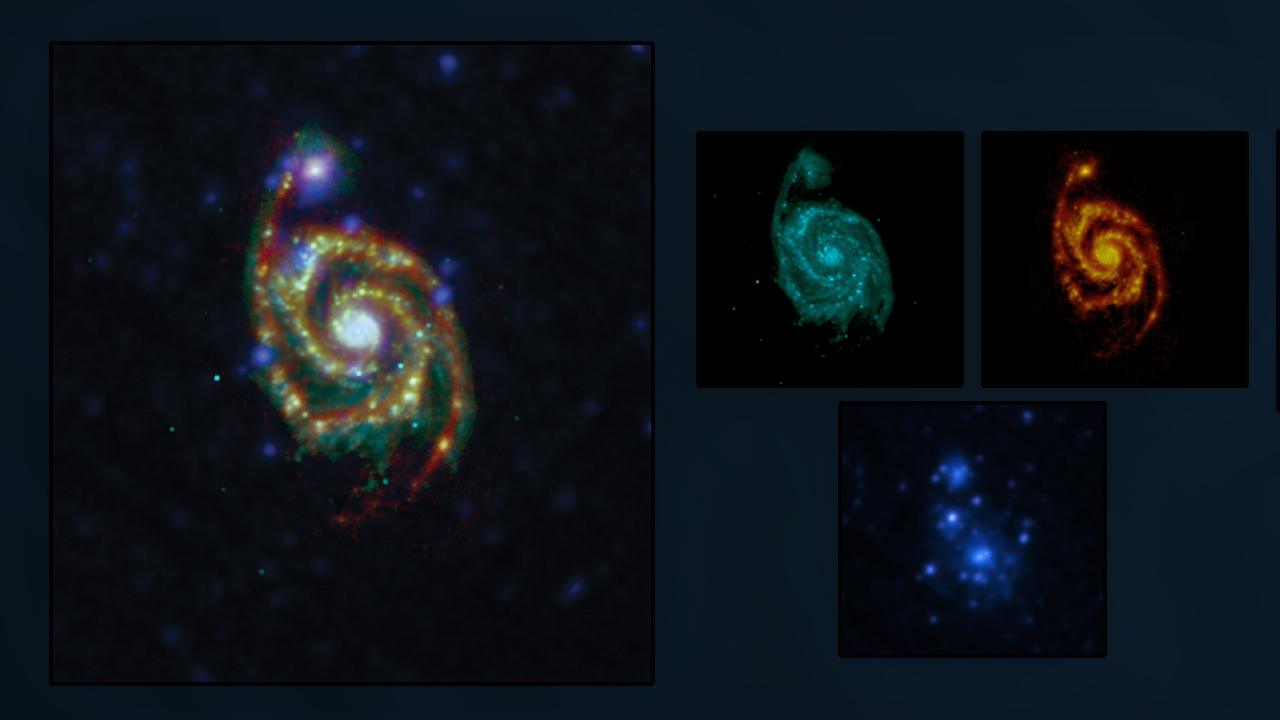





NGC 5194, also known as M51, the Whirlpool Galaxy, is one of the most spectacular examples of a spiral galaxy, with two spiral arms curling into one another in a billowing swirl, this galaxy hosts over a hundred billion stars and is currently merging with its companion, the smaller galaxy NGC 5195.

Around 30 million light-years away, the Whirlpool Galaxy is close enough to be easily spotted even with binoculars. Using the best telescopes available both on the ground and in space, astronomers can scrutinize its population of stars in extraordinary detail.
Chapter 10 of the report on the 2013 community summer study held at Snowmass, titled "Communication, Education, and Outreach" is available since Jan 24th in the Cornell ArXiv. It is a 26-pages document describing the importance of outreach activities to foster the development of particle physics, and offering ideas and strategies to improve the communication between scientists and policy makers. This is none other than the problem I have often referred to as the one of "filling the gap" between science and the general media.
In a forthcoming episode of the Rationally Speaking podcast, Julia and I discuss the philosophy and science of suicide, i.e. what empirical inquiry tells us about suicides (who commits them, how, what are the best strategies for prevention) and how philosophical reflection may lead us to think of suicide. In this post I will focus on the philosophical side of the discussion, for which an excellent summary source, with a number of additional references, is this article by Michael Cholbi in the Stanford Encyclopedia of Philosophy, to which I will keep referring below.

Prion proteins are "misfolded"and cause a group of incurable neurodegenerative diseases, including spongiform encephalopathies (for example, mad cow diseases) and Creutzfeldt-Jakob disease. 

Prions are unique infective agents. Unlike viruses, bacteria, fungi and other parasites, prions do not contain either DNA or RNA. Despite their seemingly simple structure, they can propagate their pathological effects like wildfire, by "infecting" normal proteins.

PrPSc (the pathological form of the prion protein) can induce normal prion proteins (PrPC) to acquire the wrong conformation and convert into further disease-causing agents. 

A project to develop fast-blinking LED systems for underwater optical communications has led to discovering that an artificial metamaterial can increase the light intensity and "blink speed" of a fluorescent light-emitting dye molecule.

The nanopatterned layers of silver and silicon in the new material sped up the molecule's blink rate to 76 times faster than normal, while producing an 80-fold increase in its brightness.

In the late 19th century, classification of humans was in vogue and a lot of it was done based on languages and physical characteristics. Physical anthropology and ethno-linguistics created the Aryan classification among Caucasians, meaning people of Europe and western Asia whose language descended from a common root and who shared physical/biological characteristics also.

The universe of cancer mutations just got a whole lot bigger.

By analyzing the genomes of thousands of patients' tumors, a research team has discovered many new cancer genes, expanding the list of known genes tied to these cancers by 25 percent. Moreover, the study shows that many key cancer genes still remain to be discovered. The team says that creating a comprehensive catalog of cancer genes for scores of cancer types is feasible with as few as 100,000 patient samples.

If you ever watched/read the advocacy cartoon/book/Darwinian morality play "FernGully: The Last Rainforest" you might think that ruining the rainforests is a modern phenomenon brought on by McDonald's hamburgers or guitar makers or whoever and ancient man lived in harmony with nature.

It's a great mythology but just that - nature does not live in harmony with anything. Since almost the moment the last Ice Age ended, prehistoric man has kept fighting nature, including rainforests in Borneo, Sumatra, Java, Thailand and Vietnam, which had been termed 'untouched by humans.'

With the cost of American health care set to increase substantially, the search is on to start forcing people to curb preventable diseases, like those related to obesity.

But it may not be a choice, according to some psychologists. The same way that people can be addicted to drugs and alcohol, they can have an unhealthy relationship with food. 

More than one-third of U.S. adults are obese, according to the Centers for Disease Control and Prevention, putting them at greater risk for heart disease, stroke, type 2 diabetes and certain types of cancer. The estimated annual medical cost of obesity could have been as high as $147 billion in 2008 U.S. dollars, and obese people pay an average of $1,429 more in medical expenses than those of normal weight.

10 years of Opportunity and Spirit on Mars have given us some interesting insights, like that the oldest minerals show that around four billion years ago Mars had liquid water so fresh it could have supported life.

