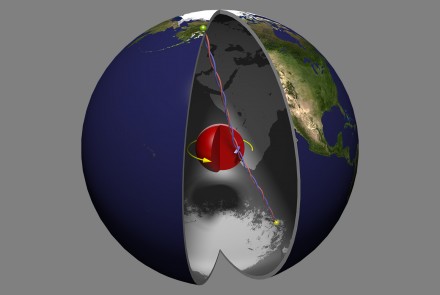









We all know that the Earth is in constant motion, rotating beneath our feet, but new research in Nature Geoscience reveals that the center of the Earth is out of sync with the rest of the planet and is frequently speeding up and slowing down.

Associate Professor Hrvoje Tkalcic from the ANU College of Physical and Mathematical Sciences and his team used earthquake doublets to measure the rotation speed of Earth’s inner core over the last 50 years and discovered that not only did the inner core rotate at a different rate to the mantle – the layer between the core and the crust that makes up most of the planet’s interior – but its rotation speed was variable.
Responsible energy production would seem to have an obvious positive roadmap; have energy companies include environmental groups in guiding pollution standards and participating in studies about natural gas extraction.

But for entrenched constituencies, that is unacceptable.
Rather than Draconian measures to cut emissions, which will impact people in various regions and economic spheres unfairly, a better solution may be to simply keep places cooler on hot days, which will reduce fuel needed for air conditioning.

And outer space can help, Stanford researchers say. They designed an entirely new form of cooling structure that cools even when the sun is shining - by reflecting sunlight back into the chilly vacuum of space. 
The movement of nitrate through groundwater to streams can take decades to occur and that long lag time means that changes in the use of nitrogen-based fertilizer (the typical source of nitrate) may take decades to be fully observed in streams, according to a recent study.

Water quality experts have been noting in recent years that nitrate trends in streams and rivers do not match their expectations based on reduced regional use of nitrogen-based fertilizer.  The long travel times of groundwater discharge, like those documented in this study, have previously been suggested as the likely factor responsible for these observations.

The large majority of non-coding DNA, which is abundant in many living things, may not actually be needed for complex life in at least one carnivorous plant, Utricularia gibba, according to a paper in Nature.

U. gibba,  the carnivorous bladderwort plant, genome is the smallest ever to be sequenced from a complex, multicellular plant. The researchers who sequenced it say that 97 percent of the genome consists of genes — bits of DNA that code for proteins — and small pieces of DNA that control those genes.

Pollution and Parliament

Is carbon dioxide a pollutant ?

I am old enough to remember the great smog and the 1953 flood.  There is nothing like a first-hand view of nature in the raw to make a person environmentally aware.  It was in the 1950s at the age of about 6 or 7 that I learned how coal was made out of vegetable matter in nature's own pressure cooker.  The origin of coal was so widely known that it was often called 'bottled sunshine'.
Hornswoggled with a Boondoggle

Etymology isn't a true science, but any etymologist worthy of the name needs to adopt scientific methods if he or she is to avoid falling into the trap of producing another piece of false etymology.

That's etymology, but if you mouth entomology, as many of your peers do, I had as lief an insect spoke my lines.  
(Hamlet  Act 3, Scene 2 - almost.)

I had as lief an insect spoke my lines
Legendary Confederate fighter Thomas J. "Stonewall" Jackson died 150 years ago but the actual cause of his death has been a subject of debate. And it was again at the 20th annual Historical Clinicopathological Conference in Maryland.

Jackson got the nickname "Stonewall" from Confederate General Barnard E. Bee, when he moved an artillery battery up to support Bee's troops as they retreated at the First Battle of Bull Run (called First Manassas by Confederate troops)(1). Bee said of the mostly unheralded Colonel, "There is Jackson standing like a stone wall. Let us determine to die here, and we will conquer. Rally behind the Virginians."
In 1992 the top quark had not been discovered yet, and it did not make much sense for the CDF collaboration to have a full meeting devoted solely to it; rather, analyses targeting the search of the top quark were presented at a meeting which dealt with both bottom and top quarks. This was called back then "Heavy Flavour meeting".
Richard Feynman was born on 11 May 1918. Today would have been his 95th birthday. This isn’t a paean to a physicist – it could be, but I’m sure millions of words have been published on this – but a game for wordsmiths and numberphiles.

Within the highly restricted format of the Pilish Poem, the aim is to be both enlightening and eloquent; plus to have some fun playing around.You can follow my train of thoughts at my first article on this so, without repeating myself, I’ll jump right in with the basic rules of what constitutes a Feyman Point Pilish Poem.

