



The Grand Canyon is spectacular to look at but figuring out how old it is can be frustrating. A new paper says that conventional models and estimates of the last 150 years are way off - it is far older than the 5 to 6 million years old commonly thought.

"Rather than being formed within the last few million years, our measurements suggest that a deep canyon existed more than 70 million years ago,"  says Kenneth A. Farley, Keck Foundation Professor of Geochemistry at Caltech and coauthor of the study.

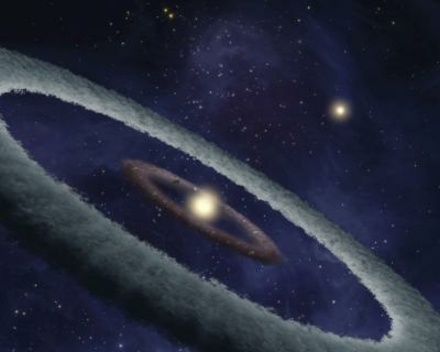
Astronomers find planets in strange places and wonder if they might support life. One such place would be in orbit around a white or brown dwarf. While neither is a star like the sun, both glow and so could be orbited by planets with the right ingredients for life.

No terrestrial, or Earth-like planets have yet been confirmed orbiting white or brown dwarfs, but there is no reason to assume they don't exist. However, new research by Rory Barnes of the University of Washington and René Heller of Germany's Leibniz Institute for Astrophysics Potsdam hints that planets orbiting white or brown dwarfs will prove poor candidates for life.

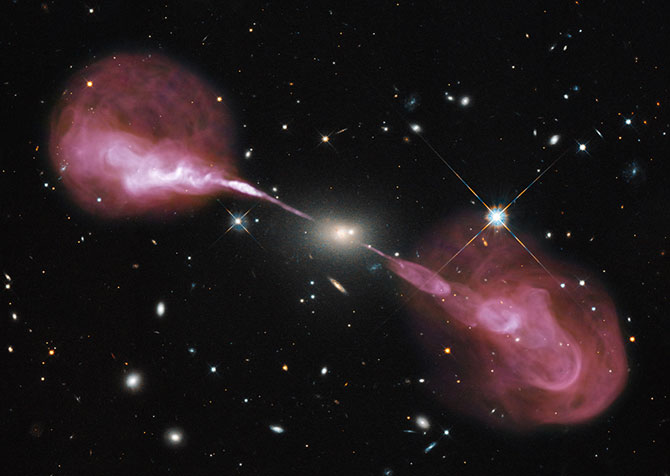
Spectacular jets powered by the gravitational energy of a super massive black hole in the core of the elliptical galaxy Hercules A are shown off by the combined imaging power of the Hubble Space Telescope's Wide Field Camera 3 and the recently upgraded Karl G. Jansky Very Large Array (VLA) radio telescope in New Mexico.

If you are obese, it is reasonably well-established that you are not going to exercise and vibration machines that sound like they might be less work, like the kind developed by the Soviets for astronauts, actually can burn through 400 calories in 15 minutes, so they are not for the casual - but a recent study found that low-intensity vibrations led to improvements in the immune function of obese mice.

If the same effect can be found in people, it would have clinical benefits for obese people suffering from a wide range of immune problems related to obesity.

 Astronomers theorize that an as-yet-unidentified form of matter is responsible for 90 percent of the gravity within galaxies and clusters of galaxies but because it is detected via its gravity and not its light, they call it "dark matter." 

The winners of the 2012 Semantic Web Challenge (SWC), determined by a jury from both academia and industry, were announced at the International Semantic Web Conference held in Boston. The challenge and allocated prizes were sponsored by Elsevier. 

 In 2003, the SWC was set up to showcase the very latest in semantic web technology and every year the final rounds of this competition take place at the annual International Semantic Web Conference. Semantic Web Challenge contestants competed in any of two challenge categories: 'Open Track' and 'Billion Triples Track'. 

A monster black hole has been detected.  With 17 billion solar masses, it is significantly heavier than models predict and could be the most massive black hole known to date. 

 Astronomers believe there is a super-massive black hole at the heart of every galaxy and its mass ranges from several hundred thousand solar masses to a few billion. The black hole that has been best investigated  sits at the center of our galaxy, the Milky Way, and has around four million solar masses.

Merck Serono, a division of Merck, has donated its 100 millionth praziquantel tablet to the World Health Organization (WHO).

