In the history of statistics, economy and decision theory, the St. Petersburg paradox plays a key role. This lottery problem goes back a full three centuries to the mathematician Nicolas Bernoulli who first formulated the problem in 1713. Twenty five years later, in 1738, his nephew Daniel Bernoulli presented the problem to the Imperial Academy of Sciences in St. Petersburg. That presentation not only gave the paradox its name, it also created a lot of commotion amongst mathematicians.
Car accidents are the number one killer of teenagers in America! There is something that should have been done a long time ago and that would help all drivers and of course their "victims". We don’t do it, because people are afraid to doubt their own agency and rationality. Benjamin Libet’s research is not difficult but people refuse to accept the science. The pet assumption in this case? That you are consciously aware of what you are doing at the time you are doing it, which you* are not! Libet’s research [1, 2] quantified how large the problem is, and it is huge when sitting in a ton of metal bolting down a busy street.
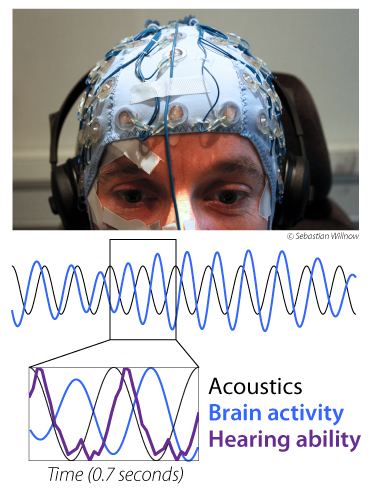
We know brain activity changes many times over the course of a day. When listening, this oscillation synchronizes to the sounds we are hearing. Not only that, say researchers from the Max Planck Institute for Human Cognitive and Brain Sciences, this oscillation influences the way we listen.
Hearing abilities also oscillate and depend on the exact timing of one’s brain rhythms. This discovery that sound, brain, and behavior are so intimately coupled will help us to learn more about listening abilities in hearing loss and perhaps people who stutter.
Though
breast cancer death rates have been in decline for 20 years, black women had higher death rates than other demographics in the newest Centers for Disease Control report covering 2005-2009. Breast cancer remains the most common cancer and is the second leading cause of cancer death among U.S. women, about 40,000 deaths annually.
Human ancestors were making stone-tipped weapons 500,000 years ago at Kathu Pan 1, an archaeological site in South Africa. The revelation pushes back the date for manufactured weapons another 200,000 years
Attaching stone points to spears - hafting - was an important advance in hunting for our early ancestors. Though hafted tools require a great deal of effort to manufacture, a sharp stone point on the end of a spear can increase its killing power and that shows strategic foresight.
The Exoplanet next door: Astronomers have discovered the lowest-mass planet yet orbiting a Sun-like star. But the even-more exciting news is that it orbits α Centauri B, a member of the stellar system that is our Solar System’s nearest neighbour. Although nearly identical to Earth in mass, the planet is much closer to its star than Mercury is to the Sun, meaning that it is likely a scorched and barren rock.
Earlier this year, the US government opened a new front in its war with China over solar panel manufacturing - tariffs designed to close the gap between U.S. and Chinese labor costs.
Tariffs don't work, we have known that since the Depression of the 1930s was prolonged due to economic tinkering and boosting tariffs. Creating higher costs for a non-essential product, especially a non-essential product for a market that is only in existence due to government subsidies, drives down demand.
The day after the American presidential election, the U.S. International Trade Commission voted to saddle Suntech Power Holdings Co., Ltd. with a tariff of 35.97% on their silicon module imports from China, which are made by the parent company.
For Marcel Proust, one of the after-effects of eating asparagus, was that it “…transforms my chamber-pot into a flask of perfume.’’
AUCKLAND, NZ – This week, I missed Wednesday.
Normally, the perils of crossing the International Date Line en route to field sites don’t bother me. After all, who really minds missing the middle of the working week?
But this time, Wednesday’s absence bothered me. That’s because two days ago, California officially opened its carbon cap and trade market with the first sale of emissions permits since the state passed landmark climate change legislation six years ago.
Marriage counseling is so 20th century. The 21st century may belong to relationship neuroinformaticians because they can create a mathematical model for efficient communication in your love life.
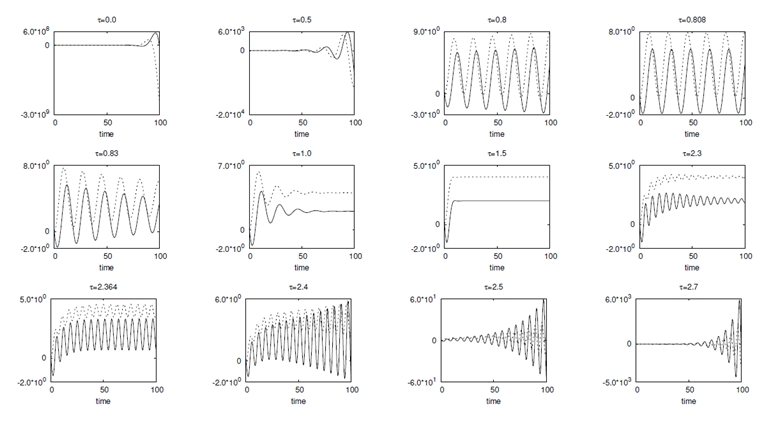
The dynamics of love can look like a sine wave, with smooth, repetitive highs and lows. That's probably not too bad. We certainly try for a flat line but that is difficult to achieve. What you want to avoid is having your other half begin to vibrate weirdly. When that happens, couples oscillate without any harmony, the waves go out of control and soon you are forced to get back down to dating weight.