If you love the appearance of getting hammered and are too classy to hold 'near' beer - or, oddly, you enjoy the taste of whisky but don't like getting hammered - there is good news; the world's first alcohol-free, whisky-flavored drink.
ArKay has the appearance, smell and taste of traditional whisky they say, but no alcohol, no calories and no sugar - they claim you will enjoy it straight or on the rocks or in a cocktail.Now, they did not send this whisky to the Science 2.0 office for proper scientific testing, but they should if they want that 'they claim' disclaimer removed. It's a good idea to be skeptical of a 'no alcohol, no calories, tastes great' marketing blurb.
Banks and brokerage houses employ a lot of physicists - it was a big fad of the last decade because the industry discovered that physicists knew how to make models and economists did not.
But physicists don't understand economics and the behavior of people any more than economists do and it hasn't worked. No rational model predicts that some trader will just go crazy and lose billions and automated schemes have been a disaster. Yet there is hope.
An experiment using single particles of light, photons, have produced and implemented them intoa quantum key distribution (QKD) link. The single photons were produced using two devices made of semiconductor nano-structures that emitted a photon each time they were excited by an electrical pulse. The two devices were made up of different semiconductor materials so they emitted photons with different colors.
QKD is a process that enables two parties, ‘Alice’ and ‘Bob’, to share a secret key that can then be used to protect data they want to send to each other. The secret key is made up of a stream of photons that ‘spin’ in different directions – vertically, horizontally or diagonally – according to the sender’s preferences.
Collisions between heavy ions at machines like the Relativistic Heavy Ion Collider (RHIC) at Brookhaven National Laboratory, and more recently the LHC, may help enlighten our understanding of the hot nuclear matter that permeated the early universe and make this hidden realm accessible by recreating the extreme conditions of the early universe on a microscopic scale.
The temperatures achieved in these collisions, more than 4 trillion degrees Celsius, the hottest ever created in a laboratory, briefly liberate the subatomic quarks and gluons that make up protons and neutrons of ordinary atomic nuclei so scientists can study their properties and interactions.
There are several schools of thought on building a CubeSat or other picosatellite. We will contrast what we call Lego-style with what we'll dub the Custom Shop approach.
Lego Style suggests using the easiest, rather than the most efficient, parts and tools to create your satellite. This is the kit-bashing or Lego bricks approach. You have several generic pieces, and you put them together to make what you want. The final end product may be a bit square and clunky, but the advantage is that you were able to quickly build and test.
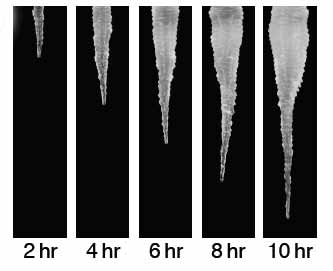
“A complete theory of icicle shape, including tip growth, self-similarity and the ripple instability, is currently lacking.”
Prompting professor Stephen W. Morris and Antony Szu-Han Chen from the Department of Physics, at the University of Toronto, Canada to construct ‘An apparatus for the controlled growth of icicles’. The team used their specially designed table-top apparatus (with a rotating support) in an attempt to grow what they call ‘ideal icicles’: In total, they managed to grow 93, both from distilled water and common tap water.
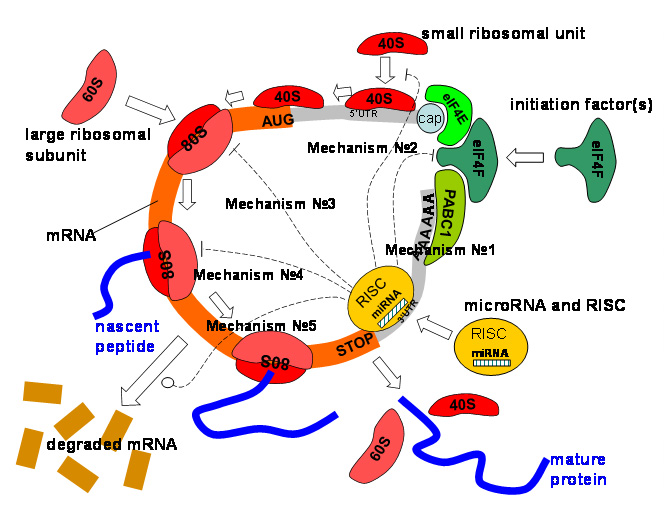
Mathematicians have proposed a new solution to understanding a MicroRNA puzzle; different and sometimes conflicting theories about ways in which microRNAs regulate protein production, since the results varied depending on only slightly changed experimental conditions.
The problem to date has been that scientists have differed over interpretations of how the production of the major building blocks of a cell, proteins, is controlled by microRNAs.
One of the pretty boys of science writing has fallen. Jonah Lehrer has finally been called out for distorting science. Many more are going to fall. Or wait. No, wait, what? Oh – I see – he misquoted some singer-song writer dude! Ohhhh – how tragic! And without misquoting Bob Marley or whoever that was (please correct me in the comments because I really really care so much), he would be still one of those celebrated “science writers” selling better than porn these days.

Jonah Lehrer - dared falsely quoting Britney Spears instead of pulling Einstein out of context. Some deeds go too far even in science writing.
Like people who approach geopolitics with the attitude of "If people would just talk to each other, we would all along", there are a lot of naïve assumptions about just dumping gasoline.
We know it causes emissions, and emissions are bad, we know a lot of the money paid for oil goes to fund Middle Eastern terrorism, and that is bad - those things should cause both the left and the right in America to want gasoline gone. And yet it is not gone. The reason is simple: gasoline is a lot more efficient than alternative energy proponents want to believe.
For as long as I can remember, academic scientists have said that applied research is great - for someone else. But for themselves, they want to do basic research and be creative and not have to worry about any applied / societal benefit.(1)
But another election season is here and, despite $140 billion of taxpayer money being spent on research, no one in either party really gives a hoot about science topics and scientists are concerned neither candidate cares.(2)