Prior to World War II and dating back to the 1890s, the phrases “social technology” and “social engineering” carried strong connotations of central planning. This became particularly true in the Soviet Union, where the terms appeared in various tracts.
Parkinson’s disease is the second most common neurodegenerative disease after Alzheimer’s disease.
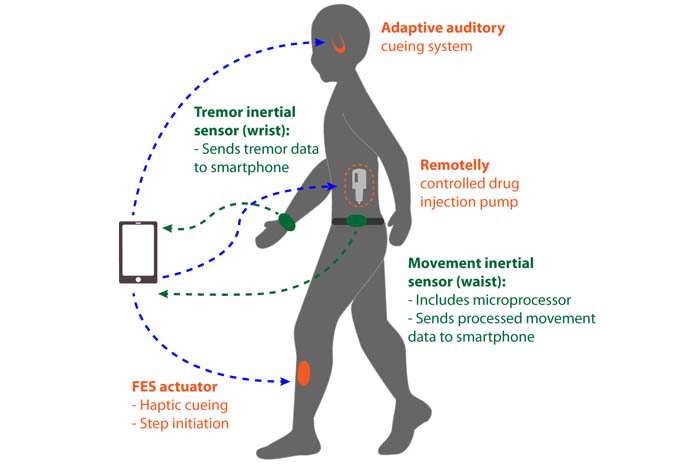
Now patients are getting some high-tech help. REMPARK (Personal Health Device for the Remote and Autonomous Management of Parkinson’s Disease) is a wearable monitoring and actuation system that identifies the motor status of Parkinson’s patients in real time. The system will also determine what phase a patient is in while walking or performing everyday activities and provide a cue to initiate movement when a gait-freezing episode occurs.
Researchers have developed a new method of repairing bone using a synthetic bone graft substitute material. Combined with gene therapy, they say it can mimic real bone tissue and has potential to regenerate bone in patients who have lost large areas of bone from disease or trauma.
The researchers have developed a scaffold material made from collagen and nano-sized particles of hydroxyapatite which acts as a frame for the body’s own cells and repairs bone in the damaged area using gene therapy. The cells are tricked into overproducing bone producing BMPs (proteins), encouraging regrowth of healthy bone tissue.
Can anyone accurately forecast the result of the London Olympics while they are a week away?
Even more daring, can they forecast results without in depth knowledge of athlete training?
Economists at Ruhr-Universität Bochum are taking a shot at it and, if it sounds like complete madness, we'll go ahead and spoil it and tell you they believe that China, USA, and Russia will top the score table with 102, 100, and 71 medals, respectively, so you can move on to another article.
But if you are interested in the nuts and bolts, read on. You can decide if this is mumbo-jumbo or solid science.
Can modern physicists examine ancient myths and teach us about modern social networks, even science ones like Science 2.0?
Pesky humanities types are always butting into science and a new article in EPL (Europhysics Letters) turns the tables. Pádraig Mac Carron and Ralph Kenna from Coventry University performed detailed text analyses of the Iliad, Beowulf and the Táin Bó Cuailnge and found that the interactions between the characters in all three myths were consistent with those seen in real-life social networks. Taking this further, the researchers compared the myths to four known works of fiction -- Les Misérables, Richard III, Fellowship of the Ring, and Harry Potter -- and found clear differences.
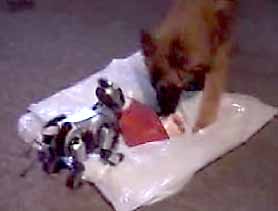
How might real dogs react to robotic dogs?
The
Sony Corporation has been investigating. Researchers at its
Computer Science Laboratory in Paris, which
“… engages in fundamental research in cutting edge areas of science that are relevant for pushing the state of the art in computing.” tested the ground by exposing real dogs to
AIBO – their now-famous computer-controlled semi-autonomous dog-bot.
Null results are important in science, but that doesn't mean scientists want other people to see theirs. The reason is obvious: competition. If one group has a null result and another group is working on something similar, they potentially give the competitor a shortcut by publishing a negative result.
So it goes in just about every field. The food industry has its own null results, but they can be a lot more expensive. The failure rate of new product launches is a shocking (to outsiders) 50%. It seems shocking because these are experts, armed with expensive demographic analyses and psychological information on the marketplace. They should know what people want.
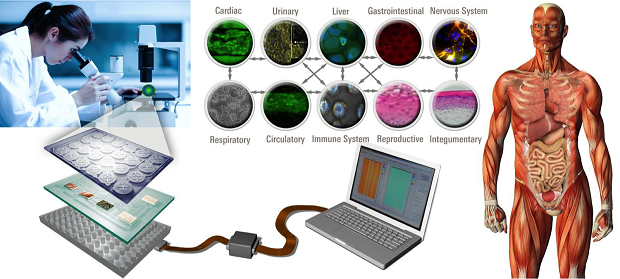
Defense Advanced Research Projects Agency (DARPA) and the National Institutes of Health (NIH) are teaming up to provide $32 million for development of a technology platform that will mimic human physiological systems in the laboratory, using an array of integrated, interchangeable engineered human tissue constructs - a human body on a chip.
The new program is called “Barrier-Immune-Organ: MIcrophysiology, Microenvironment Engineered TIssue Construct Systems” (BIO-MIMETICS) and includes the Department of Biological Engineering at MIT, the Charles Stark Draper Laboratory, MatTek Corp. and Zyoxel Ltd.
Is ‘a pair’ big enough to be called ‘a group’? The tricky subject of dyads has recently been causing considerable professorial debate in the journal ‘Small Group Research’. (Note: the word ‘dyad ‘ is derived from the Greek ‘dýo’, meaning ‘two’.)
Almirall, S.A. (ALM.MC) and Forest Laboratories, Inc. announced that the U.S. Food and Drug Administration (FDA) has approved Tudorza(TM) Pressair(TM) (aclidinium bromide inhalation powder) for the long-term maintenance treatment of bronchospasm associated with chronic obstructive pulmonary disease (COPD), including chronic bronchitis and emphysema.
COPD is a common, progressive, and debilitating lung disease characterized by persistent airflow limitation that makes it hard to breathe; it is currently the third leading cause of mortality in the US. Characteristic symptoms include breathlessness, excessive production of sputum, and a chronic cough.