The National Academies Press will roll out some new national science standards for K-12 educators and for the first time, those standards will include guidelines on teaching climate change.
Good luck with that. As No Child Left Behind showed, positive results and the welfare of kids will not matter in a political fight - any attempts to create an education standard and accountability are going to flop unless education unions buy into it and any attempts to create a science standard for climate education will flop unless teachers do. And a lot of them don't.
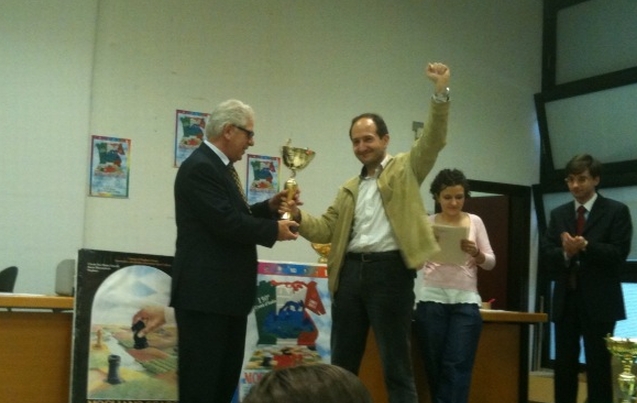
Chess is a game, a sport, and a very radical way to test one's concentration and discipline in pure thought. Besides liking it as a game (a precondition to enjoy the other benefits), I also enjoy immensely the demands that a chess game puts on your brain's functioning; and this is brought to the extreme during a chess tournament, where you are also subject to pressure from competition factors extraneous to the 64 squares where the battles develop.
Our solar system is believed to be around 4.5 billion years old, but it's difficult to know how long it actually took to form.
The reason is, basically, our 'clocks'.
Establishing chronologies of past events or determining ages of objects require having clocks that 'tick' at different paces - nuclear clocks used for dating are based on the rate of decay of an atomic nucleus expressed by a half-life, which is the time it takes for half of a number of nuclei to decay, a property of each nuclear species. Radiocarbon dating is the most famous. It was invented in Chicago in the late 1940s and can date artifacts back to prehistoric times because the half-life of radiocarbon (carbon-14) is a few thousand years.
If a species´ reproductive strategy is evolutionarily adapted to the environmental constraints encountered by that species in its natural habitat, such as availability of food resources and predictability of the environment, and the aim generally is to produce the largest possible number of surviving offspring under particular conditions, then common dormice are defying that just a little.
In western countries there are 20 times more people aged 65 years andr older than one hundred years ago. With those demographic changes have come changes in brain research. Understanding the mechanisms responsible for aging-related changes in cognitive processes, including spatial orientation, has become especially important for people’s everyday lives.
Al Armendariz, the top Environmental Protection Agency official in the oil-rich Southwest region, resigned from his post, effective today. It's the latest twist in the never-ending and increasingly ugly fracking fracas.
If we had a prize for Most Celebrated Business Hero in America, it would have to be Steve Jobs, the late founder of Apple.
The agile doge of Silicon Valley had a “death stare” you couldn’t escape.
He had a up-from-orphan back story you couldn’t resist.
And he had the vision of ten of his fellow technology executives.
That’s why--we’re told--Apple was so good at making the things we love. All things “I”, that is--from iPads and iPhones, to iPods and iTunes.
Lately, it also seems that Jobs and the company he left behind were also awfully good at all things Me.
Of all the available publications on
'Aircraft Nose Art', very few have investigated its psychological undercurrents.
An exception is ‘
Aircraft Nose Art: From World War I to Today’ (1991). Chapter 1 of which was authored by the late
George R. Klare, who was Distinguished Professor of Psychology at

Ohio University.
While cold fusion remains a pipe dream, fusion as an energy source for the future continues to be funded and improved.
In nuclear fission, current nuclear energy, the nucleus of an atom is split, but in fusion two lightweight atoms join together. The biggest benefit is no explosion.
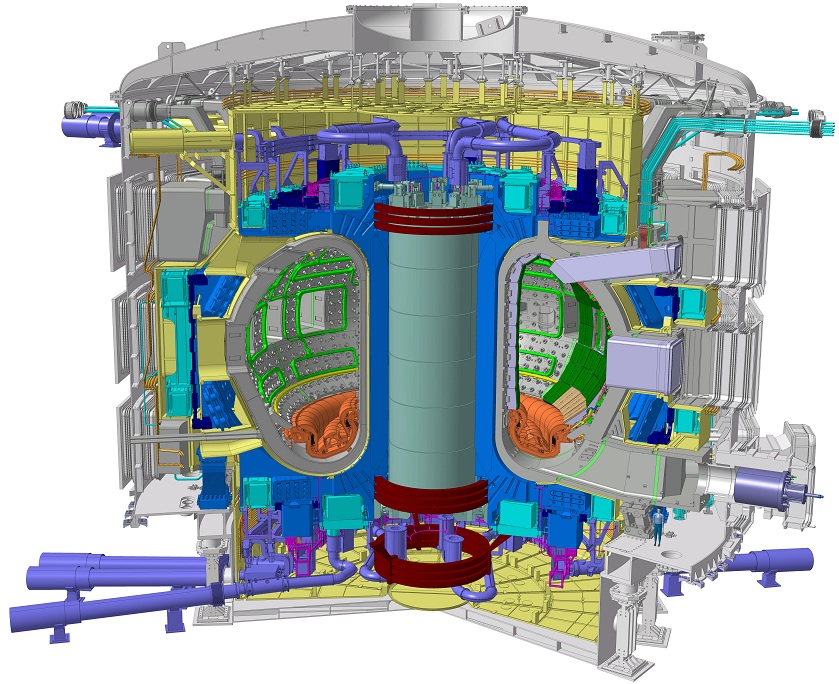
The ITER project is seeking to turn nuclear fusion into reality and is making use of the Tokamak reactor for this purpose. Reactors of this type and the plasma used in them to carry out fusion have a number of control problems, and to solve them, electronics engineer Goretti Sevillano has come up with some tools in her thesis defended at the University of the Basque Country.
Researchers have discovered a previously unknown particle composed of three quarks in the Large Hadron Collider (LHC) particle accelerator. The baryon known as Xi_b^* confirms fundamental assumptions of physics regarding the binding of quarks.
The baryon family refers to particles that are made up of three quarks and quarks form a group of six particles that differ in their masses and charges. The two lightest quarks, “up” and “down” quarks, form the two atomic components, protons and neutrons. All baryons that are composed of the three lightest quarks (“up”, “down” and “strange” quarks) are known. Only very few baryons with heavy quarks have been observed to date. They can only be generated artificially in particle accelerators, as they are heavy and very unstable.