During the educational reform efforts of the No Child Left Behind Act,
females achieved parity with males on math tests for the first time in history, yet stereotypes die hard. Some people think females are just not as good at math. Is there truth to it?
Matter annihilates antimatter, mostly resulting in light (no, not “pure energy”, whatever that is supposed to be). Matter and antimatter can also come into existence together via a process that is the reverse of annihilation. Yet our universe has almost no antimatter. How can such be if they come into existence in exactly equal amounts, each particle together with its antiparticle?

Everyone has heard of hindsight - where the context of past events is much clearer in memory than they were at the time - but a new study of the blindsight phenomenon, where a person is cortically blind yet they can still discriminate visual information without any awareness, could make the architecture of the brain a lot clearer.
Toward that end, Tony Ro, a neuroscientist at the City College of New York, is artificially recreating blindsight in his lab. Sound scary? Just wait.
In my late teenage years I grew fond of Scientific American. Although language caused a barrier, and while I could digest and understand only some of the articles, the popscience presented opened my eyes to exciting developments and invited me to study further the subjects presented.
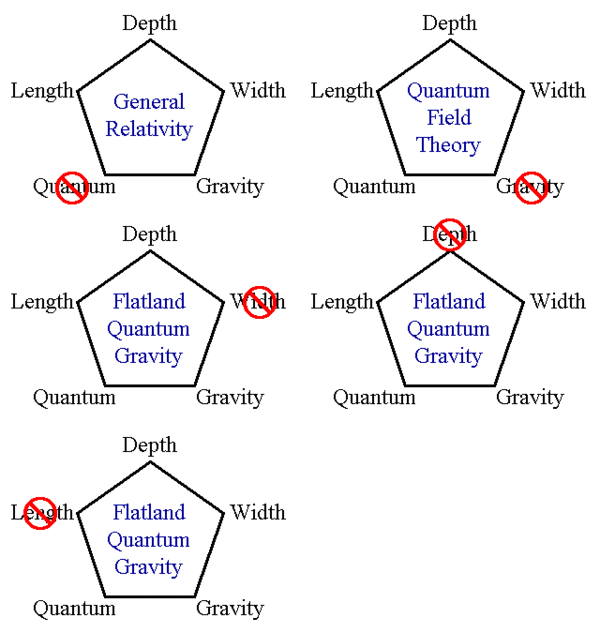
These days, many years later, I still glance through the magazine, but generally with less enthusiasm. Today's editions seem packed with rather superficial information, and the articles tend to be less inviting towards further studies. Yet, once in a while, a hidden jewel attracts my attention. Such is the case this month with an article by Steve Carlip from UC Davis. Subject is quantum gravity. Quantum gravity in a pancake universe, that is.
What happens when genomics and synthetic biology labs get together? Anti-science people flip out. Because, you know, anti-science hippies think scientists are inhuman crazies without families who only care about breaking the laws of nature (maniacal laugh).
As almost every parent of an autistic child knows, there is no shortage of books out there on autism, but true gems are rare. Eileen Riley-Hall’s new book Parenting Girls on the Autism Spectrum is just that, though, a true gem and a must-have book for anyone with daughters on the spectrum.
A few months ago, I read Electric Universe by David Bodanis (ISBN 1400045509). There are two chapters on radar during the Second World War, #7 dealing with Britain’s defences and #8 dealing with the area bombing of Germany, a tactic down to ‘Bomber’ Harris, which to this day gives rise to doubt in Britain, such that we feel a conflict between honouring the bomber crews who sustained the heaviest proportional loss of all our armed forces, and disturbance at the methods of their commander, who went for mass
“Viewing a stressful soccer match more than doubles the risk of an acute cardiovascular event.”
This disturbing conclusion was published in a 2008 study based on data regarding 4,279 Bavarian medical emergency cases. The number, and character, of adverse cardiovascular events which occurred during the FIFA World Cup (held in Germany from June 9 to July 9, 2006) were compared 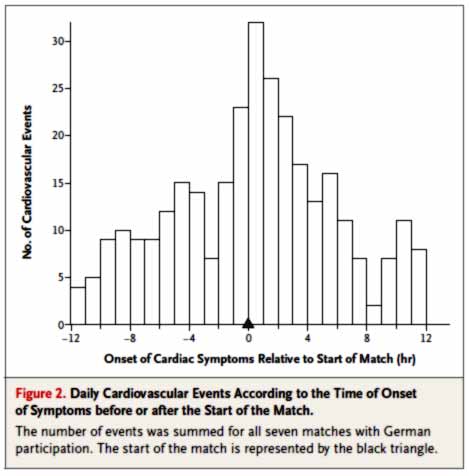 with those in a control period. Not only was there double the incidence of cardiac problems, but their time of onset starkly correlated with the beginning of the matches. [see graph at right]
A dramatic sea-level rise occurred at the onset of the first warm period of the last deglaciation, known as the Bølling warming, approximately 14,600 years ago. This event, referred to as Melt-Water Pulse 1A (MWP-1A), corresponds to a rapid collapse of massive ice sheets 14,600 years ago and resulted in global sea-level rise of ~14 m.
The Tahiti Sea-Level Expedition 310 of the Integrated Ocean Drilling Program (IODP) was carried out in 2005 by the European Consortium for Ocean Research Drilling (ECORD) and the ECORD Science Operator (ESO) on behalf of IODP.
Periodically it seems that the subject comes up regarding human colonization of space and then all manner of problems and difficulties are discussed with various people taking their respective sides on the physics that's possible and what isn't.
However, I would offer a different perspective on this and argue that it isn't a physics problem. This isn't about speed, about time, or about energy, although these are problems. The problem is about biology.
More specifically, the problem is about the passengers we have to take. Not humans, not embryos, or not some cryogenically preserved individuals. The problem is bacteria.







ECORD-IODP.jpg "Global Warming In 12,000 B.C.")

