

SpareOne may be the world's most useful emergency cell phone. It debuted today at the World Mobile Congress in Barcelona and runs on a single AA battery, providing up to 10 hours of talk time and 15 years (yes, years) of talk-ready stored power (based on Energizer(R) Ultimate Lithium AA battery, included with the phone.) Because AA batteries are the most widely used batteries in the world, that makes it quite useful, even in the absence of electricity.  Take that, Apple and your 'we don't want you to replace the battery ever' mentality.

Calliope integration and testing is on hold until Spring break, possibly until Summer.  This is driven by two factors: my new job has me short on time, and InterOrbital's deadlines have removed a strong time pressure.  It's a good situation-- it's always better to have more time.

One aspect of my new job is presenting mission scenarios and case studies from Mission Operations.  I posted a key trade in my science blog, looking at explosive bolts versus springs from a risk point of view.  In retrospect, this column-- being about crunchy engineering topics-- may have been a better venue.

88% see WiFi as a commodity that should be available everywhere but it should be super secure and it should be free.  They don't care who provides it, just like water or electricity. 

Is that a business model?  

 Devicescape, which manages the largest virtual network of hotspots worldwide, thinks so and unveiled the results of its latest WiFi usage survey as supporting evidence. They found that 88% of consumers think of WiFi access as a ubiquitous commodity. The 200 mobile WiFi users who participated in the survey also said maintaining appropriate levels of security over WiFi is still an issue.  That means more costs.

Fire in Brazilian Antarctic Base.

A fire has destroyed a major part of the Comandante Ferraz Antactic base, leaving two people dead and one injured.
All of the scientists have been evacuated from the station.
Some military personnel have been able to stay in Antarctica thanks to Chile's hospitality at their Eduardo Frei research base.


Image source: BBC News.
My friend has written a paper on Pantelleria (which I am a co-author of), and I thought it was a good opportunity to discuss some of the techniques we can use to reconstruct a volcano's magma chamber using the petrology (chemistry and texture of the crystals and glass) of the rocks erupted at the surface.
To no one's surprise, environmentalists and industry lobbyists are butting heads in a major legal wrangle over California's "wetfish"--sardines, anchovies, mackerel, and market squid. As you may recall, the pretty little market squid is the state's single biggest fishery:


Opalescent inshore squid by Joshua Sera

I don’t multitask. Or, I do it so badly that I end up dropping everything in a massive tangle of badness with me standing baffled at its center. This frustrates my wife to no end. She can balance on a beach ball while writing things in her calendar, listening to Radio Lab, text-messaging, and juggling chainsaws (it’s a neat trick — and also kind of hot). I hold that monotasking allows me to get a string of things done right, one at a time. Kristi thinks that multitasking is a prerequisite for inclusion in post-Stone Age society and that monotaskers should be rounded up and reprogrammed at underground government facilities.

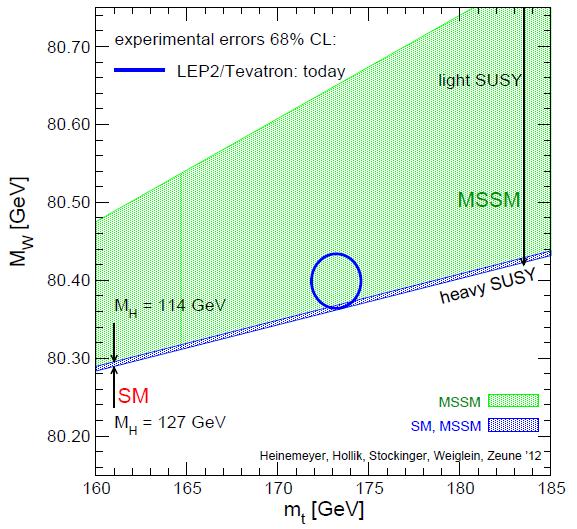
Thanks to Sven Heinemeyer and his colleagues, we can give a peek today at the status of the agreement of top and W boson masses with Standard Model predictions for the Higgs boson mass, and with SUSY predictions as well. The figure below is just one of the many versions he has produced.


Maybe I should not say "SUSY predictions", as it is clear, by inspecting the figure above, that the green band is quite wide, a result of the many free parameters whose value have an impact in determining the mass of the lightest Higgs scalar.
Previously undiscovered islands of cold gas and a mysterious haze of microwaves could bring us closer to revealing the blueprint of cosmic structure.

The results include the first map of carbon monoxide to cover the entire sky. Carbon monoxide is a constituent of the cold clouds that populate the Milky Way and other galaxies. Predominantly made of hydrogen molecules, these clouds provide the reservoirs from which stars are born but hydrogen molecules are difficult to detect because they do not readily emit radiation. Carbon monoxide forms under similar conditions and, even though it is much rarer, it emits light more readily and therefore is more easily detectable. So, astronomers use it to trace the clouds of hydrogen.
The Tevatron collider has been shut down for almost half a year now, but the CDF experiment is still busy producing world-class measurements of fundamental Standard Model parameters.

Actually, the above is not quite correct: CDF is re-defining "world class" in some cases. The measurement I am going to describe, which has just been made public (if you are quick you can follow live the seminar presented by Prof. Ashutosh Kotwal at Fermilab here), totally outperforms all previous determinations of a crucial ingredient of the Standard Model: the W boson mass.

