

Fake Banner
    Engineering Roleplaying
    By Alex "Sandy" Antunes | February 5th 2012 09:59 AM | 4 comments | Print | E-mail | Track Comments
    About Alex "Sandy"

    Read more about the strange modern world of a day laborer in astronomy, plus extra space science-y goodness....

    View Alex "Sandy"'s Profile

    Hey, you got simulation in my roleplay! Hey, you got roleplay in my simulation! Wait, it's two great tastes that taste great together!

    Thus my students surprised me when they tossed in a role-based stance into what I thought was a straightforward systems engineering analysis. Herein lies the tale.

    Background: I'm teaching a course in space mission operations that focuses heavily on scenario analysis. I presented them with a case where they had to balance risk versus success for a space-borne telescope. In rocket science, risk is never something you can eliminate, no matter how much money or resources you toss at it. That's part of what makes it rocket science. Risk can be reduced, mitigated, or even accepted, but never eliminated.

    The example was to show that you could boost reliability by accepting more risk, and was based on a historical case called SAC-B + CUBIC. SAC-B was the big mission, and CUBIC was a tag-along. Put simply, the choices were whether to minimize risk to the entire mission (SAC-B) by accepting higher risk of failure for your specific component (CUBIC), or to maximize your own success (CUBIC) at the cost of jeopardizing the entire mission (SAC-B).

    I should have realized they'd roleplay it. The question that surprised me was "are we in charge of the entire mission of SAC-B, or are we the CUBIC people?" And they were quite right, as that does make a difference.

    If they were in charge of the main SAC-B, then obviously they'd prefer to shunt the risk onto the sub-mission CUBIC. However, if they were that CUBIC sub-mission, their initial stance was "to heck with the primary, let's make them take the risk because we only care about our success or failure!"

    From an abstract engineering point of view, that was unexpected. However, that is often how the real world works, a "world revolves around me" pragmatism I found refreshing. And in the process, we had to add components including political concerns and game theory. For example, if you take a hardline "only we matter" stance, will future missions partner with you? Does reputation matter?

    In short, by invoking real world concerns, my students turned my cold equations into a roleplay.

    Until next month,
    Alex

    p.s. the short scenario is below, for reference. Permission granted for anyone who wishes to use it in any teaching capacity.


    SCENARIO: SAC-B and CUBIC

    The US/Argentina solar observatory SAC-B carries the HXRS and GXRE instruments for studying the high energy spectrum of solar flares plus the ISENA instrument for measuring neutral particles.

    SAC-B costs $21.5 million.

    The Cosmic Unresolved Background Instrument using CCDs (CUBIC) is a secondary payload designed to fit onto the back side of SAC-B (away from the sun) to do spectrographic (not imaging) measurements of the X-ray diffuse background. It is also a technology prototype providing the first testing of X-ray CCDs in space (prior to their use in other more expensive missions). CUBIC cost $2 million to build (and took 4 years of time).

    (note: SAC-B did launch on Nov 4, 1996 via Pegasus. Full details are at: http://www2.astro.psu.edu/xray/cubic/index.html)

    Situation:

    CUBIC is sealed during launch then has to open its 'door' to operate. This door only has to open once. If it opens, CUBIC is a success; if it doesn't open, CUBIC fails. There are 3 methods for opening doors in space: motor, spring, and explosive bolts.

    Motors: medium reliability; failure = CUBIC full or partial failure
    Spring: medium reliability; failure = CUBIC full failure
    Explosive bolts: very reliable; failure = damages entire SAC-B platform.

    Discuss whether to use a motor, spring or bolt.
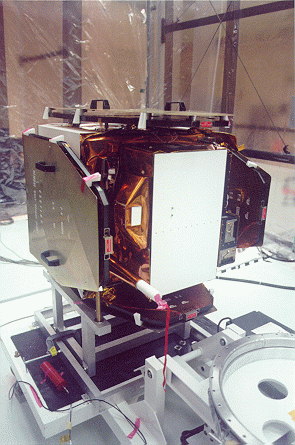
    SAC-B+CUBIC

    This photo shows the SAC-B satellite on its Ground Support Equipment in a clean room at the OSC facility on Vandenberg Air Force Base, awaiting its attachment to the rocket. The satellite is on its side, with CUBIC on the near side, facing to the left. The solar panels are installed, but are still covered with protective covers. (source: astro.psu.edu)


    Comments

    Richard King
    “In rocket science, risk is never something you can eliminate, no matter how much money or resources you toss at it.”

    There is no such thing as rocket science.

    Risk cannot be eliminated from any physical activity, or from any engineering activity, which is the field that the activities you are describing most accurately come under.

    “From an abstract engineering point of view, that was unexpected.”

    From a real engineering point of view it would be either expected, or come as no surprise.

    “In short, by invoking real world concerns, my students turned my cold equations into a roleplay.”That is likely because engineers live and work in the real world, at lest the real physical world but other considerations are another story entirely. I am not sure about the situation in the U.S.A. but in the U.K. to become a Chartered Engineer we used to have to satisfy, among other things, something called “Engineer in Society”; that still applies. It is a fundamental part of engineering to consider the effects of the works of engineers on the society they serve.

    The three methods presented for opening doors in space: motor, spring, and explosive bolts are relatively straightforward matters of, respectively, mechanical, or electromechanical engineering, mechanical engineering and mechanical engineering with the added complication of pyrotechnics, though with the added complication of surviving a challenging launch environment and operating in a hostile environment.

    The notion that explosive bolts might damage the “entire SAC-B platform” seems a little quaint, at least in part because it seems obvious that, if explosive bolts were used, it would be necessary to ensure adequate protection from the effects of using such devices. To me that seems to be a basic engineering consideration.
    So from your reading, I would think you a) agreed it was useful to teach students real-world factors in engineering such as is done in the UK course you cite, and b) that risk is indeed not something that can be eliminated, while c) the use of explosive bolts is not recommended unless additional protection is used (even though such protection can, of course, not eliminate risk), while combining these, obviously you cannot eliminate the risk of explosive bolts damaging the entire spacecraft because risk cannot be eliminated.

    What puzzles me is that, given you agreed with all the article points, your tone is so negative.

    Puzzled,
    Alex

    Richard King
    There was no intention to be negative. Primarily, I was puzzled by the reference to “rocket science” by someone teaching engineering and your apparent surprise that engineers reacted in the way you describe. Why give the impression that aerospace engineering is a science? No form of engineering is a science, it is much more than that. I much prefer the engineering ways; these tend to involve more consideration for other people, effects on them and so on. Nor does engineering have the arrogance that much of science has these days; not that I recall it that during my early years of science. I ended up in engineering by “accident”, in a sense, though not so on another level; that will be explained when I, finally, get my book finished.
    calliope
    Hello again,

    I've been musing on the 'rocket science' definition.  It may just be shorthand for 'astronautical engineering'.  I also think science and engineering have a strong overlap, but then, I also think a good scientist should be somewhat humble and not have the 'arrogance that much of science has these days' that you mention.  However, since I cannot reconcile using a cool term like 'rocket science' with 'humble', I may have to think on this more.  Let me know when your book comes out, maybe that will help me here.

    Getting to engineering, the explosive bolts issue came up at a talk Friday by astronaut Frank Culbertson.  During a satellite deployment on STS-51, there was an explosive bolts malfunction that nearly destroyed the shuttle hydraulics (missed by half an inch).  One bolt was supposed to fire, but both bolts (put there for redundancy) fired, creating shrapnel.

    As with the CUBIC scenario, then, you have to factor in that explosive bolts cannot simply be engineered around, but that the balance between their high reliability compared with other methods, against the fact that, if they do fail, they can cause great catastrophe, means a key trade analysis is necessary.

    I have a new scenario up, at my other column on satellite building, where I may start to focus more on mission operations concepts (for those interested).

    Cheers,
    Alex

    p.s. Sorry for the slow reply.
    0

    Add a comment

    The content of this field is kept private and will not be shown publicly.
    • Allowed HTML tags: <sup> <sub> <a> <em> <strong> <center> <cite><TH><ul> <ol> <li> <dl> <dt> <dd> <img> <br> <p> <blockquote> <strike> <object> <param> <embed> <del> <pre> <b> <i> <table> <tbody> <div> <tr> <td> <h1> <h2> <h3> <h4> <h5> <h6> <hr> <iframe><u><font>
    • Web page addresses and e-mail addresses turn into links automatically.
    CAPTCHA
    If you register, you will never be bothered to prove you are human again. And you get a real editor toolbar to use instead of this HTML thing that wards off spam bots.
