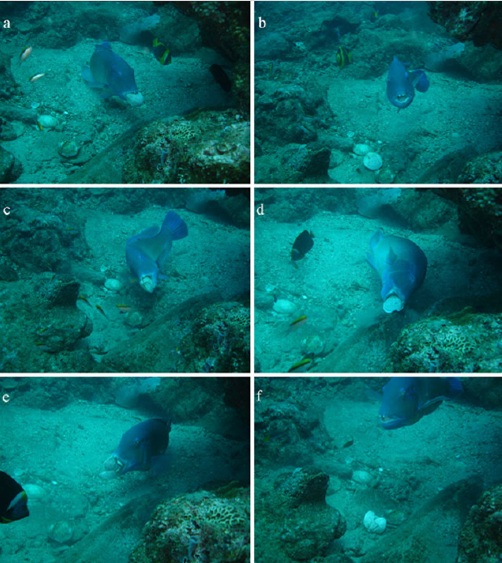






Once upon a time, tool use was considered to be a uniquely human feature, setting us apart from the rest of the animal kingdom. But, when Jane Goodall observed chimpanzees using sticks to ‘fish’ for termites (see video 1) in the 1960’s, this idea received a serious blow. Since then, tool use has been observed in a variety of animals, ranging from the usual primate suspects, to less expected critters, such as crows, dolphins, elephants, otters and even octopuses (see video 2).

Video 1: Chimpanzees using tools to 'fish' for termites.

(Source: BBC documentary 'Cousins')

Life is hard when you're cutting edge.  Coming up with a good topic and title for a Science 2.0 article is not easy.  Today I tried to conceive of a unique and insightful piece about a little-talked about topic.  Specifically, the topic of the last space shuttle flight, which just occurred today.

But what title could really capture this epic yet unreported event?  'The Day America Cried'?  Or maybe 'The Day America Shrugged', or perhaps 'The Day America Clicked on FB for, like, the 50th Time Today' might work better.  But perhaps that issue itself is too niche.  In the end, I abandonded that topic in favor of a new article.  But what to write about?
Just as struggling calculus students wonder if they will ever actually use their new proof-finding skills in real life, developing athletes may be curious if their endless practice drills will ever serve them off the field or court?  Well, researchers at the University of Illinois have found at least one real life task that will benefit from an athlete’s unique cognitive abilities; crossing the street.
I've long said that what NASA needs is not a James Webb Space Telescope but an actual James Webb for the 21st century.

Webb, if you are not familiar with NASA lore, was a bold leader rather than a bureaucrat tasked with perpetuating funding, and it was due to his leadership that NASA launched 75 missions into space, including putting a man on the Moon.

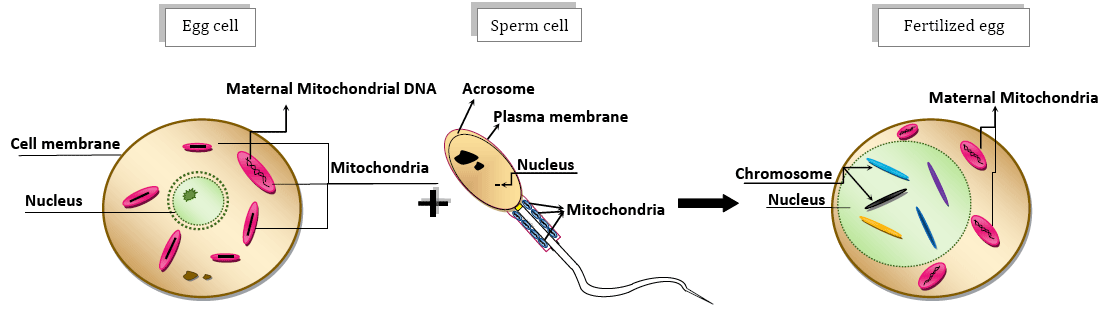
Apparently, the female ancestor of present-day polar bears was a brown bear, living in what presently corresponds to Ireland. An international research team has used mitochondrial DNA (see figure 1) to trace back the polar bears (maternal) ancestry. And it turns out that, 20,000 to 50,000 years ago, they interbred with brown bears.

Figure 1: During fertilization, the sperm cell does not contribute mitochondria to the egg.

(Source: http://www2.le.ac.uk/departments/emfpu/genetics/explained/mitochondrial)

A new finding may mean that nearly all leukemia and lymphoma patients in need of a transplant can find donors.

Results of two clinical trials show transplant results with half-matched bone marrow or umbilical cord blood are comparable to fully matched tissue, thanks in large part to the availability of effective anti-rejection drugs and special post-transplant chemotherapy. 

Plans are under way for a four-year randomized trial for so-called haploidentical marrow or cord blood transplants in 380 patients to begin late this year or early next year. Many large medical centers, including Johns Hopkins, are expected to participate.

Sometimes a person who gets drunk can perform functions their friends might regard as ordinary, like carrying on a conversation or driving a car - but the drunkard might have no memory of those things and those periods of amnesia, commonly known as "blackouts", can last from a few minutes to several hours.

Parents are always looking for new treatments to help their children with autism; it can be daunting to keep up with the multitude of new therapies constantly popping up on the internet, many with similar sounding names. There are several different “listening therapies” or auditory integrative training programs available online promising relief for autism symptoms. According to Sinha, Silove, Wheeler, and Williams (2006), “treatments to overcome variations in auditory sensitivity commonly encountered in people with autism have been developed and are collectively called auditory integration therapies. They include auditory integration training (AIT), the Tomatis method and Samonas sound therapy.”

Last week, the United Nations added 18 sites around the globe to its list of biosphere reserves, bringing the total number of sites so designated under its Man and the Biosphere Program to 581.

Most of us are probably more familiar with another U.N. collection: World Heritage Sites, which identify “universally” valued spots for conservation and awareness efforts. Indeed, some particularly special locales receive both designations.

But the purpose of biosphere reserves transcends basic conservation. The reserves are intended to showcase ways that humans can reconcile our needs and activities with those of native flora and fauna. They highlight unique and innovative strategies that are working — right now.

A Democratic president banned the use of federal money for human embryonic stem cell (hESC) research, a Republican president restricted federal hESC funding to existing lines and a Democratic president continues to limit federal money for hESC research.   Who is regarded as anti-science on this issue? Republicans.

I know, I know, Democrats are anti-science on plenty of other things - animal research, agriculture, vaccines and a whole list of others - but this is just about hESC research and there it is clearly just a Republican issue.   The mainstream media and science bloggers say so.

