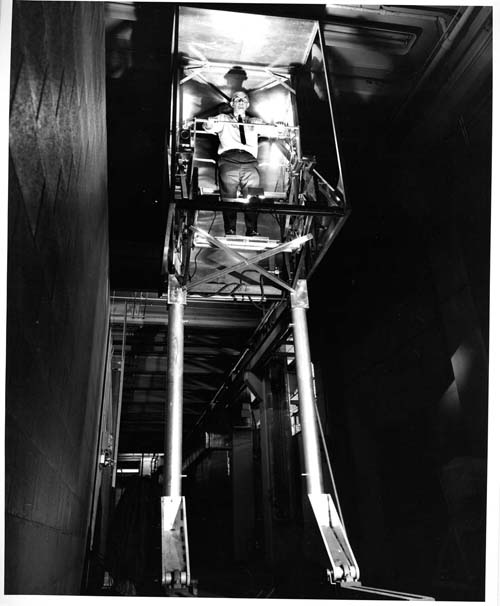
Long before "Star Wars", science-fiction had talked of robot walkers. In "War of the Worlds", even aliens from Mars had giant, mechanized tripeds and they got killed by a few germs.
But the real world worked on them also. Now on display at the US Army Transportation Musem at Fort Eustis is GE’s Pedipulator, or “Walking Truck", which was developed for the U.S. Army in the mid-‘60s. This quadroped first lumbered through testing paces Pittsfield, Massachusetts, circa 1962.
Botany: A Blooming History
And now we come to part three of this series
Joanna Dolgoff covers new research on how obesity spreads through social contact over at Huffington Post. I'm sure this comes as a huge surprise to those of us who have watched our waistlines spread along with the waistlines of our friends. Well, at least until we lose sight of our friends because they can no longer get out of their house and we can no longer get out of ours.
A recent
BBC docu-drama called 'Atlantis' recreated the last days of the Bronze Age civilisation on the island of Thera (now known as Santorini), that I've meant to blog about for a while now. This program, along with a more
traditional 'Timewatch' documentary, argued that the eruption in roughly 1600 B.C.
An article on Science 2.0 addresses a new study on just how easy it is to create false memories. According to the article, researchers "show a unique pattern of brain activity when false memories are formed – one that hints at a surprising connection between our social selves and memory." The conclusion of the article is that "social reinforcement could act on the amygdala to persuade our brains to replace a strong memory with a false one." (video on study available here.)
Looking back at over 2 years of writing, this column has covered a lot of ground. Here's a topical index as proof.
Growing human, perfectly matching organs inside a pig and then transplanting them into humans is not a new idea - it may revolutionize medicine - but a new discovery may also allow pig tissue to be transplanted directly into humans. The research in the Journal of Leukocyte Biology may lead to filling the short term lack of organs for human transplantation.
Altering or overexpressing the human programmed death ligand-1 (PD-L1) molecule in the endothelial cells of pig arteries reduced the conditions that lead to rejection, it says. This strongly suggests that successful Xenotransplantation means humans could receive altered porcine organs with fewer complications.
We've all had an Asian person say, 'All you Americans look alike' - but they aren't being racist, there may be some biology at work.
The brain works differently when memorizing the face of a person from one's own race, according to a study which used EEG recordings to measure brain activity and which may shed light on one of the most replicated psychology findings - that people are less likely to remember a face from a racial group different from their own.
If you pay a lot of taxes and get little to show for it, you don't have much trust in government, but if you are in a disaster-prone area, you have more confidence in government than most, say researchers in the International Journal of Wildland Fire.
Here's a way to make the bloated costs of health care reform seem more palatable to opponents - it will knock 220,000 illegal immigrants out of the health care system just in California alone.
A new policy brief from the UCLA Center for Health Policy Research says up to 20 percent of all uninsured children in California are those of illegal immigrants, but even some who are here legally may not apply because of confusing rules in The Patient Protection and Affordable Care Act of 2010 (ACA) , known colloquially, thanks to pundits like Bill Maher and detractors in the debate, as ObamaCare.