Does 3-D television seem like a waste of time to you? Perhaps you will like Smell-O-Vision more.
Or not. Even if you like neither of those things, they are waypoints on the path to immersive, interactive environments. So buy this stuff today and some day we Science 2.0 folks can solve mysteries on the Holodeck with Data from "Star Trek: The Next Generation."
Television programming executives want to be able to trigger your emotions as effectively as possible so engineers have focused on sight and sound - but that doesn't mean it has to stop there. Wouldn't Pizza-Hut love to advertise right after the characters on a program eat some pizza and you can smell it? Indeed they would.
Recently, I
reviewed Simon Baron-Cohen's new book,
The Science of Evil, and
interviewed him concerning zero empathy, neurological disorders like autism spectrum disorders and personality disorders like narcissism, borderline, and psychopathy.
Anti-science progressives in a culture war over food insist modern agriculture - including where we precisely modify changes in genetics instead of letting high-energy cosmic rays do it randomly - is bad. But a group of anthropologists say it isn't just modern agriculture feeding billions that is bad.
Apparently farming has been a health negative for mankind since it began.
Recycling is good, we are told, though in actuality government recycling has been nothing except an expensive waste, with landfills for recycled materials as big as landfills for regular garbage.
Now it turns out recycled packaging may be risking our health more directly. Harmful mineral oils from the printing inks used on cardboard can migrate into food if recycled cardboard is used for food packaging. It may contaminate food even if the recycled cardboard is used for the corrugated card transport box that holds individual packs.
Using living cells as more efficient tools for delivering medicines to diseased parts of the body has gotten a little closer.
In a new report, Dayang Wang and colleagues explain that the human body's efficiency in getting rid of foreign substances can also be an obstacle. Some foreign substances, such as viruses, are harmful and should obviously be removed, but the body also considers drugs and nanoparticles — meant to treat diseases and allow physicians to see cells and organs — to be foreign objects, and they are also quickly removed.
In 2009, Elizabeth. H. Blackburn, Carol W. Greider and Jack W. Szostak were awarded the Nobel Prize in Physiology or Medicine for their discovery of telomerase, an enzyme that replenishes the telomeres (see figure 1), DNA sequences at the endings of the chromosomes which appear to play a very important role in the aging process. This process, however, is far from being completely elucidated.
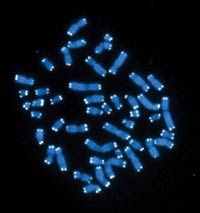
Figure 1: Human chromosomes, with the telomeres highlighted. (Source: National Institute of General Medical Sciences)
New results from the T2K collaboration have been presented at a KEK Physics Seminar today, and they are really interesting stuff. In a nutshell, six electron neutrino events have been seen by their far detector, illuminated by a pure and intense beam of muon neutrinos. The estimated backgrounds from non-oscillating-neutrino sources are estimated to amount to 1.5+-0.3 events, and the observed counts thus constitute a 2.5-standard-deviation effect, hopefully a first hint of direct detection of nu_mu -> nu_e oscillations.
Before discussing the
conclusions of this paper released this week, I'll start with a pub-quiz style question. How much of Earth's atmosphere has not been made by living things?
The answer is: less than 1%, which is mostly argon. The overwhelming majority is biogenic; the nitrogen is a product of denitrifying bacteria, the oxygen from plants, and the inconspicuous CO2 is produced by everything, but especially animals.
You've seen the advertisements on television; schools that market heavily with dubious promises of how wonderful the job market is, but then students who incur student loan debt to get those degrees - loans which are unlimited since the government in the early 1990s said higher education meant more money - find that in a market where everyone has some sort of degree or another, it doesn't mean much.
Into every satellite a little grunt work must fall. Today you get to read the exceedingly boring but entirely real details of a typical week of satellite construction and project management.
Outreach Work
The flight pins and first mission patches have arrived for the 76 exceptional contributors to Calliope! This week I will be packaging up approximately 76 bundles to mail out. Oh, and I have to write this week's project update-- which you're reading now.
Assembly Work