In a report sure to send left-wing science blogging into a tizzy, an analysis by Sen. Tom Coburn, M.D., Republican from Oklahoma (naturally, because Republicans hate science if they object to obscure studies that cost hundreds of thousands of dollars) says the NSF is spending money foolishly.
Does high-fructose corn syrup, a common ingredient in soft drinks and snacks and too many products to count, make you fatter than sugar? The Sugar Association, Inc., which represents sugar growers, certainly wants you to think so.
But, like cultural pundits who insist Ronald McDonald makes kids fat, there needs to be more than one study funded by an interested party to make the case. A review of studies analyzing research on High Fructose Corn Syrup (HFCS) and other sweeteners found there is no evidence of any significant variation in the way the human body metabolizes HFCS as opposed to standard table sugar, or any difference in impact on risk factors for chronic disease.
The
locavore movement, which was born on the US West Coast, may have convinced more people to shop at their local farmers' markets and participate in
community-supported agriculture--but it's been a challenge to make similar progress toward
eating local fish.
The main commercial catch off our local [Southern California] coast are sardines and squid, but many Americans prefer to stick with the greatest hits (a.k.a. shrimp, salmon, and tuna.) So the primary market for our catch is overseas.
The rapid development of Mars, as little as two to four million years after the birth of the solar system (far more quickly than Earth) explains why it is so small by comparison, according to a new paper.
Mars probably is not a terrestrial planet like Earth, which grew to its full size over 50 to 100 million years via collisions with other small bodies in the solar system, says Nicolas Dauphas, a geophysicist at the University of Chicago. "Earth was made of embryos like Mars, but Mars is a stranded planetary embryo that never collided with other embryos to form an Earthlike planet."
In a recent set of posts there was a discussion about evolutionary psychology and how it can be used to explain various behaviors. However, one of the fundamental challenges raised is whether the references to biological phenomenon are, in fact, settled issues and whether they should serve as a basis for drawing additional conclusions. As a result, I wanted to focus on one particular paragraph from one paper to illustrate the problem.
For our Calliope picosatellite mission, I want to make it a real space experience. That means it needs a mission patch. And first, let me thank you all-- our fans and community-- for ensuring our Kickstarter fundraiser made its goals! With less than 11 hours left, we hit our target figure! Woo! You're all awesome!
Contributors get a mission patch (or two, or six), and designing those mission patches is its own story. The motive was "every mission should have a mission patch", rooted deep in NASA tradition. Totally copying from
LittleSDO, we have a brief history of mission patches.
With all the huge (and sadly tragic, in some cases) storms we have had
in mostly the middle to eastern portions of the United States this Spring, many
opportunities arise to see natural events rarely witnessed. Some are obvious,
such as the bears in trees in the Louisiana floods (I heard on the radio they
can survive in the canopy for up to three weeks!) Other natural occurrences are
not so easy to observe – unless you know where to look.
A few months ago LHC took a special run of proton-proton collisions at 2.76 TeV. Why the lower energy, now that we are accustomed to searching for new phenomena at the highest available energy of 7 TeV ? Because of the wish to compare lead-lead collisions, taken last year at 2.76 TeV nucleon-nucleon energy, with proton-proton ones. The comparison allows to extract extremely interesting results.
The astrocyte, most common cell in the human nervous system, is finally getting some respect; researchers have used embryonic and induced pluripotent stem cells to cultivate the star-shaped astrocyte.
Not just putty in the brain and spinal cord
The ability to make large, uniform batches of astrocytes, explains stem cell researcher Su-Chun Zhang, opens a new avenue to more fully understanding the functional roles of the brain's most commonplace cell, as well as its involvement in a host of central nervous system disorders ranging from headaches to dementia. What's more, the ability to culture the cells gives researchers a powerful tool to devise new therapies and drugs for neurological disorders.
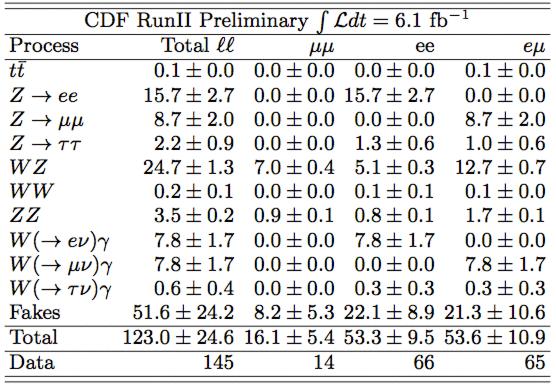
The plot of the week is actually a table this week. A histogram with several background components can be extremely informative, but sometimes a table provides more detail and one can focus better on interesting features.
The table below has been produced in a CDF search for events containing same-sign lepton pairs: a striking signature of new physics, faked by very few processes. Because of the paucity of Standard Model sources, even relatively small new physics signals can emerge in such a sample. The CDF analysis is based on 6.1 inverse femtobarns of proton-antiproton collisions collected at the Tevatron during Run II. Let us see what the table tells us.