This is a new title:
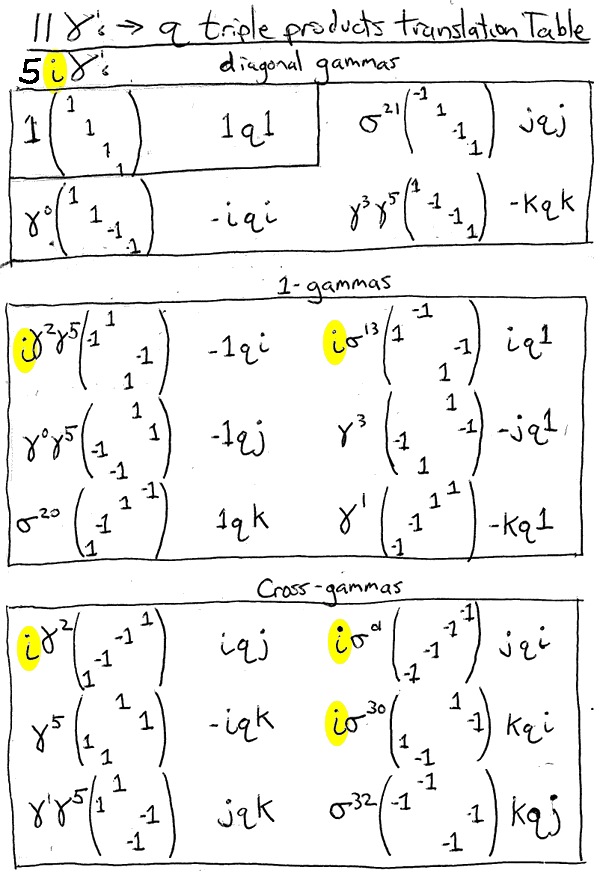
Gotta Get 11 Dirac Gamma Girls, Plus 5 Doing an Imaginary Twist
[Note: based on discussions below, I decided to alter the title from "Gotta Get 16 Gamma Girls". The core figure in the blog is not of the 16 gammas in the Dirac basis, but only 11 of them. 5 of them have an extra factor of i. I will have to consult a few articles on the subject to see how they handled this issue.]
I like to think I once led an eclectic, interesting life. I have bribed police in the mid-East, outrun the Bulgarian mafia while driving to get my picture taken with Albanian rebels in Macedonia and searched for the spark true conviction in ancient monasteries. I have generally thought there should be some type of D&D game about my life, or at least a TV movie of the week.
But I am not complete. For example, I have never owned a nightclub, been on any Vanity Fair 'fabulous' list, had a Haitian drug gang put out a hit on me or...died of a drug overdose. Drugs are nasty business, I am told, right after being told how awesome they are, and always by the same people.
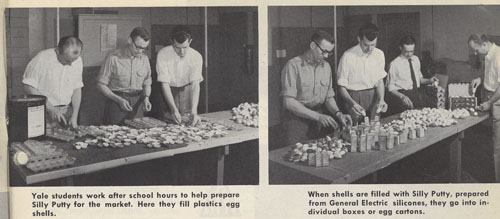
Industry does quite a lot of basic research today but government funds the majority. Prior to and during World War II those ratios were inverted and the private sector funded most basic research in hopes that the next big thing would be invented by them.
It's a natural proclivity to play the what-if game. What if we could go back and change things? What if we could alter some particular trait about ourselves or an event? Would we do it? It's a favorite plot device in fiction. In the disability community, especially in the autism community, it takes on a whole new edge. Instead of posing these what ifs about ourselves, many parents engage in the what if question about autism: what if there were a magic pill that would remove all the negatives our children face? Would we give it? Just as many of us would not change our past experiences, recognizing that who are today is fundamentally built upon the experiences of the past, so too do many autistic adults who have incorporate autism into their personalities as a core feature of who they are.
Recently scientifically 2.0 so topical Schrödinger's cat jumped into being in the 1935 three-part article (in German) in Die Naturwissenschaften, just at the end of part one:Man kann auch ganz burleske Fälle konstruieren. Eine Katze wird in eine Stahlkammer gesperrt, zusammen mit folgender Höllenmaschine …
In a display of nonchalance that should teach us a thing or two, the ATLAS collaboration has put an end to the
Easter Higgs Rumour (EHR), which brought the blogosphere in an excited state for at least a week, and experimentalists and theorists for even more time. They did so by publishing
a very narrow-focused document, totaling less than five pages, where they discuss the backgrounds to Higgs boson decays in the diphoton final state.
Leukotriene receptor antagonists (LTRAs)are easier to use and just as effective as conventional treatment with inhalers, according to a new study led by the University of East Anglia (UEA).
Asthma is an increasing problem affecting around 300 million people worldwide and can significantly impact on a person's quality of life. It is a chronic condition characterized by inflammation of the airways causing wheezing, coughing, chest tightness and shortness of breath.
I missed a cool paper last year on the effects of squid ink on angiogenesis--the growth of new blood vessels. And therefore I also missed the chance to run the sensationalist headline SQUID INK BLOTS OUT CANCER, or something equally punny and misleading.
Growing new blood vessels seems like a good thing, and indeed it often is. But, as the
Angiogenesis Foundation points out:
Abnormal blood vessel growth, either excessive or insufficient, is now recognized as a “common denominator” underlying many deadly and debilitating conditions, including cancer, skin diseases, age-related blindness, diabetic ulcers, cardiovascular disease, stroke, and many others.
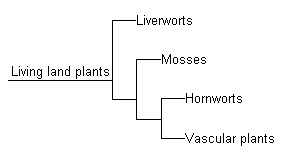
As a teenager, in the early 1960s, I developed an interest in botany, and in particular ferns and the so-called “fern-allies”. So, living in the drier South-East of England, I welcomed trips to places where these plants about, such as Wales, mountainous Scotland, and Cornwall.
But today I am travelling through time, showing how our knowledge of this branch of the Plant Kingdom has expanded over the last 200 years or so.
In science, you need a theory, an approach, and a way to measure the results. In politics, you only need an opinion and a microphone. Therefore, it is interesting that a major Green advocate -- promoting sensible environmental solutions -- took the stand to criticize past Green efforts.
George Monbiot (winner of a UN Global award, among others) recently scribed
Let's Face it, none of our environmental fixes break the planet-wrecking problem. There was immediate outcry and, as usual, the pundits somehow claiming this is proof that Green=Bad are missing the point on this.