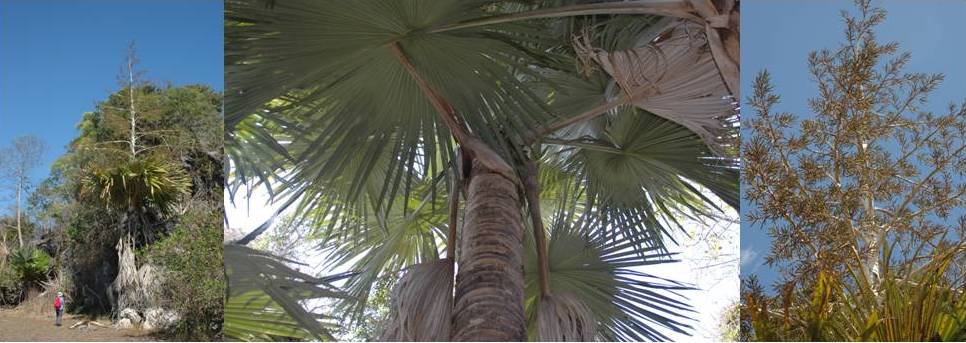
The International Institute for Species Exploration at Arizona State University and an international committee of taxonomists – scientists responsible for species exploration and classification – today announce the top 10 new species for 2009, consisting of those described in 2008.
On the list are a pea-sized seahorse, caffeine-free coffee and bacteria that live in hairspray. The top 10 new species also include the very tiny (a snake just a slither longer than 4 inches or 104 millimeters), the very long (an insect from Malaysia with an overall length of 22.3 inches or 56.7 centimeters) the very old (a fossilized specimen of the oldest known live-bearing vertebrate) and the very twisted (a snail whose shell twists around four axes).
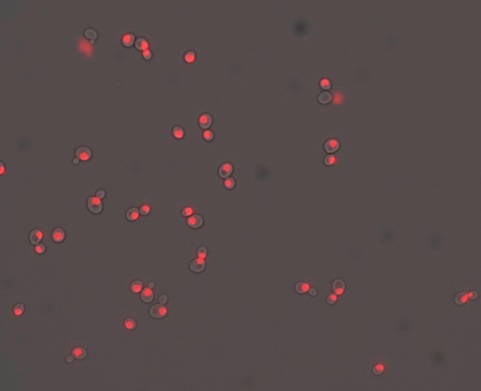
It is the concentration of a few signaling molecules that determines the fate of individual cells during the early development of organisms, say a team of molecular biologists writing in Current Biology. Pia Aanstad of the University of Innsbruck and colleagues report that a variety of molecular mechanisms accounts for the interpretation of the concentration of the signaling molecule Hedgehog.
The development of an organism is a complex process to which a dozen or hundreds of signaling molecules contribute. Some of these molecules have dozens of functions in the fruit fly and in humans alike.
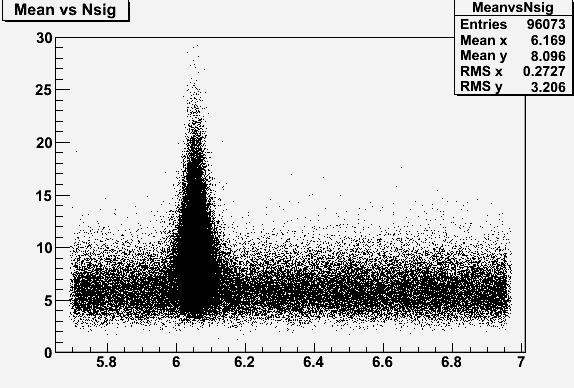
Last Tuesday CDF announced their own discovery of the Omega_b baryon, a measurement which creates a controversy with the competing experiment at the Tevatron collider, DZERO. That is because DZERO had already claimed discovery for that particle, almost one year ago, and because the two measurements disagree wildly with each other. Just browse through
my past few posts in this column and you will find all the information you need (how lazy can one be with links?).
HIV/AIDS has left its mark on mankind. Millions of people have been lost to a disease that seems so uniquely designed to tear down our defenses and ruin us, the Barbarians to our Roman Empire. An almost unrivaled effort in the scientific community has been bent on cracking the code of HIV since the 1980’s, and although we have discovered much about the virus, and its action inside the body, we have yet to develop a vaccine or adequate long term treatment.
The difficulty with HIV is multifaceted, but there are a few that hinder our progress most significantly. HIV is a rapidly mutating virus, and therefore there are countless strains of HIV which makes one vaccine, with broad action protection, nearly impossible to formulate.
In exploring some of the biological issues surrounding selfishness and altruism, invariably the philosophical issue of selfishness surfaces. Ayn Rand has argued that selfishness is a virtue because it is the rational and principled concern with one’s own well-being and is necessary to lead a healthy, purposeful, and fulfilling life. It isn’t my intent to deal with Ayn Rand, but rather to examine the sense that many people have regarding these concepts.
The only problem with Ayn Rand’s definition is that the meaning of “selfishness” was manipulated to become “self-interest”. According to the dictionary definition, “selfishness” is “extreme or exclusive self-interest” which is also the commonly understood form of the word.
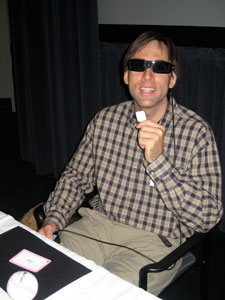
Erik Weihenmayer wears sunglasses often. He was wearing them to protect his eyes when he reached the summit of Mount Kilimanjaro in 1997. He had them on when he completed the 2003 Primal Quest, the world's toughest multi-sport adventure race. And, he put on a pair during a recent visit to the National Eye Institute (NEI).
But this last set is no ordinary pair of Oakley sunglasses.
Weihenmayer looks through them, peering down at a white note card on a table. He silently moves his head back and forth, up and down. After a few moments, he says, "Is that a 12?"
In 1988, Günter Wächtershäuser published a remarkable idea that excited tremendous interest, even being featured in a Scientific American article. It ran counter to prevailing ideas about the origin of life, and suggested new experimental approaches involving mineral interfaces. Wächtershäuser is a patent lawyer in Munich, Germany who enjoys fabricating intricate and novel approaches to the origin of life, then challenging others to test them. He is greatly influenced by the philosopher Karl Popper, who made the point that explanations are useless unless they are falsifiable.
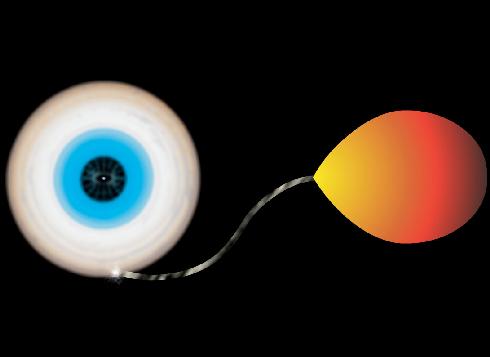
Pulsars are superdense neutron stars, the remnants left after massive stars have exploded as supernovae. Their powerful magnetic fields generate lighthouse-like beams of light and radio waves that sweep around as the star rotates. Most rotate a few to tens of times a second, slowing down over thousands of years.
The Mars rover, Opportunity, surveyed the rim and interior of Victoria Crater on the Red Planet from September 2006 through August 2008. Key findings from that work, reported in the May 22 edition of Science, reinforce and expand what researchers learned from Opportunity's exploration of two smaller craters after landing on Mars in 2004.
You're sitting in a room filled with a gazillion air molecules - how likely is it that most of those air molecules will spontaneously end up in the corner of the room opposite of where you're sitting?
Most likely you're not too concerned about this scenario, because something like that, a massive fluctuation in the distribution of air molecules in the room, is extremely unlikely, to put it mildly.
When you have zillions of air molecules bouncing around in a room (zillions here being on the order of 10^28 molecules of the various gases that make up air), the fluctuations away from the average distribution are miniscule.