




HOUSTON -- Under stress from chemotherapy or radiation, some cancer cells dodge death by consuming a bit of themselves, allowing them to essentially sleep through treatment and later awaken as tougher, resistant disease.

Interfering with a single cancer-promoting protein and its receptor can turn this resistance mechanism into lethal, runaway self-cannibalization, researchers at The University of Texas MD Anderson Cancer Center report in the journal Cell Reports.

Montreal, April 3, 2014 – Bruno Giros, PhD, a researcher at the Douglas Mental Health University Institute and a professor in the Department of Psychiatry at McGill University, has demonstrated, for the first time, the role that dopamine plays in a region of the brain called the hippocampus. Published in Biological Psychiatry, this discovery opens the door to a better understanding of psychiatric diseases, such as schizophrenia.

Dopamine is a neurotransmitter that plays a central role in brain function, and many mental illnesses involve an imbalance in this chemical. What Bruno Giros has shown in particular is that dopamine is present in the hippocampus—the brain area associated with memory and learning—and that it plays a key role in this region.

A University of Colorado Cancer Center study recently published in the journal Cell Reports and presented today at the American Association for Cancer Research (AACR) Annual Conference 2014 shows that the cellular process of autophagy in which cells "eat" parts of themselves in times of stress may allow cancer cells to recover and divide rather than die when faced with chemotherapies.

Chestnut Hill, MA (April 5, 2014) – A survey of science teachers finds they support a new approach to science education, but they struggle to believe that all students are capable of exploring science using a method called argumentation, according to researchers from the Lynch School of Education at Boston College.

Furthermore, teachers in low-income schools said the pressure to meet testing requirements curbs the use of argumentation in their lessons, according to the findings, which were presented today at the American Educational Research Association annual meeting in Philadelphia.

Sorry Batman, the dark knight persona is going exactly where Frank Miller predicted it would three decades ago in "The Dark Knight Returns" - you are going to be labeled an over-medicated, mentally disturbed sociopath.

The over-medicated may be right. The recent shooting at Fort Hood in Texas was in a "gun-free" zone but a soldier who had never been in combat was still on prescription medication for psychiatric issues related to combat zone trauma. As long as psychiatry remains trapped in the symptom-based world of the past, it is going to be the case that someone who complains enough will get a prescription.
Researchers have have found that the repeated application of manure contaminated with antibiotics changes the composition of bacteria in the soil.

The focus of the investigation was on sulfadiazine (SDZ), a widely used antibiotic in animal husbandry which enters the soil via manure. The researchers report that repeated application of the antibiotic leads to a decrease in beneficial soil bacteria and at the same time an increase in bacteria that are harmful to humans.
Two things send our Uncanny Valley creepiness meter straight to red - realistic robots that flirt and anything that laughs. 

Realistic laughing is actually not trivial. We see it in real life, we can often tell when someone is fake laughing. On computers it is even more off-putting. Scholars at the Numediart Institute of the University of Mons are members of a project called ILHAIRE - The Science Of Laughter, which seeks a better understanding of laughter features in order to incorporate them into interactive systems. 
Some long non-coding RNAs can give rise to small proteins that have biological functions, according to a recent study that describes how researchers have used ribosome profiling to identify several hundred long non-coding RNAs that may give rise to small peptides.

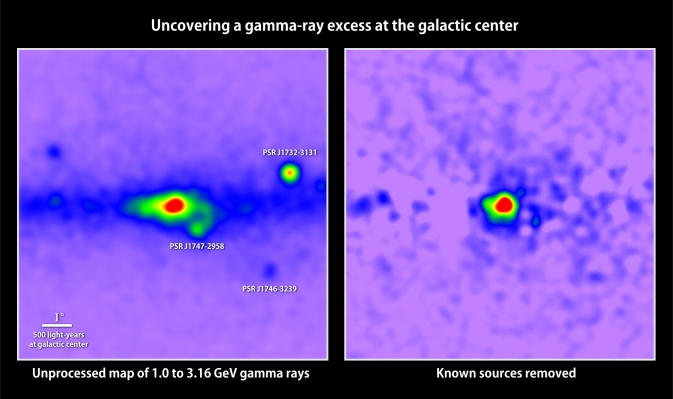
A new study of gamma-ray light may lead to evidence of dark matter, a hypothetical blanket term for whatever must make up most of the material universe.

Using publicly available data from NASA's Fermi Gamma-ray Space Telescope, scholars at the Fermi National Accelerator Laboratory (Fermilab), the Harvard-Smithsonian Center for Astrophysics (CfA), the Massachusetts Institute of Technology (MIT) and the University of Chicago have created new maps and they believe their maps show that the galactic center produces more high-energy gamma rays than can be explained by known sources.

They believe this excess emission is consistent with some forms of dark matter.

Since the discovery of microRNAs, these small ribonucleotides have been implicated in a broad range of cellular processes(1). MicroRNAs typically work as inhibitory gate-keepers to keep the expression of numerous genes in check(1). They do so by binding to the 3’ untranslated region of target messenger RNAs (mRNAs) that encode specific genes, and consequently preventing the translation of these mRNAs into their corresponding protein products.

