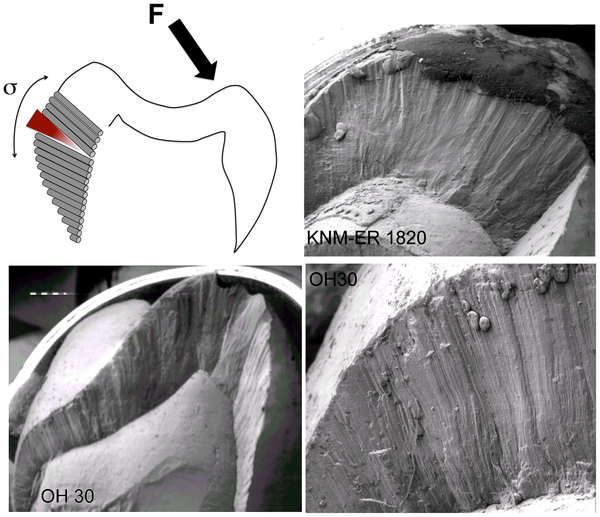
Paranthropus boisei, nicknamed "Nutcracker Man" because of his big flat molar teeth and powerful jaws,lived in East Africa between 2.4 million-1.4 million years ago.

A new paper postulates that he survived mainly on a diet of tiger nuts - edible grass bulbs still eaten in parts of the world today- along with fruits and invertebrates, like worms and grasshoppers.  

Volcanic rock textures and ages suggest that the painting of a mural by residents of Çatalhöyük was recording an explosive eruption of the Hasan Dagi volcano. 

Scientists analyzed rocks from the nearby Hasan Dagi volcano in order to determine whether it was the volcano depicted in the mural from ~6600 BC in the Catalhöyük Neolithic site in central Turkey.

To determine if Hasan Dagi was active during that time, scientists collected and analyzed volcanic rock samples from the summit and flanks of the Hasan Dagi volcano using (U-Th)/He zircon geochronology. These ages were then compared to the archeological date of the mural.

This idea dates back to the Russians in the early 1970s. The surface of Venus is far too hot, and the atmosphere too dense, for Earth life. However, our air is a lifting gas on Venus with about half the lifting power of helium on Earth. A habitat filled with normal air will float high in the dense Venus atmosphere, The atmospheric pressure there is the same as Earth sea level (1 bar). Temperatures are perfect for Earth life too, just over 0°C.

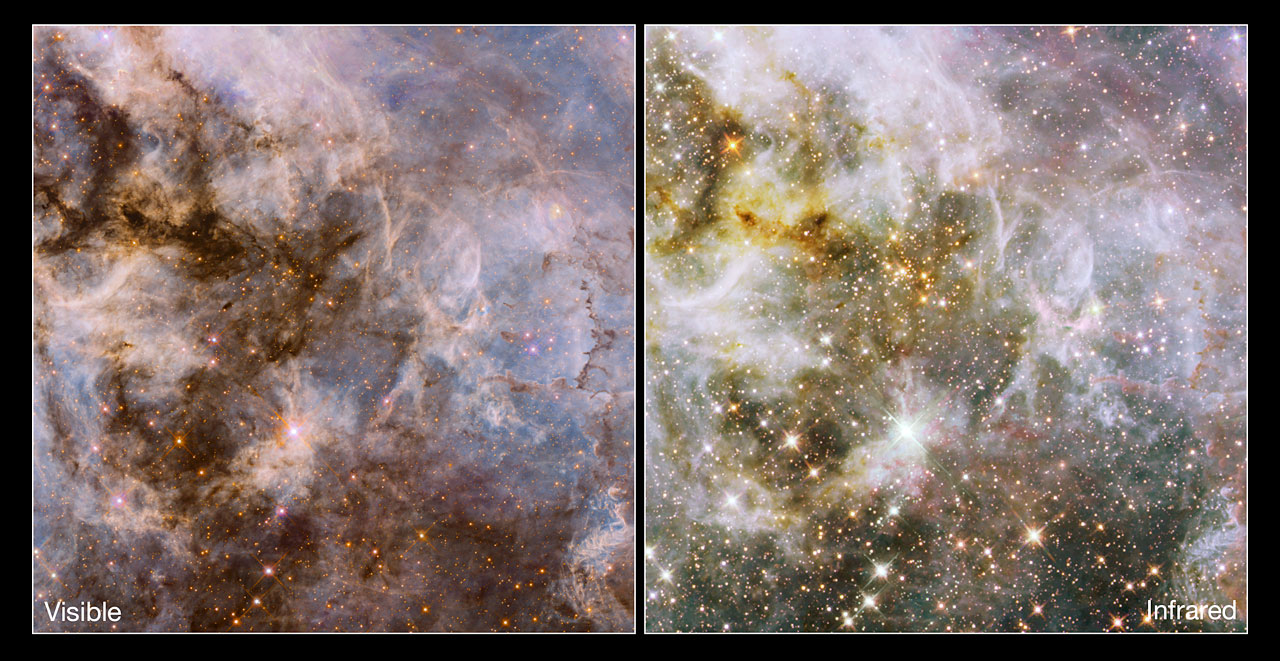
The near-infrared vision of NASA's Hubble Space Telescope has given us a new view deep inside the Tarantula Nebula - and its more than 800,000 stars and protostars within.

Bearing in mind that the word ‘ovoid’ means ‘egg-shaped’, the question : ‘Why are eggs ovoid?’ has much in common with questions like or ‘Why are hearts heart-shaped?’ or ‘Why are sausages sausage-shaped?’ And the Zen-like qualities of the egg-shape question have not escaped professor Yutaka Nishiyama, (Osaka University of Economics, Japan) who decided to approach this enigmatic problem from a mathematical viewpoint in his paper ‘The mathematics of egg shape’ (Osaka Keidai Ronshu, Vol. 58, Sept. 2007). In which the professor not only developed a formula to describe egg-shapes -

In the comments section of my previous article I demonstrated an optical Theremin. This article is the build for that circuit. The circuit and circuits that are similar to it in function have also been called a “Light Sensitive Tone Generator,” “Photo Theremin,” and “Audible Light Meter.” These three circuits are usually based on the two-transistor Light Sensitive Tone Generator from The Forrest Mims Circuit Scrapbook, Volume 1 (Radio Shack, 1976). The circuit built in this article is based instead on the 555 timer IC.

Everyone has seen what athletes do after a victory - footballers may take their shirts off and slide on their knees, baseball hitters may pump their fists. 

That instinctive reaction that occurs is a biological imperative to display dominance over opponents rather than a sense of personal satisfaction, according to a paper in Motivation and Emotion.

Marine cyanobacteria are tiny ocean plants that produce oxygen and make organic carbon using sunlight and CO2, and so they are primary engines of Earth's biogeochemical and nutrient cycles.

They nourish other organisms through the provision of oxygen and with their own body mass, which forms the base of the ocean food chain. Researchers have discovered a new benefit of these tiny cells: Cyanobacteria continually produce and release vesicles, spherical packages containing carbon and other nutrients that can serve as food parcels for marine organisms. The vesicles also contain DNA, likely providing a means of gene transfer within and among communities of similar bacteria, and they may even act as decoys for deflecting viruses.

The Battle of Raphia occurred in 217 BC near modern Rafah during the Syrian Wars. It was documented by Polybius and the orders of battles listed tens of thousands of foot soldiers, thousands of cavalry and elephants on both sides, making it the only known battle between Asian and African elephants. 

The Z machine at Sandia National Laboratories is moving us toward a fusion future by stepping into the past - in this case using a 19th century device called a Helmholz coil, which is a pair of circular coils on a common axis with equal currents flowing in the same sense and that produces a nearly uniform magnetic field when electrified. 

In recent experiments, two Helmholz coils, installed to provide a secondary magnetic field to Z's huge one, unexpectedly altered and slowed the growth of magneto-Rayleigh-Taylor instabilities, an unavoidable, game-ending plasma distortion that usually spins quickly out of control and has sunk past efforts to achieve controlled fusion.

