



Type 2 diabetes, which is blamed for over three million deaths each year, is on the increase and various food pundits and politicians say they can cure it if people would just ban trans fats or sodas or whatever they happen to be against this year.

And then there is genetics. There are genetic variants that have been associated with it but why wouldn't they have been eliminated by natural selection? Obviously if they had some other value but it has been shown that genetic regions associated with increased risk of type 2 diabetes were unlikely to have been beneficial to people at stages through human evolution.

Culturally, it's discussed that being a man in the Western world is going out of fashion. People are instead supposed to be homogenized into some sort of gender-neutral swirl of beliefs and actions, with only slight variation.

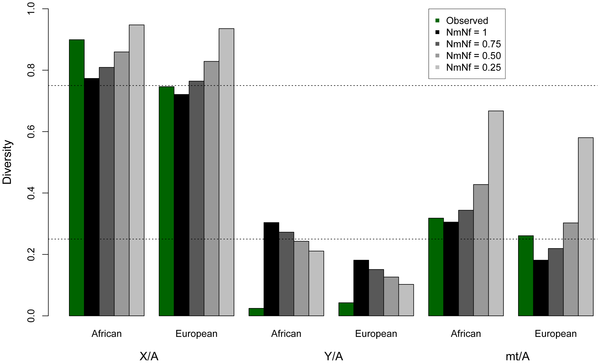
Even the Y chromosome is dwindling. Is it at risk of being lost?

The human Y chromosome contains 27 unique genes, compared to thousands on other chromosomes. Some mammals have already lost their Y chromosome, though they still have males, females and normal reproduction. This has led people to speculate that the Y chromosome is becoming superfluous. But the genes on the Y chromosome are important, they have been maintained by selection.  They're probably not going anywhere.

Because caffeine is a mild diuretic, there is a common assumption that caffeinated beverages, such as coffee, also have this effect.

The problem is that a kernel of scientific knowledge can be misconstrued in news outlets. As we discussed on Thanksgiving, everything in a Thanksgiving dinner contains chemicals found by someone somewhere to be a carcinogen in rats and could therefore be banned if they did not occur naturally. 

With increased regulations on pharmaceutical companies, billion-dollar research that will fail 95 percent of the time and a short window to sell successful products before genetic versions and lawsuits take the revenue away, the future might be the past: it's a lot smarter to find new uses for old drugs than risk developing new ones.

The Fleckvieh is a breed of cattle that originated in the Alpine region and is now found on every continent, with an estimated worldwide population of around 40 million.

America is back at mid-1990s levels of carbon dioxide emissions. Some of that is due to the ongoing recession, of course, but a large chunk is due to the switch from the dirty coal plants that ballooned after America stopped producing emissions-free nuclear energy to natural gas.

While energy overall is back at early 1990s levels of emissions, coal specifically is back at early 1980s levels of emissions.

And it's all been done without mitigation, rationing or increased cost, even during a political climate of hostility against traditional energy. It isn't just CO2; "combined cycle" natural gas power plants also release significantly less nitrogen oxides and sulfur dioxide, finds a study
in Earth's Future. 

A new study may have a solution for both acid mine drainage and natural radioactivity in hydraulic fracturing – fracking –   wastewater that can be found in 'flowback fluid.' In hydraulic fracturing, water is injected at high pressure down wells to crack open shale deposits buried deep underground and extract the natural gas trapped within the rock. Some of the water can flow back up through the well, along with natural brines and the natural gas.  

If you donate money to Greenpeace and get a tax deduction, is your act less moral?

Indeed it is, at least in the perception of other people, according to a new psychology paper on the "tainted-altruism effect", which suggests that charity in conjunction with self-interested behavior is viewed less favorably because we tend to think that the person could have given everything to charity without taking a cut for themselves. 

Of course, plenty of people give to charity or commit charitable acts without thought of any benefit. Perception about altruism is in the eye of the beholder. And Greenpeace is just an example, you could think about churches or, in the case of one experiment below, a man who volunteers in order to impress a girl.

Messier 83, the Southern Pinwheel Galaxy, is one of the largest and closest barred spiral galaxies to us.  At 15 million light-years away, it is one of the most conspicuous galaxies of its type in our skies.  It's in the constellation of Hydra (The Sea Serpent) and is a prominent member of a group of galaxies known as the Centaurus A/M83 Group, which also counts dusty Centaurus A  and irregular NGC 5253 as members. 

Spiral galaxies come in a range of types depending on their appearance and structure -- for example, how tightly wound their arms are, and the characteristics of the central bulge. Messier 83 has a "bar" of stars slicing through its center, leading to its classification as a barred spiral. The Milky Way also belongs to this category.

Children believe the world is far more segregated by gender than it actually is, according to a psychology paper which analyzed classroom friendships in five U.S. elementary schools.  

While the boys and girls had no problems being friends together, they had a perception that only boys played with boys and girls played with girls. The biological differences were a clear differentiating point. If so, does that mean the cause is evolutionary psychology, social psychology or sociology?

Jennifer Watling Neal and colleagues examined classroom friendships in five U.S. elementary schools. They found boys and girls had no problems being friends but had a perception that only boys played with boys and girls played with girls.

