





Part 1, ‘Generative Text Generation’

Daniel Shiffman  is Assistant Arts Professor at the Interactive Telecommunications Program at NYU’s Tisch School of the Arts.

The professor has developed a Markov chain-based Generative Text computer programme which he describes (and provides the code for) here. The programme is able to generate English text which appears at first glance to make sense, but in reality has more in common with ‘context-free-grammar’ or, as some might say, gibberish.

I'm sorry I've been away so long:  The "press of life" got the "better of me".  Sometimes, life just "gets in the way".  (No excuses.  I simply had other "things" that needed to take priority.  Unfortunately, I don't see that changing any time soon.  So, unfortunately, I cannot promise to have an especially active presence here for the foreseeable future.)

[Note:  Since the creation of footnotes and cross references can be so tedious on this site, I shall go ahead and publish this version of this article without such, at first.  However, I shall endeavor to add such in as I can find the time.  I apologize for the lack of "polish" or completeness this will produce, at this time, but feel it will help me get this out to you in a more timely mann

If you have been to a tomato farm, you know that commercial tomato plants have a very different look from the backyard garden variety. Rather than being tall and lanky plants, tomatoes that will be canned for sauces and juice are harvested from plants that stop growing earlier than classic tomato varieties and are more like bushes. The architecture of these compact bushy plants allows mechanical harvesters to reap the crop, but the early end of growth means that each plant produces fewer fruits than their home garden cousins.

The federal government's proposal to discontinue protection for the gray wolf across the United States could have the unintended consequence of endangering other species, insist academics who don't actually live in places where wolves are running wild, threatening animals and people.

In the last few years it became popular to sell health books blaming fructose for obesity and, more recently, to blame all sugars. Pancake syrup bottle today highlight that they have no high fructose corn syrup on giant labels, while the first ingredient is still corn syrup - which is still fructose, just in random rather than precise amounts.

A new study found that fructose does not have any impact on an emerging marker for the risk of cardiovascular disease known as postprandial triglycerides - beyond the general impact of eating a lot of calories, anyway, but that applies to all foods.

People who identify with the various versions of the skeptic / atheist / rationalist / freethinking movement(s) hold up the Enlightenment, the famous “Age of Reason,” to be the pinnacle of human civilization, as well as a model for future progress.
Some bacteria achieve resistance to antibiotics through mutation but other types of bacteria, known as 'persistent' bacteria, are not resistant to the antibiotics but simply continue to exist in a dormant or inactive state while exposed to antibacterial treatment.  

These bacteria later 'awaken' when that treatment is over, resuming their work.

It was known that there is a connection between these kind of bacteria and the naturally occurring toxin HipA in the bacteria, but scientists did not know the cellular target of this toxin and how its activity triggers dormancy of the bacteria.

There are many pests in the world which attack plants or compete with them for the resources they need to grow.  This is true for plants growing in natural stands, but also for the plants that people grow as crops.  If pests are left unchecked, crop productivity is compromised.

Without good pest control, it would take a lot more land to feed humanity - land we simply don't have. Pest damage can also compromise the storage or shelf-life of foods leading to more wasteful inefficiencies. Pests can also make foods dangerous through the production of mycotoxins (see contaminated corn below)

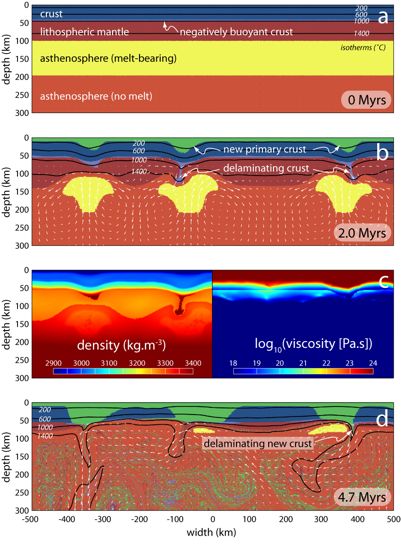
4 billion ago, during the Archean eon, Earth's mantle temperatures were significantly higher than they are today, according to recent numerical model calculations.

A new paper from researchers at at Johannes Gutenberg University Mainz says the Archean crust that formed under these conditions was so dense that large portions of it were recycled back into the mantle. According to the calculations, this dense primary crust would have descended vertically in drip form. In contrast, the movements of today's tectonic plates involve largely lateral movements with oceanic lithosphere recycled in subduction zones.

The findings add to our understanding of how cratons and plate tectonics, and thus also the Earth's current continents, came into being.

Physicists at Yale and Harvard have thrown a new curve at Supersymmetry, the popular hypothesis about what lies beyond physics' reigning model of fundamental forces and particles, the Standard Model. And it involves the electron's almost perfect roundness.

The researchers have reported the most precise measurement to date of the electron's shape, improving it by a factor of more than 10 and showing the particle to be rounder than predicted by some extensions of the Standard Model, including Supersymmetry. Supersymmetry posits new types of particles that help account for ideas like dark matter, a mysterious, unknown substance estimated to make up most of the universe.

