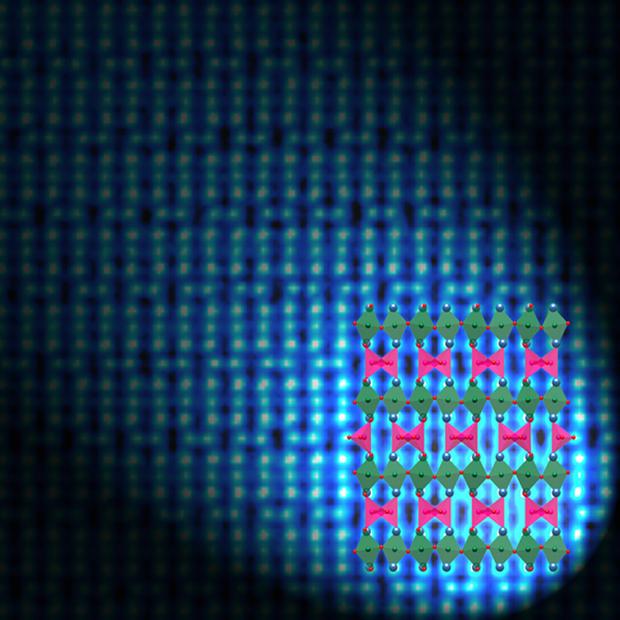

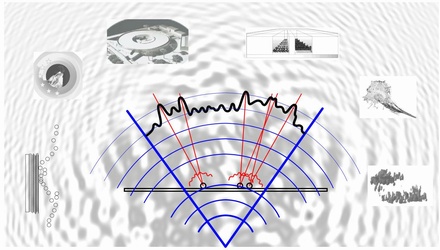


Oak Ridge National Laboratory researchers have developed a new oxygen “sponge” that can easily absorb or shed oxygen atoms at low temperatures.  Materials containing atoms that can switch back and forth between multiple oxidation states  are very rare in nature but useful in devices such as rechargeable batteries, sensors, gas converters and fuel cells.

In the zeal to promote carbon dioxide emissions as a magic bullet to stave off climate change, a lot of other factors were minimized. Soot was a big one, but a new study in PNAS suggests that the abrupt retreat of mountain glaciers in the European Alps in the 1860s was due to absorption of sunlight in snow by soot. A rapidly industrializing Europe still gets the blame, but for a different reason.

New findings from an archaeological excavation prove that copper mines in Israel thought to have been built by the ancient Egyptians in the 13th century BC actually originated three centuries later, during the reign of the legendary King Solomon, according to the dig lead.

Based on the radiocarbon dating of material unearthed at a new site in Timna Valley in Israel's Aravah Desert, the findings overturn the archaeological consensus of the last several decades. Scholarly work and materials found in the area suggest the mines were operated by the Edomites, a semi-nomadic tribal confederation that according to the Bible warred constantly with Israel.

It's easy to forget that there was once a time when a lot of hype resulted from claims that magnetic resonance imaging (MRI) showed biological differences between political brains - it was open season on the opposition by people who understand biology even less than psychology. 
A new hard metal recently developed can be used to replace tungsten carbide (WC), the hard metal widely used in industry today and whose global availability is becoming critical.

The new material, developed over the past three years by Finnish-based Exote Ltd and the VTT Technical Research Centre of Finland, also possesses excellent bullet-proofing qualities.  Ballistic tests have show it has an un-equalled ability to stop armor-piercing bullets.
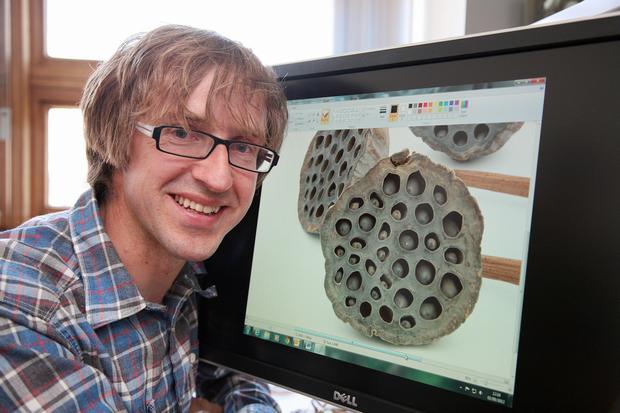
A new paper says there may be a biological reason why you are afraid of soap bubbles. An ancient evolutionary part of the brain, say psychologists Dr. Geoff Cole and Professor Arnold Wilkins  from the Centre for Brain Science at the University of Essex, is worried about poisonous animals.

If  the sight of aerated chocolate or a lotus flower seed pod bring you out in a cold sweat and make you feel panicky, you could be one of many on the Internet claiming to have one of the most common phobias you have never heard of; trypophobia, the fear of holes. For trypophobes, the sight of clusters of holes in various formations can cause intensely unpleasant reactions, from serious migraines and panic attacks to hot sweats and increased heart rate.

A case study discusses an example of life insurance discrimination due to genetic test results for cancer predisposition.

James (pseudonym), in his early 20s, was denied full life insurance coverage because he revealed that he had discussed genetic testing with a genetic counselor. He was later tested and found to carry a mutation in the MSH6 gene; after disclosing this, he was denied cover for cancer by two other life insurance companies.

He then filed a complaint with the Australian Human Rights Commission.

A new control suite with a microprocessor, wireless radio, GPS receiver, and an attitude and heading reference system gives lazy dog owners  a way to command their pets with a remote control, or a smart phone, or even with out hands at all - the new system provides autonomous guidance of the canine using an embedded command module with vibration and tone generation capabilities. Tests in a structure and non-structured environment show obedience accuracy up to almost 98%.

That old "best friend" can get a bit tiresome, all that rolling over, shaking paws, long walks and eating every crumb of food off the floor. But, what if there were a way to command your dog with a remote control, or even via your smart phone...or even without hands?

A new species called Gondwanascorpio emzantsiensis is now the oldest known land-living animal discovered in Gondwana. Dr. Robert Gess, from the Evolutionary Studies Institute at Wits University, discovered the 350 million year old fossilized scorpion from rocks of the Devonian Witteberg Group near Grahamstown.

Explaining his discovery, Gess said that early life was confined to the sea and the process of terrestrialization - the movement of life onto land - began during the Silurian Period roughly 420 million years ago. The first wave of life to move out from water onto land consisted of plants, which gradually increased in size and complexity throughout the Devonian Period. 

Syphilis has become a serious health issue (again) in Latin American countries, with 3 million cases. Every year 330,000 pregnant women with syphilis receive no treatment, resulting in 110,000 children born with congenital syphilis and a similar number of miscarriages.

Commercial kits for early syphilis detection are too expensive to use in a systematic screening of all pregnancies in Latin American countries where, in some areas, there are five new cases daily. The proteins needed for the test come from the bacterium that causes syphilis. And reducing the price of the tests requires producing high volumes of these proteins.

