




Cancer occurs most often in adults because it often takes decades of accumulating genetic errors for a tumor to develop - pediatric tumors are another issue.

Recently, researchers may have found a missing piece of the pediatric cancer puzzle; a mechanism behind the early development of some pediatric solid tumors.

In healthy cells, a checkpoint prompts the cell to repair damaged DNA before it replicates. Many researchers believe that cancer cells flourish when these checkpoints are skipped or inhibited, as the mutated cells can survive and rapidly reproduce. A growing collection of damaged cells can lead to the solid tumors of many childhood cancers, such as those of rhabdomyosarcoma, neuroblastoma and osteosarcoma.

The largest known submarine landslide has been identified in the Gulf of Mexico, generated by the Chicxulub extraterrestrial impact which also caused the mass-extinction at the end of the Cretaceous period, providing new evidence for widespread Chicxulub-induced slope failure.

The landslide, the single largest-known mass wasting deposit, was triggered when seismic shock waves and tsunamis caused sediments on the Gulf of Mexico sea floor deposited during the prior 10 million years to be eroded and lifted up into the water column. 

Gingivae is soft tissue that serves as a biological barrier to cover the oral cavity side of the maxilla and mandible. Recently, the gingivae were identified as containing mesenchymal stem cells (GMSCs). However, it is unknown whether the GMSCs are derived from cranial neural crest cells (CNCC) or the mesoderm. 

Oceans cover 70 percent of the earth's surface and compared to terrestrial ecosystems, the animal and plant species concealed under water have been researched relatively little.  

An international collaborative project recorded the times, places and concentrations of oceanic plankton occurrences worldwide and the data have been collected in a global atlas that covers organisms from bacteria to krill.

The Atacama Large Millimeter/submillimeter Array (ALMA) has captured the first ever image of the snow line in an infant solar system.

Say what?

On our planet, snow lines form at high altitudes where falling temperatures turn the moisture in the air into snow. This line is clearly visible on a mountain, where the snow-capped summit ends and the rocky face begins. The snow lines around young stars form in a similar way, in the distant, colder reaches of the dusty discs from which solar systems form.


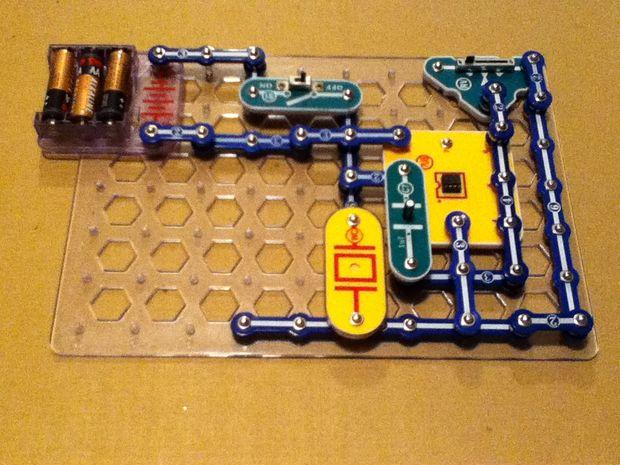
Snap Circuits is an educational toy that teaches electronics with solderless snap-together electronic components. Each component has the schematic symbol and a label printed on its plastic case that is color coded for easy identification. They snap together with ordinary clothing snaps. The components also snap onto a 10 X 7 plastic base grid somewhat analogous to a solderless breadboard. There are several Snap Circuits kits that range from a few simple circuits to the largest kit that includes 750 electronic projects.

Gleaning from the natural process of X chromosome inactivation, scientists recently discovered a way to “turn off” the extra copy of chromosome 21 in Down syndrome, a strategy that might one day cure this disorder.

Rapid coastal subsidence in the central Ganges-Brahmaputra Delta (Bangladesh) since the 17th century has been deduced from submerged salt-producing kilns.

NASA's Curiosity rover on Mars, which first landed inside the Gale Crater on Aug. 6th, 2012, may provide clues as to how the red planet lost its original atmosphere, which scientists believe was much thicker than the one left today.

Today I am quite happy to report of a new groundbreaking result from the CMS collaboration at the CERN LHC - the experiment to which I devote 100% of my research time. We published overnight a report on the Cornell arxiv, and will present this week at the EPS conference in Stockholm, of the observation of B_s meson decays to muon pairs, an exceedingly rare process which is of extreme importance for the searches of new physics beyond the standard model. And in so doing, CMS now leads this race, with better results than LHCb and ATLAS. (UPDATE: but see below, at the bottom of the article).

