

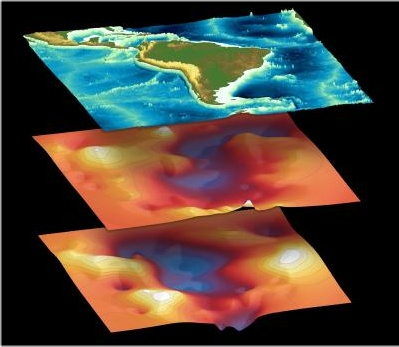

An international team of environmental scientists says that sea-level rise along the Atlantic Coast of the United States in the 20th century was 2 millimeters faster than at any point in the last 4,000 years.

Sea-level rise prior to the 20th century is generally attributed to coastal subsidence. This occurs as land is lost to subsidence as the earth continues to rise in response to the removal of the huge weight of ice sheets during the last glacial period. 
Researchers at Rice University and Baylor College of Medicine (BCM) have found an unexpected weakness in H1N1's method for evading detection by the immune system. They say the virus has been keeping a secret that may be the key to defeating it and other flu viruses as well.

Comparing its genetic sequences going all the way back to the virus's first known appearance in the deadly "Spanish flu" outbreak of 1918, they discovered a previously unrealized role of receptor-binding residues in host evasion, which effectively becomes a bottleneck that keeps the virus in check. The team compared the sequences of more than 300 strains of H1N1 to track its evolution; Their results appear in a recent online edition of PLoS One.
With the fall semester coming to a close, a Purdue University psychologist has some advice for all those college students who are poring over their notes in preparation for finals. Don't.

In a paper recently featured in the Journal of Experimental Psychology: General, psychologist Jeffrey D. Karpicke suggests that students spend their study sessions testing themselves repeatedly, improving their memory retrieval skills, as opposed to cramming for tests using written notes. He says this strategy will make recalling the information much easier when the pressure is on.

Karpicke found in his study that college students are more likely to invest their time in repetitive note reading, and those who do practice retrieval spend too little time on it.
Paleontologists have unearthed a previously unknown Theropod dinosaur from a fossil bone bed in northern New Mexico, settling a debate about early dinosaur evolution, and hinting at how dinosaurs spread across the supercontinent Pangaea.

 The description of the new species, named Tawa after the Hopi word for the Puebloan sun god, appears in the Dec. 10 issue of the journal Science.

This image of a tiny patch of sky reveals the oldest galaxies ever seen. Their light has traveled 13 billion years to the Hubble Space Telescope, stretched along the way from ultraviolet to near-infrared by the expanding universe. After this long wait, astronomers wasted no time, publishing 12 papers on the data in 3 months.  The beautiful color images were just released yesterday:


“Yes, Virginia, there is a Santa Claus.”

That sentence from American journalism’s best-known Santa Claus editorial (the New York Sun’s “Is There A Santa Claus?”) is still so popular that 112 years after it first ran, Macy’s is basing its holiday advertising campaign on it for the second consecutive year. 

This year, Macy’s and the CBS television network are co-sponsoring an animated children’s program about Virginia O’Hanlon, the eight year old girl who sent her inquiry “Please tell me the truth. Is There A Santa Claus?” to the Sun in 1897.
To Know CO2

To Know CO2

Dec 10 2009 | comment(s)

You have to know your CO2! When I wrote Your CO2 Is Bad For You In Your Space Suit I was not talking about the EPA. Here I will not talk about the life's CO2 exchange cycle either unless I have to. My focus is on some new thoughts related to carbon dioxide. Have you observed the birth of a CO2 molecule for instance?


An image straight out of a CGI powered sci-fi movie lit up the skies over Norway earlier today at 8:45 a.m. local time. The phenomenon appeared as a spinning spiral of white light, entered around a bright star-like object. A bright blue tail streamed from the center of the object down towards earth.

The phenomenon was visible for over two minutes, could be seen for hundreds of miles, and was witnessed by thousands of individuals. It has been dubbed “Star-Gate,” and theories of its origin range from a misfired Russian missile, a meteor fireball, northern lights, a black hole, and alien activity. The only thing that everyone agrees upon, including scientists and the military, is as of now its appearance is a mystery - and is like nothing ever seen before.
What's the relationship between soy consumption and breast cancer? Some major news from JAMA:

