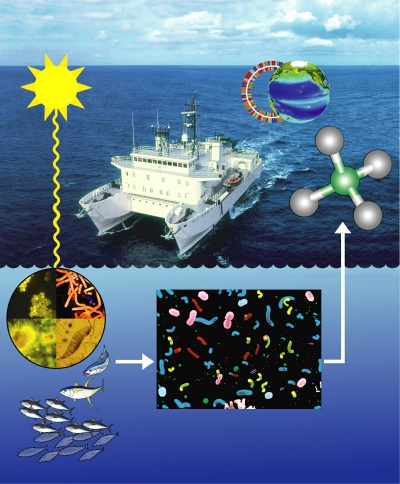






A new pathway for methane formation in the oceans has been discovered, with significant potential for advancing our understanding of greenhouse gas production on Earth, scientists believe.

A paper on the findings published in Nature Geoscience reveals that decomposition of a phosphorus-containing compound called methylphosphonate may be responsible for an unexpected supersaturation of methane in the oceans' oxygen-rich surface waters.

Through the National Science Foundation (NSF) Center for Microbial Oceanography: Research and Education (C-MORE), oceanographer David Karl of the University of Hawaii and microbiologist Edward DeLong of the Massachusetts Institute of Technology, co-authors of the Nature Geoscience paper, are working to learn how and when microbes turn on and off their methane production genes in response to methane precursors like methylphosphonate.

Nothing knows how to survive changes on Earth like bacteria. Microorganisms once reigned supreme on the Earth and they thrived by filling every nook and cranny of the environment billions of years before humans first arrived on the scene.

Their ability to grow from an almost infinite variety of food sources may help bail out society from its current energy crisis, according to the Arizona State University Biodesign Institute's Bruce Rittmann, Rosa Krajmalnik-Brown, and Rolf Halden.

Two distinct, but complementary approaches will be needed:

A team of London scientists have found clues for the potentially therapeutic benefits of nicotine on learning, memory and attention while minimising the risk of addiction. The research announced in Geneva today will assist the search for new drugs for dementia.

The pharmaceutical industry has striven to discover nicotine-like substances for conditions such as Alzheimer’s disease. Nicotine itself is difficult to administer by conventional means. The differences between doses that produce cognitive and toxic effects are small and, most significantly, there is also high risk of addiction. The balance, however, between costs and benefits is much more favourable for people with serious illnesses such as dementia.

Superconductors are materials that conduct electricity with no resistance. Electricity comes from electrons traveling through wire conductors. Those electrons bumping into each other generate an enormous amount of heat. With superconductors, however, there is no jostling, therefore no heat. But there's a catch: "High-temperature" superconductors (a very relative term) only behave this way when they are cooled to liquid nitrogen temperatures – between -346°F and -320.44°F.

Scientists have been unable to decipher just how copper-oxide HTS materials become superconductors. In its natural state, copper-oxide behaves like a permanent magnet. Scientists "dope" the material – which involves adding impurities to increase the number of electron carriers – and as a result of the doping and the cooling, the material turns into a superconductor, with the doped electrons pairing up to effortless carry electricity. But how, and where in the material, does this happen?

Meteorites are a major tool for knowing the history of the solar system because their composition is a record of past geologic processes that occurred while they were still incorporated in the parent asteroid.

Most of the meteorites that we collect on Earth come from the main belt of asteroids located between Mars and Jupiter [1]. They were ejected from their asteroidal "parent body" after a collision, were injected into a new orbit, and they finally felt onto the Earth.

One fundamental difficulty is that we do not know exactly where the majority of meteorite specimens come from within the asteroidal main belt. For many years, astronomers failed to discover the parent body of the most common meteorites, the ordinary chondrites that represent 75% of all the collected meteorites.

You may have heard the news that Louisiana's governor recently signed an "Academic Freedom" bill, the first such bill to pass in a recent string of efforts to allow public school teachers to push non-scientific alternatives to evolution. (I previously wrote about Missouri's failed version.) All of these bills claim to promote academic freedom for public school teachers to teach the Intelligent Design movement's so-called evidence against evolution. But the concept of academic freedom in a high school curriculum makes no sense.

In the New Scientist story linked to above, Josh Rosenau of the National Center for Science Education points out that "if you look at the American Association of University Professors' definition of academic freedom, it refers to the ability to do research and publish." The whole point of academic freedom is, like tenure, to protect independent scholars and scientists from having their work suppressed, manipulated, or managed by administrators or other people outside the research community who might want to pressure scholars to alter their conclusions or not research unfavorable topics.

SWINDON, England, July 12 /PRNewswire/ --

The management of Foxhill Motocross is looking for the best video to capture the thrills and excitement at Foxhill on July 27th.

Genevieve Mather, the track's owner says, "You can talk all day about how fantastic the track is, but unless you see the jumps and the harrowing turns, it's all a bit flat. We're looking for the one video that best captures the excitement of Foxhill."

Circuit Manager Jamie Bouloux continued, "We have some exciting prizes for the winning video."

1. The winning entrant will win two lifetime passes to every Foxhill Motocross event for 120 years. Yes, you may leave the tickets to your future generations. (This does not include access to any restricted areas.)

Researchers at the University of Pennsylvania School of Medicine discovered that the activity of a specific family of nanometer-sized molecular motors called myosin-I is regulated by force. The motor puts tension on cellular springs that allow vibrations to be detected within the body.

This finely tuned regulation has important implications for understanding a wide variety of basic cellular processes, including hearing and balance and glucose uptake in response to insulin.

Myosin-I is a biological motor that uses the chemical energy made by cells to ferry proteins within cells and to generate force, powering the movement of molecular cargos in nearly all cells.

Imagine having three clocks in your house, each chiming at a different time.

Astronomers have found the equivalent of three out-of-sync "clocks" in the ancient open star cluster NGC 6791. The dilemma may fundamentally challenge the way astronomers estimate cluster ages, researchers said.

Using NASA's Hubble Space Telescope to study the dimmest stars in the cluster, astronomers uncovered three different age groups. Two of the populations are burned-out stars called white dwarfs. One group of these low-wattage stellar remnants appears to be 6 billion years old, another appears to be 4 billion years old. The ages are out of sync with those of the cluster's normal stars, which are 8 billion years old.

Farm-raised tilapia, one of the most highly consumed fish in America, has very low levels of beneficial omega-3 fatty acids and, perhaps worse, very high levels of omega-6 fatty acids, according to new research published in the Journal of the American Dietetic Association.

The researchers say the combination could be a potentially dangerous food source for some patients with heart disease, arthritis, asthma and other allergic and auto-immune diseases that are particularly vulnerable to an “exaggerated inflammatory response.” Inflammation is known to cause damage to blood vessels, the heart, lung and joint tissues, skin, and the digestive tract.

