




A series of studies presented today at the American College of Neuropsychopharmacology (ACNP) annual meeting elucidates evidence that there is a genetic link between schizophrenia and cancer, providing a surprising possible scientific explanation for lower rates of cancer among patients with schizophrenia – despite having poor diets and high rates of smoking – and their parents.

Researchers at the National Institute for Mental Health (NIMH) emphasize that many of the genes associated with schizophrenia are the same as the genes associated with cancer, but that the cells that have these genes use them in opposite ways in the two disorders.

Brain overgrowth in the latter part of an infant’s first year may contribute to the onset of autistic characteristics, according to research presented at the American College of Neuropsychopharmacology (ACNP) annual meeting. These findings support concurrent research which has found brain overgrowth in autistic children as young as two years old.

Lead researcher Joseph Piven, M.D., Director of the Neurodevelopmental Disorders Research Center at the University of North Carolina, Chapel Hill and an ACNP member, says that behavioral studies of infants at high risk for autism suggest that the onset of most behavioral symptoms which define the disorder, such as problems with and social interaction, also occur at about age one.

NUSA DUA, Indonesia, December 8 -- The World Future Council (WFC),a global forum of 50 respected personalities who give voice to the shared ethical values of citizens worldwide that includes Bianca Jagger, Chair of the Executive Committee, Tariq Banuri and Anders Wijkman, today accused delegates from the world's wealthiest nations, above all the USA and Canada, of putting the brakes on negotiations.

Industrial countries, especially the US they say, still refuse to commit to drastic cuts in CO2 emissions. This suggests that an agreement on binding climate protection resolutions for the period after 2012 is becoming less likely.

Industrialised countries are attempting to tie-in their emissions commitments with concessions from emerging countries such as China and Brazil.

In science fiction, binary stars are often shorthand for the exotic. A pair of suns rising over some alien landscape quickly communicates the foreign and the outlandish. But that reaction just shows our bias toward what is familiar. Out in the universe, twosomes are nothing out of the ordinary. Astronomers think that a third to more than half of all stars are part of binary systems.

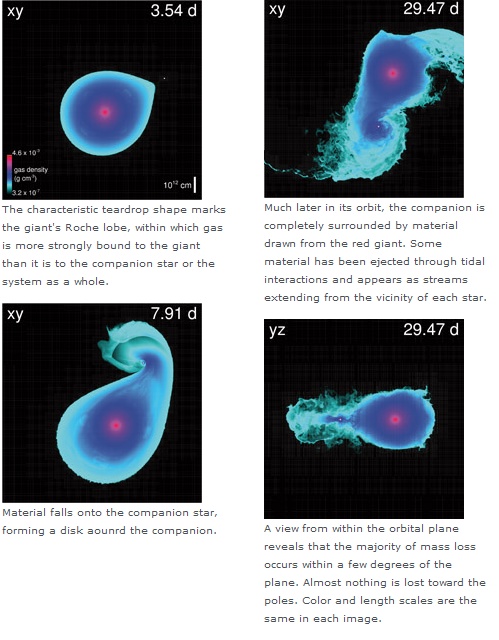
Northwestern University's Ronald Taam has used a progression of systems at NCSA over the last seven years to explore how these binaries operate. Taam works closely with Paul Ricker, a research scientist at NCSA and an assistant professor of astronomy at the University of Illinois at Urbana-Champaign, studying what is known as the common envelope phase.

NEW YORK, December 8 /PRNewswire/ --

Christmas trees are appearing in homes throughout the country and families prepare for the holiday season. But in this age when we are all asked to be aware of the impact we are having on the environment, is the right choice to purchase an artificial tree and use it year after year, or go in search of the perfect living tree to be the centerpiece of our holiday decorating?

The answer may surprise you.

Christmas Tree

Following ground-breaking research showing that neurons in the human brain respond in an abstract manner to particular individuals or objects, University of Leicester researchers have now discovered that, from the firing of this type of neuron, they can tell what a person is actually seeing.

The original research by Dr R Quian Quiroga, of the University’s Department of Engineering, showed that one neuron fired to, for instance, Jennifer Aniston, another one to Halle Berry, another one to the Sydney Opera House, etc.

The responses were abstract. For example, the neuron firing to Halle Berry responded to several different pictures of her and even to the letters of her name, but not to other people or names.

Last year, Britain imported 14,000 tons of chocolate covered waffles - and exported 15,000 tons. Doesn't make sense? It's not just bizarre waffle travels; Europeans are importing more food from overseas than ever before, even while exporting things they grow locally and get $60 billion in annual subsidies to produce.

By studying what Europeans eat and from where, scientists hope to understand the economic, political, and cultural impacts of food on European society. One obvious impact of Europeans buying food from outside Europe is that it has greater impact on the environment. For example, as food travels more, it has to be protected with more packaging.

New research at the University of Leicester reveals that plants react to change in light quality in order to develop freezing tolerance. It showed that a reduction in the ratio of red to far-red wavelengths (R:FR) of light increases the expression of freezing tolerance genes in the model plant species Arabidopsis thaliana.

The ratio of red to far-red light, which is detected by specialized plant photoreceptors called the phytochromes, is highest in direct sunlight and lower in the shade of vegetation or at twilight, which is prolonged at higher latitudes.

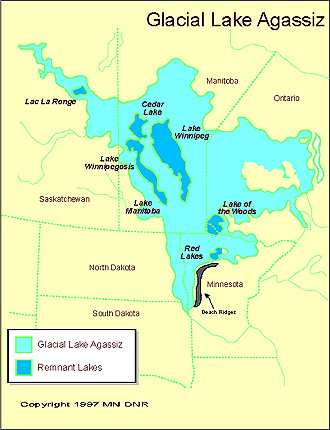
As the giant North American ice sheets melted an enormous pool of freshwater, many times larger than all of the Great Lakes, formed behind them. About 8400 years ago this pool of freshwater burst free and flooded the North Atlantic.

About the same time, a sharp century long cold spell is observed around the North Atlantic and other areas. Researchers have often speculated that the cooling was the result of changes in ocean circulation triggered by this freshwater flood. The sudden addition of so much freshwater would have curtailed (suppressed) the sinking of deep water in the North Atlantic and as a consequence less warm water would be pulled north in the Gulf stream.


Extant of Lake Agassiz.

