





Fertilizing the ocean with iron or other nutrients to cause large algal blooms, has been proposed as a possible solution to global warming because the growing algae absorb carbon dioxide but research performed at Stanford and Oregon State Universities and published in the Journal of Geophysical Research suggests that ocean fertilization may not be an effective method of reducing carbon dioxide in the atmosphere.

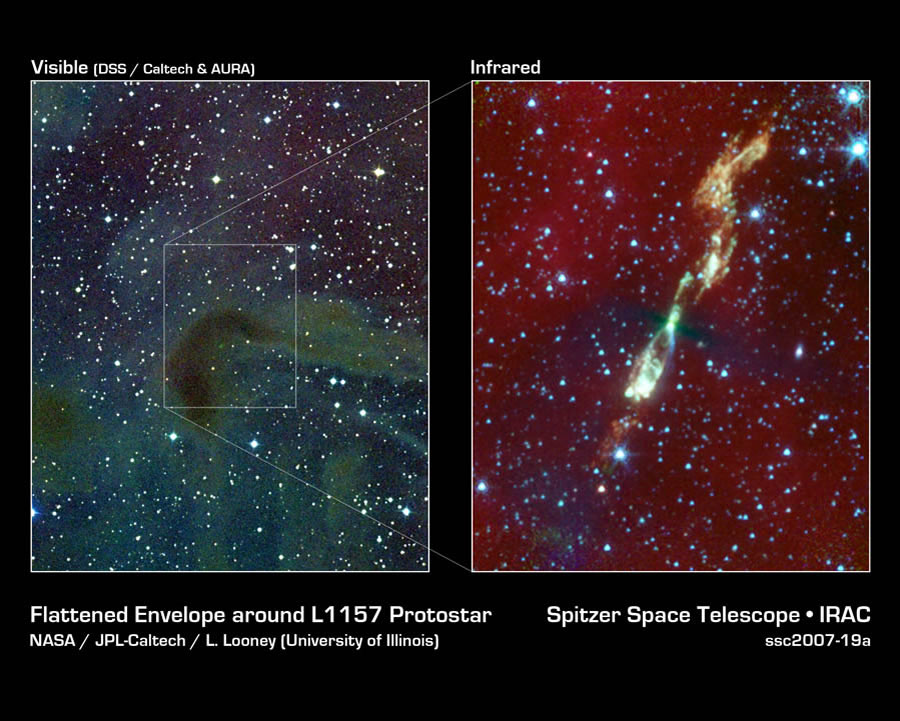
Astronomers at the University of Illinois have found the first clear evidence for a cradle in space where planets and moons form. The cradle, revealed in photographs taken with NASA’s Spitzer Space Telescope, consists of a flattened envelope of gas and dust surrounding a young protostar.

“We are seeing this object in the early stages of stellar birth,” said U. of I. astronomy professor Leslie Looney, the lead author of a paper accepted for publication in Astrophysical Journal Letters. “Eventually, the protostar will form into a star much like our sun, and the disk will form into planets and moons.”

Located about 800 light-years away in the constellation Cepheus, the object is obscured by dust and therefore invisible to the eye.

Meiosis is a type of cell division that produces cells with only one copy of each chromosome—spores in yeast, and eggs and sperm in higher organisms.

During meiosis, chromosome pairs line up in the middle of the cell. The chromosome pairs are then pulled apart, with complete copies of all of the chromosomes ending up at opposite sides of the cell. To ensure that the chromosomes align properly in the middle of the cell, the chromosomes crossover—swap certain sections of genes. Without the crossovers, the chromosomes could misalign and both copies of a chromosome could end up in one cell. When this happens, the cells die or suffer from severe genetic problems, such as Down syndrome.

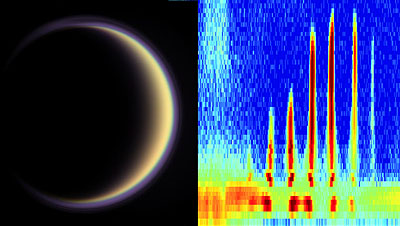
Scientists analysing data gathered by Cassini have confirmed the presence of heavy negative ions in the upper regions of Titan’s atmosphere. These particles may act as building blocks for more complicated organic molecules.

The discovery was completely unexpected because of the chemical composition of the atmosphere (which lacks oxygen - responsible for forming negative ions in the lower ionosphere of the Earth - and mainly consists of nitrogen and methane). The observation has now been verified on 16 different encounters.

Prof Andrew Coates, researcher at University College London’s Mullard Space Science Laboratory and lead author of the paper, says: “Cassini’s electron spectrometer has enabled us to detect negative ions which have 10 000 times the mass of hydrogen.

It's hard to say when scientists realized that policy makers were not always going to make the best decisions regarding science funding but a safe bet would be somewhere before 3,000 BC.

In the intervening 5,000 years, not a lot has changed in how well scientists, politicians and the public really understand each other. A week doesn't go by when there isn't an article lamenting that one project or another doesn't get funding or that one government bureau is over-zealous or too conservative.

Scientists learned early that the best way to get the message across to the people who can truly influence policy makers was to consult them directly. In past ages it was advisors to kings.

“When biologists talk about the ‘Battle of the Sexes,’ they often tacitly assume that the battle is between persistent males who always want to mate and females who don’t,” says Jakob Bro-Jørgensen of University of Jyväskylä in Finland. “However, in topi antelopes, where females are known to prefer to mate with males in the center of mating arenas, we’ve found a reversal of these stereotypic sex roles.”

The classical view of sexual conflict holds that males, for whom reproducing is cheap, will mate as much as possible. On the other hand, females, who must pay a heftier price, are choosier about their mating partners.


Finally, those females have stopped hounding me - male Topi

Astronomers at the University of Michigan have found what are believed to be some of the youngest solar systems yet detected.

The systems are around the young stars UX Tau A and LkCa 15, located in the Taurus star formation region just 450 light years away. Using a telescope that measures levels of infrared radiation, the researchers noticed gaps in the protoplanetary disks of gas and dust surrounding these stars. They say those gaps are most likely caused by infant planets sweeping those areas clear of debris.

A paper on the findings by astronomy doctoral student Catherine Espaillat, professor Nuria Calvet, and their colleagues is published in the Dec. 1 issue of Astrophysical Journal Letters.

In two days, December 1st, the media all over the world will be filled again with those pretty red ribbons, at the edge of a newspaper, on the corner of the TV screen, beside the logo of major websites. It is that special day of every year that many people see it, but don’t realize exactly what it means. Young children may even think that this means Christmas is near!

Unfortunately, it is not so. I mean, yes, the Christmas is near, but not for the whole world. The “Red Ribbon” campaign was inspired some years ago as a motto for global awareness against HIV, a very special and very resilient virus that is haunting the medical community since the early ’80s.

CHICAGO – Using a novel imaging technique to study autistic children, researchers have found increased gray matter in the brain areas that govern social processing and learning by observation. Results of the study conducted at the Fay J.

CHICAGO – Stereoscopic digital mammography, a new diagnostic technique capable of producing three-dimensional, in-depth views of breast tissue, could significantly reduce the number of women who are recalled for additional tests following routine screening mammography. Results of a clinical trial being conducted at Emory University Breast Clinic in Atlanta were presented today at the annual meeting of the Radiological Society of North America (RSNA).

“Standard mammography is one of the most difficult radiographic exams to interpret,” said David J. Getty, Ph.D., division scientist at BBN Technologies of Cambridge, Mass.

