





The recreational use of cocaine has rapidly increased in many European countries over the past few years. One cause of this is the fall in the price of the drug on the street from 100 Euros for one gram (about 5 lines) in 2000 to 50 Euros in the Netherlands today. One line of cocaine is, thus, now as cheap as a tablet of ecstasy. This means cocaine is no longer considered an “elite” drug but is affordable for all, especially for recreational use.

A new study suggests that a holistic approach is needed in assessing the potential environmental and health effects of toxic effluent from industry. The study is published in the International Journal of Environment and Pollution.

Studies of industrial effluent toxicity usually focus on a single contaminant, such as an environmental or marine pollutant, a potential carcinogen, or a toxic heavy metal. However, according to Tatjana Tišler of the National Institute of Chemistry, in Ljubljana, and Jana Zagorc-Koncan of the University of Ljubljana, Slovenia, toxicity tests of effluent using bacteria generally underestimate the total toxicity.

Effluents from industrial or municipal sources may contain hundreds to thousands of chemicals, but only a few are responsible for aquatic toxicity.

The HIV-1 virus is one of the most difficult targets for therapy because it hijacks the cells of our immune system and particularly because the virus mutates rapidly, making it drug resistant. Up to 20% of HIV-infected patients host virus that is drug resistant.

The current "Highly active antiretroviral treatment" (HAART therapy) against HIV uses a combination of several different drugs, which increases the probability of simultaneous development of resistance against different drugs. A team of Slovenian undergraduate students from the University of Ljubljana together with their mentors from the National institute of chemistry of Slovenia (NIC) has developed a new strategy of antiviral defense that is not breached by viral mutations.

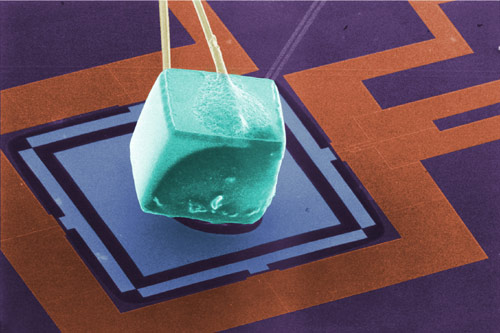
A Finnish group of researchers at the Low Temperature Laboratory of Helsinki University of Technology (TKK) have developed and fabricated a nanoscale heat transistor, and simultaneously the smallest refrigerator ever made.

The device, nanofabricated with the help of electron beam lithography, functions at extremely low temperatures of less than one degree above absolute zero. The possibility to control the electrons going through the device one by one in the metal-superconductor structure enables its use as a heat transistor.


For your six pack of atoms. Credit: N. Miller, A. Clark/NIST

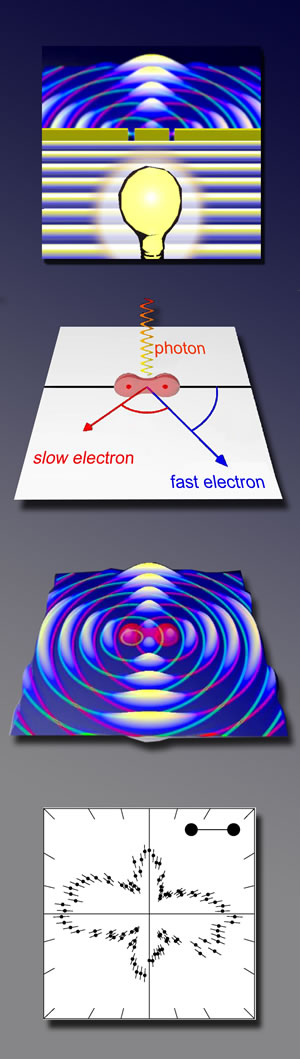
The big world of classical physics mostly seems sensible: waves are waves and particles are particles, and the moon rises whether anyone watches or not. The tiny quantum world is different: particles are waves (and vice versa), and quantum systems remain in a state of multiple possibilities until they are measured -- which amounts to an intrusion by an observer from the big world -- and forced to choose: the exact position or momentum of an electron, say.

On what scale do the quantum world and the classical world begin to cross into each other? How big does an "observer" have to be? It's a long-argued question of fundamental scientific interest and practical importance as well, with significant implications for attempts to build solid-state quantum computers.

People who have a mother with Alzheimer’s disease appear to be at higher risk for getting the disease than those individuals whose fathers are afflicted, according to a new study by NYU School of Medicine researchers.

The study is published in this week’s online edition of the Proceedings of the National Academy of Sciences. It is the first to compare brain metabolism among cognitively normal people who have a father, a mother, or no relatives with Alzheimer’s disease, and to show that only individuals with an affected mother have reduced brain metabolism in the same brain regions as Alzheimer’s patients.

Over the last two decades a number of studies have shown that people with the disease have significant reductions in brain energy metabolism in certain regions of the brain.

Is there such a thing as being too safe on the Internet?

A team of researchers from the St Vincent’s Campus in Sydney have developed a novel way to control the extreme weight loss, common in late stage cancer, which often speeds death.

The findings, published in Nature Medicine, suggest it may soon be possible to prevent this condition, giving people the strength to survive treatment and improve their chances of recovery.

The team of researchers from the Centre for Immunology at St Vincent’s Hospital and the University of New South Wales and the Garvan Institute of Medical Research have shown that most common cancers produce large amounts of a molecule known as MIC-1, which in turn targets receptors in the brain that switch off appetite.

Foregoing food for a day each month is one of the religious practices of members of the Church of Jesus Christ of Latter-Day Saints (LDS or Mormons), who have lower rates of heart disease than other Americans, researchers reported at the American Heart Association’s Scientific Sessions 2007.

“People who fast seem to receive a heart-protective benefit, and this appeared to also hold true in non-LDS people who fast as part of a health-conscious lifestyle,” said Benjamin D. Horne, Ph.D., M.P.H., study author and director of cardiovascular and genetic epidemiology at Intermountain Medical Center and adjunct assistant professor of biomedical informatics at the University of Utah in Salt Lake City.

Is there any point other than public relations in dispatching emergency field hospitals knowing they won't arrive in time to save lives that are in emergency situations? International donors want aid based on local needs but if only one third of needs assessments contain information about the local population or their health needs, is the humanitarian aid being applied effectively?

The first academic thesis in Sweden on international health assistance in disaster zones shows that international assistance is often sent to disaster areas without any prior needs assessment having been made of the affected population.

Dr Johan von Schreeb has carried out needs assessments in a number of disaster situations.

