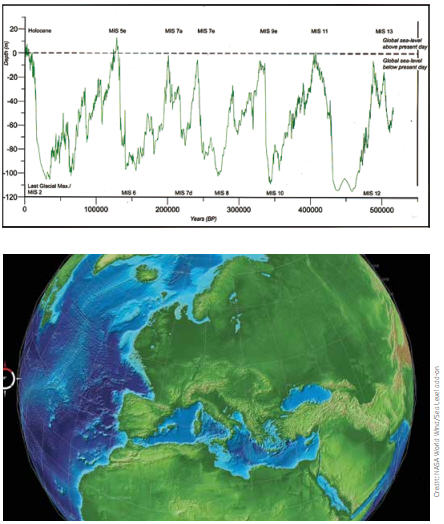












The social sciences have simultaneously become increasingly specialized and over-lapping. A new field calls itself Continental Shelf Prehistoric Research and it studies the remains of prehistoric human settlements which are now submerged beneath coastal waters.

Some of the now-drowned sites are tens of thousands of years old, requiring archaeologists to get help from oceanography and the geosciences. A recent paper describes how during the successive ice ages of the last million years, the sea level dropped at times by up to 120 meters and the exposed area of the continental shelf added 40% to the land area of Europe; a terrain occupied by vegetation, fauna, and people.


Come play with us. For ever. And ever. And ever. Alex Eylar

By Baden Eunson, Monash University

Recently, the Danish Toymaker Lego announced its plans for a reality TV show to be launched in 2015, rumored to be based on the idea of Master Builders, the top “construction workers” in the insanely successful Lego Movie earlier this year.

Economics is a dwindling field. Long called the 'dismal science' it is now considered just another philosophical school of thought; people in the money business who want quantification hire physicists rather than economists.

And the lack of female interest in the field shows it is no longer in vogue. A new analysis finds that women make up 57 percent of undergraduate classes at UK universities but only 27 percent of economics students. The women who like math are doing something else with it. 1.2 percent of females apply to study economics while 3.8 percent of boys do.  

If it isn't taxes, it is OPEC but oil prices are likely to go up - people are still going to drive. It's necessary.

So is physical fitness but a new economics analysis finds that if prices to swim go up, people are inclined to drop it rather than pay more - but a gym membership stays. That's reason enough for economists behind a new paper to advocated a new government subsidy.

The work by Brunel University London's Health Economics Research Group consisted of interviews with 1,683 people, 83% of whom took part in physical activity in some form. It found that people facing 10% higher entry fees to swimming pools were 29% less active, once other variations such as their age and differences in income were taken into account. 

Talk to long-time anglers with a favorite spot and they will often tell stories of one fish they could never get. In mythical overtones, they will speak of its ability to avoid capture, attributing an almost supernatural intelligence (for a fish). Such stories were once so common that 'fish story' became its own brand of tall tale.

A new study mapped individual heritable traits of fish to environmental conditions and concluded that some fish really are going to be harder to catch.

The work by the University of Eastern Finland and the Finnish Game and Fisheries Research Institute
in the Paltamo Unit of the Finnish Game and Fisheries Research Institute

In the past, it was common practice to get rid of anything that was used - and unused - in operating rooms, but with rising health care costs due to government insurance and growing realization that many countries have few supplies at all, recovery of unused operating room materials has gotten new life.

Johns Hopkins University School of Medicine reported during the 2014 Clinical Congress of the American College of Surgeons that recovery of unused medical supplies from operating rooms for donation to surgical centers in developing countries can potentially alleviate a significant global burden of surgical diseases. 

Damage assessments from environmental hazards are always a challenge because of the competing constituencies pulling on science and the fuzzy nature of estimates. After the 2010 Deepwater Horizon spill in the Gulf of Mexico, the Obama administration was editing science reports to reflect its goals, environmentalists were raising money claiming earth was ruined and using wild guesses for damage, and BP lobbyists were mitigating penalties behind the scenes by claiming it wasn't so bad.

What about possibly 2 million barrels of oil that are still down there? Are they a hazard? Where did they go?

 
Credit: Yamanaka Tamaki/Flickr

By Meredith Knight, Genetic Literacy Project

Jean Tirole's theories, capturing reality as an afterthought? IMF, CC BY-NC-ND

By David Spencer, University of Leeds

It’s that time of year again – when academic economics, thanks to the Nobel Prize announcements, is thrust into the public gaze.

In the United States, Democrats have long insisted that women should vote for Democrats, because abortion was the most important issue.

Abortion is not really an issue any more. It was allowed by states prior to the Roe v. Wade Supreme Court decision and has been the law of the land for 40 years. In cases where someone tries to run on abortion, it fails. But marketing scholars say global warming has replaced abortion as the litmus test for why women should be Democrats - if women care about long-term consequences of their actions, that is.

