



Do you believe that COVID-19 was created by Bill Gates so he and his Big Pharma pals could get rich selling a cure? Do you believe career government employees are exaggerating COVID-19 to sway the election to their side?
Yaws is a childhood disease causing highly infectious skin lesions. It is spread by touch and, in advanced cases, can leave sufferers with severe bone disfigurement.

While it is easily curable in its early stages today, and is almost eradicated, the bone disfigurements are irreversible. Yet 4,000 years ago there was no treatment and a new study looked at skeletal remains from the Man Bac archaeological site,  excavated in 2005 and 2007, in the Ninh Bình Province of Vietnam. After seeing what might be yaws on a photograph of Man Bac remains, a team of experts confirmed it - and University of Otago graduate student Melandri Vlok found a second example of the disease. 
A new study shows there is even more reason to worry about the Zika and chikungunya viruses and the pests that spread them; increased risk of neurological diseases like stroke.
A new mathematical model seeks to predict economic performance of crops, which will allow breeders to obtain the plants with the highest possible quality. 

Using even the most advanced legacy tools, it is very difficult to create a new variety of plants and it usually takes 10-12 years. Using genomic selection models, this process can be accelerated several times, finds the new study, using a new mathematical model for predicting crop phenotypic traits as a function genotype.
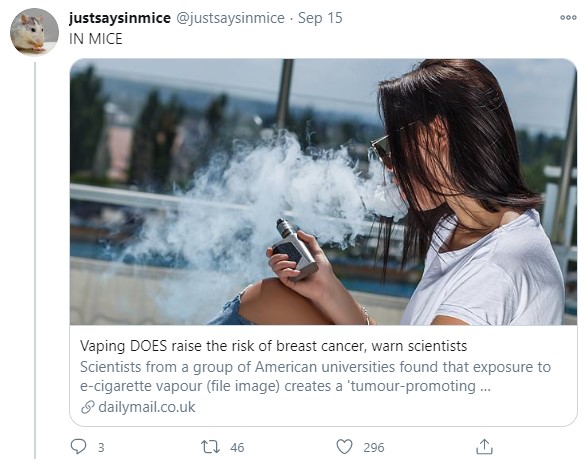
When e-cigarettes - vaping - began to gain in popularity in the early part of this decade, critics like Dr. Stan Glantz at UC San Francisco claimed they were only going to be used in addition to cigarettes, so risk reduction and smoking cessation would not happen.

Former smokers dismissed both him and his Johnson  & Johnson funding - they make nicotine patches that compete with vaping - as a little too convenient, and data since has shown his claims were unfounded. 

Numerous criticisms of medical science have been articulated in recent years. Some critics argue that spurious disease categories are being invented, and existing disease categories expanded, for the aim of profit. Others say that the benefits of most new drugs are minimal and typically exaggerated by clinical research, and that the harms of these drugs are extensive and typically underestimated by clinical research.

On Sept. 14, 2020, a new planet was added to the list of potentially habitable worlds in the Solar System: Venus.

(Inside Science) -- For the first time, an intact world may have been discovered around a white dwarf, suggesting that even after typical stars die, they may still host planets, a new study finds.

White dwarfs are the cooling Earth-size cores of dead stars left behind after average-size stars have exhausted their fuel and shed their outer layers. Our sun will eventually fade into a white dwarf after first bloating to become a red giant. The same fate awaits more than 90% of the stars in our galaxy.

With COVID-19 and worries about the SARS-CoV-2 virus keeping millions of people at home, activists and lawyers are hoping to resurrect worry about a problem dismissed by scientists as a money grab; third-hand smoke.
A new estimate says that of 378 metropolitan areas, many could actually exist on locally grown food - if the local area is up to 200 miles away, which means New York City could claim farms in Delaware, New Jersey, Pennsylvania, Rhode Island, Massachusetts, and Connecticut are local to New York. 

Even then, diets would have to change, because progress has meant having diversity and choice, and if locally-grown were really necessary, the population would starve along the Eastern Seaboard and the Southwest of the U.S. And meat would only be for the rich.

