

New research on Jakobshavn Isbrae, a tongue of ice extending out to sea from Greenland's west coast, shows that large, marine-calving glaciers don't just shrink rapidly in response to global warming, they also grow at a remarkable pace during periods of global cooling.  Glaciers change.

Through an analysis of adjacent lake sediments and plant fossils, the researchers determined that the glacier, which retreated about 40 kilometers inland between 1850 and 2010, expanded outward at a similar pace about 200 years ago, during a time of cooler temperatures known as the Little Ice Age.
Trees absorb carbon dioxide from the atmosphere as they grow so forests are a completely natural way to offset climate change - but rather than let them passively sit there, the amount of carbon dioxide they extract from the atmosphere could be boosted by 400 percent if wood was harvested and used in smaller buildings instead of the steel and concrete that require a lot more fossil fuels during manufacturing, producing carbon dioxide.
Fact #1: There will be a solar event in the next five years that wipes out the electrical grid for the US.

Fact #2: Solar and space weather prediction is about as accurate as hurricane predictions-- lots of maybes and false warnings, but great after-disaster analysis.

Fact #3: It's hard to educate and convince at the same time, and the public doesn't know what space weather is, yet.

Query: Are we doomed?

In Solar Cosmic Katrina and Chicken Little, we find out that:
The National Science Foundation and various other government groups with more funding than knowledge of the public wastes billions of dollars on STEM (Science Technology Engineering and Mathematics) outreach, using the strange mentality that smart kids who might otherwise become veterinarians or game designers need to become scientists and engineers or America will collapse.

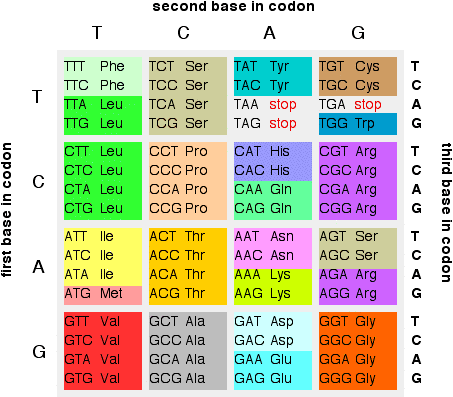
Editing DNA holds great promise, but like all new technologies that are still in their infancy, it’s still slow, expensive and hard to use. However, researchers are developing genome-scale editing tools that might aid in quickly and easily rewriting the genomes of living cells. Harvard-based researchers have developed a new way to edit the genome of living bacteria.

Have a computer?  Of course you do, or you aren't reading this article.   That, and a little space on your floor can make you a 'citizen seismologist.'

The Quake Catcher Network is 6,000 tiny sensors, part of the densest networks of seismic sensors ever devoted to studying earthquakes, and it began rolling out in the San Francisco Bay Area where volunteer installers delivered 200 sensors to people who signed up to host them.
My paper on Squid Babies (which started out as a dissertation chapter) just got accepted!

Well, technically it's Accepted with Revisions, which, for the non-academics in the room, means my co-authors and I have to change a few things before it gets published. But still! It's going to get published! This calls for celebration!

So, in honor of Squid Babies, have a gorgeous video by pacificcoast101 on the embryonic development of the California market squid:


Consider the following scenario. An initial measurement indicates that two indistinguishable particles – particles of the same type, carrying no kind of identity tag are headed northward and southward, respectively. The next (relevant) thing that is indicated by a measurement is that two particles of exactly the same type are headed eastward and westward, respectively. We also assume that the scattering is elastic no particles are created or annihilated in the meantime and that the pair of outgoing particles is in some sense the same as the pair of incoming particles: no other particle has entered or left the scene in the meantime.
Students are often driven by baser concerns and robotics students even more so - hungry all of the time?  Invent a robot that can cook.   Need to take over the Republic?   Build some robots that, oddly, use colored swords.   

The Experimental Robotics course at Stanford gives students a chance to show off their automated ideas to classmates in the Artificial Intelligence Laboratory.     The course is a chance for students to take the math and programming skills they learned in the Intro to Robotics course and use them to direct a pre-fabricated robotic arm to perform a task in the real world.

