



One of these loons who thinks all university research is worthless managed to get another op-ed to that effect published in the Chronicle of Higher Education. It's worth looking at, not for the article itself, but for the lengthy and emotional comment thread.

Thought experiments are mental exercises, or imaginative experiments, which are often not possible to perform with current technology. They appear to be particularly popular in physics and philosophy, but are by no means limited to these two fields. There are a couple of thought experiments that employ demons. After all, an imaginary entity with awesome powers can be quite useful in a thought experiment, can’t it?


Three of the most famous thought experiments that center around a demon with amazing capabilities, are:


Descartes’ Evil Demon


Between Easter’s religious reminders and a molecular evolution class overdose of population genetics, I shouldn’t have been surprised to wake up yesterday from an unsettling dream about taking my midterm exam on Noah’s Ark. The ocean was rising, Noah was hustling animals aboard, and I was battling asthma (thanks, furry animal allergies). But what bothered me most about all this wasn’t that I’d forgotten the formula for heterozygosity. It was that there were only two animals of every kind.

Religious beliefs aside, today’s scientific consensus is that you need more than two individuals to save a species.

Larger portions mean we eat more food but bigger bites less intuitively lead to eating less in restaurants,  according to new study in the Journal of Consumer Research.

The authors conducted their study in an Italian restaurant by using two sizes of forks to manipulate bite sizes and found that diners who used large forks ate less than those with small forks.

The authors then began to investigate why this finding seems to contradict earlier research on portion sizes. "We observe that diners visit the restaurant with a well-defined goal of satiating their hunger and because of this well-defined goal they are willing to invest effort and resources to satiate their hunger goal," the authors write.

44 trillion watts of heat continually flow from Earth's interior into space. Where does it come from?

Researchers can say with 97 percent certainly that 50 percent of the heat is due to radioactive decay and other sources, like primordial heat left over from the planet's formation, must account for the rest.

Knowing that radioactive decay of uranium, thorium, and potassium in Earth's crust and mantle is a principal source, in 2005 scientists in the Kamioka Liquid-scintillator Antineutrino Detector (KamLAND) collaboration first showed that there was a way to measure the contribution directly.

In the autism community, it can’t help but be noticed that a good portion of the parents of autistic kids deal with the same kinds

Nutmeg Liquor

Nutmeg Liquor

Jul 17 2011 | comment(s)

I am going Nuts” introduced a misunderstood gem, the Nutmeg, and mentioned the problem of the nuts being very diverse, as you can see in the picture below, and thus a little difficult to dose. One solution is to produce liquor, or in other words, perform an extraction.


Halved nutmeg nuts: Size, oil content, and so on, differ a lot between nuts. Also notice the very black, gray and extremely white nuts, who seem to have different kinds of fungi attacking them. The nuts look pretty much the same from the outside!

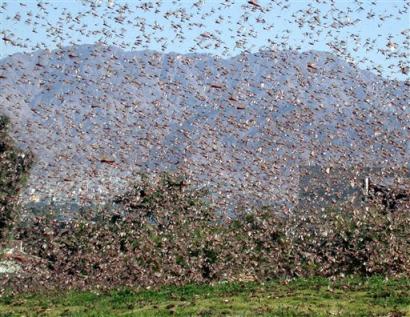
Twitter and Facebook have been studied extensively and have provided some insights into the formation and maintenance of human social networks. But could this approach be adapted to gain understanding of swarming behavior in animals, say, locusts?

Rice accounts for nearly half the daily calories for the world's population but crops are at risk from tsunamis and tidal surges and perhaps future unknown effects of climate change.  

But naturally occurring fungi called endophytes might come to the rescue. 

In an effort to explore ways to increase the adaptability of rice to disasters that have already led to rice shortages, USGS researchers and their colleagues colonized two commercial varieties of rice with the spores of fungi that exist naturally within native coastal (salt-tolerant) and geothermal (heat-tolerant) plants. 
An unusual number of destructive storm surges along the East Coast during the 2009-2010 El Niño winter could be a taste of things to come - with more destructive storm surges in future El Niño years, according to a new study by NOAA.

El Niño conditions are characterized by unusually warm ocean temperatures in the Equatorial Pacific that normally peak during the Northern Hemisphere 'cool season.' They occur every three to five years with stronger events generally occurring every 10-15 years. El Niño conditions have important consequences for global weather patterns, and within the U.S., often cause wetter-than-average conditions and cooler-than-normal temperatures across much of the South.


