Very cool new research on feeding in ancient ammonites! (Thanks to
R. Olley for the link.)
Ammonites, though not the direct ancestors of modern-day cephalopods, are their ancient cousins--and they were the most successful cephalopods of all time, in terms of diversity and sheer abundance.
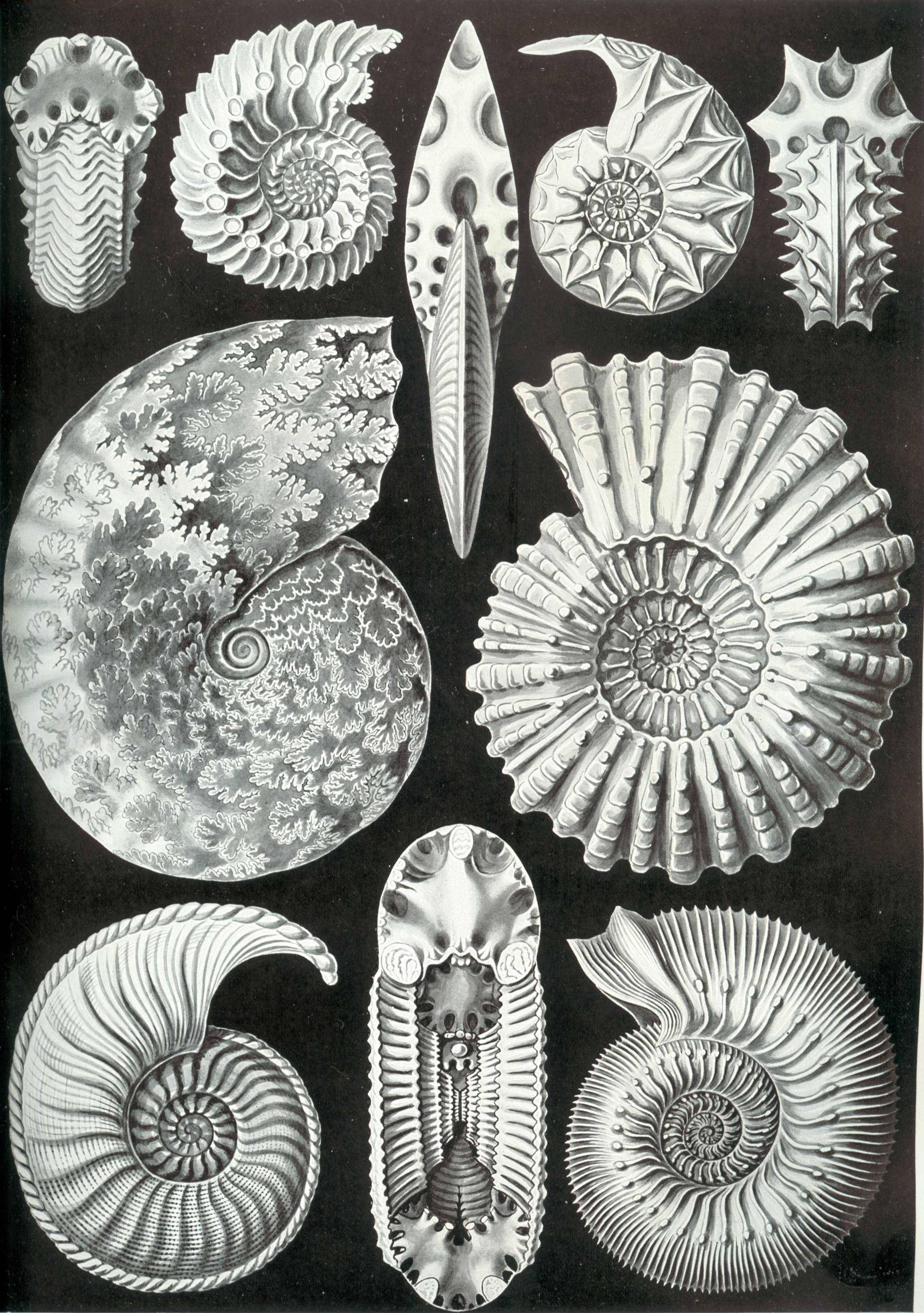 Ammonites from Ernst Haeckel's 1904 Kunstformen der Natur (Artforms of Nature).
There is a theory in economics known as the median voter theorem, attributed to Duncan Black in 1948. The theory has been used to justify the two party, winner take all system, mathematically by political economists, as the best possible system.
Its conclusions are that given his assumptions, a two politician model maximizes the likelihood of a policy outcome to be closest to the policy preference of the citizens, because a politician maximize his chances of winning by choosing the mean voters policy preference.
New important information on high-energy particle physics has recently been released by the CDF experiment, one of the two detectors scrutinizing the 2-TeV proton-antiproton collisions copiously produced by the Fermilab Tevatron collider located near Batavia, Illinois (see aerial view of the site below). The CDF experiment has ruled out the existence of so-called "Z' bosons" (particles extraneous to the Standard Model which are predicted by a number of new physics models) for Z' masses below one Tera-electronvolt.
Are you thinking about majoring in science or engineering? Want to get into a good college and leap out into a job? Here's some advice for science-curious students in high school.
As a HS junior, take HS Physics, Biology, or Chemistry-- whichever matches your major. For engineering or physics or astronomy, HS Physics. For biology, HS Biology and Chemistry. For chemistry, HS Chemistry. For pre-med, heck, take them all.
You should also take any and all Advanced Placements (all topics-- Sci, Math, English). AP gives you free credits, so you can go right into stuff you want and sprinkle your electives more freely during your four years-- or even graduate in 3.5 years.
A new study following the evolution of lice discovered something interesting - modern humans started wearing clothes about 170,000 years ago, and that was a key factor in successfully migrating out of Africa.
Principal investigator David Reed, associate curator of mammals at the Florida Museum of Natural History on the UF campus, studies lice in modern humans to better understand human evolution and migration patterns. His latest five-year study used DNA sequencing to calculate when clothing lice first began to diverge genetically from human head lice.
Ibn al-Haytham can be called the father of modern optics. His 11th-century Book of Optics, which was published 1000 years ago, is considered by some to be in the same league as Newton's Principia regarding its influence in physics, yet very little is known about the writer.
It may seem intuitive that the Moon might have a core, just as Earth does, but science doesn't work on intuition. Absent drilling or inference, it has been hypothesized that Luna has a core but now researchers are closer to an answer, thanks to old Apollo missions.
A group of researchers analyzed older seismic data using new techniques and now say the Moon possesses an iron-rich core with a solid inner ball nearly 150 miles in radius, and a 55-mile thick outer fluid shell.
If you're not from a part of the U.S.A. that read the "Li'l Abner" comics by Al Capp, you may not know Sadie Hawkins Day - but butterflies do. Sadie Hawkins, as comic strip aficionados know, was 'the homeliest gal in the hills' so her prominent father, worried about her never finding a husband, invented a day where women could chase men and marriage was the result. The strip debuted in November of 1937 and was wildly popular, resulting in Sadie Hawkins dances all over the country for decades since.
The cool days of November aren't lucky for just bachelor men. Butterflies have sex role reversal when the days get cooler as well.
A number of scientific organizations these days are creating Meet the Scientist programs and sending scientists and engineers out into public schools, science cafes, and other venues with the hope that they can drum up interest in pursuing careers in these fields. The idea is students will come to an assembly or a festival or some other place and be inspired by the excitement of learning how scientists work.
The following is a story written by my fiancee, who has Tourrette's syndrome, regarding a personal experience at a Mental Institution. In my eyes, this is the real reason why healthcare is so expensive. Many primary care givers are resentful to have to give their care. No matter how much their parent institution pays them. The treatment of patients, and the arrogance of staff is common among the healthcare sector. Just ask your first year intern.
----------------------------------
A Loss of Here