Tangential Science: it's not necessarily science, but it's still funny.
1. Science of Karma
Can there be science to 'Karma'? Likely not, since Karma is, by definition, an Eastern religious concept that has been colloquiallized into a philosophical one. In the East (considered globally since Hindus, Jains, Sikhs and Buddhists all lay claim to it), Karma is basically cause and effect, which is all very Newtonian, and it is echoed in Western religions with the 'as you sow, so also shall you reap' idea ... except at least in the West you are only screwed over once by what you do and actions have consequences over multiple lifetimes.
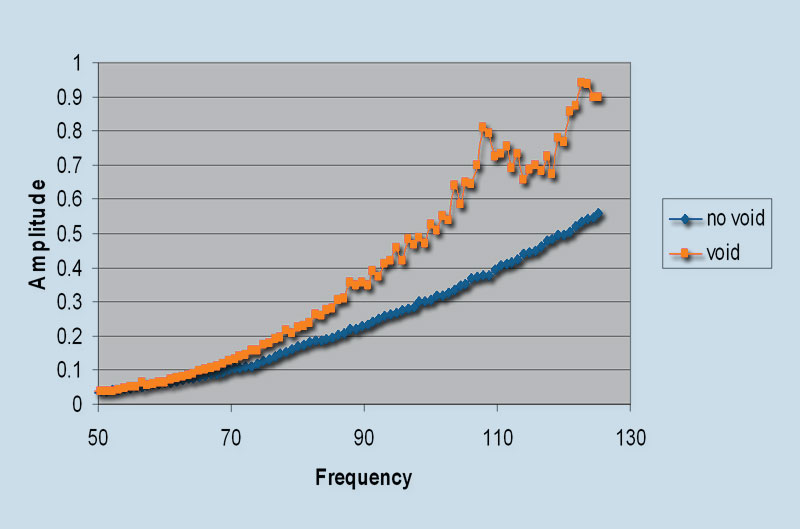
Idaho National Laboratory engineer Phillip West holds a curious metallic device about as wide as a steering wheel. It looks a bit like a flat, stoic face, with two large circular holes for eyes, protruding cylindrical ears and a long, disc-ended snout.
"Are we ready?" he asks, then kneels and nestles the snout gently into the dirt. West flips a switch on one of the machine's handles, and for the next eight seconds a rising tide of sound waves, strong enough to shake your shoes, floods the earth underfoot.
Do you ever wonder how many harmful mutations you carry in your genome? Even if you've never worried about how much of a mutant you are, geneticists have spent a lot of time thinking about this issue. They are interested in a) how much genetic variation is out there, and b) how much of that is potentially harmful and connected to disease? This month's issue of Genome Research has some new research on an individual's personal mutational load.
Should early 20th century researcher Paul Kammerer be credited as the founder of epigenetics? It would certainly be a dramatic change from current perceptions of his work.
Kammerer, a leading proponent of the
Lamarckian theory of evolution, achieved global prominence in the 1920's by arguing that acquired traits could be passed down through generations and, in his most controversial experiment, forced land dweller midwife toads to live in water. Their offspring preferred to live and mate in water and by the third generation he noted that they began to develop black nuptial pads on their forelimbs, a feature common to water dwelling species.
A TubeSat picosatellite lifts 200 grams of payload. That's about 7 ounces. Looked at one way, that's less than half a can of soda. But it's enough to lift an entire Nintendo DS game handheld into orbit. 200 grams can be a lot of electronics.
When I committed to this project, I didn't yet have the specific electronics in mind. I've built mini guitar amps and guitar sound processors that come in well under 7 ounces. I assumed I could kit-bash stuff and create my own schematics for the final assembly. What I didn't expect was that there would be a company that already builds everything I need.
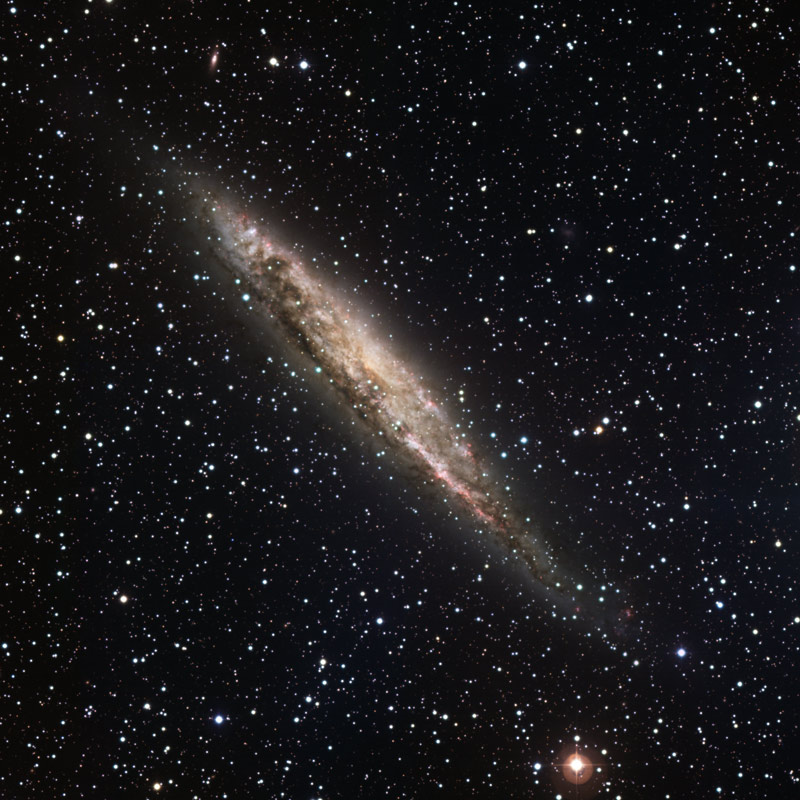
A new image of nearby galaxy NGC 4945 shows that it looks a lot like our own Milky Way.
NGC 4945 seems to be a spiral galaxy with swirling, luminous arms and a bar-shaped central region, though NGC 4945 has a brighter center that likely harbors a supermassive black hole which is devouring reams of matter and blasting energy out into space.
One component of interstellar clouds emitting unusual infrared light known as the Unidentified Infrared Bands (UIRs) is a gaseous version of
naphthalene, the chief component of mothballs back on Earth, according to research led by Michael Duncan, Regents Professor of Chemistry at the University of Georgia, along with doctoral student Allen Ricks and Gary Douberly, now an assistant professor in the department of chemistry at UGA.
The UIRs have been seen by astronomers for more than 30 years, but no one has ever identified what specific molecules cause these patterns.
The Eastern Seaboard had higher than normal sea levels in June and July and a new NOAA technical report blames persistent winds and a weakened current in the Mid-Atlantic .
After observing water levels six inches to two feet higher than originally predicted, NOAA scientists began analyzing data from select tide stations and buoys from Maine to Florida and found that a weakening of the Florida Current Transport—an oceanic current that feeds into the Gulf Stream—in addition to steady and persistent Northeast winds, contributed to this anomaly.
There were a number of reasons carbon dioxide got singled out as a primary contributor to global warming and a key one was that it was the easiest problem to fix in Europe - more nuclear power and closing Soviet-era factories made goals achievable. The US had no quick fix, since environmentalists dislike nuclear power in America, and with world leader China exempt from emissions caps, the effort to curb CO2 basically stalled.
A giant galaxy, so distant that it is seen as it was 12.8 billion years ago, is as large as the Milky Way and contains a supermassive black hole with at least a billion times as much matter as our Sun.
The discovery, in a paper in the journal Monthly Notices of the Royal Astronomical Society by University of Hawaii astronomer Dr. Tomotsugu Goto and colleagues, lays claim to the most distant supermassive black hole ever found.