A third of patients have unnecessary tubes (cannulae) inserted when they are in hospital, needlessly exposing them to serious complications such as infection and blood clots, research launched at the British Pharmaceutical Conference (BPC) in Manchester has shown.

Pharmacy researchers from Robert Gordon University in Aberdeen also showed that in 71% of patient records there was no documentation of cannula insertion and in 57%, no documentation of cannula removal.

Complications associated with intravenous (IV) cannula use include problems with veins (phlebitis), leakage of drugs into tissues around the site of the tube (extravasations), serious infection and blood clots.

The fight against fake medicines could soon be aided by a small, portable device that quickly measures the hardness of a tablet, revealing whether it is counterfeit, according to research presented at the British Pharmaceutical Conference (BPC) in Manchester.

The study tested a series of dummy paracetamol tablets made with varying degrees of real medicine, versus lactose (an ingredient used by counterfeiters to replace the active drug). Tests showed that the fake tablets were harder than the tablet with the correct amount of paracetamol, and were more difficult to crush.

When scientific terms become part of the cultural fabric they often lose their meaning. Biology has had its share of modern misunderstandings with 'evolution' becoming colloquial rather than scientific, along with the general term 'theory', which today is used by anyone with a crackpot notion about particle physics, math or the end of the world due to a tunnel in Switzerland.

So it goes. That's why today we have advertising claims like 'the next evolution in cars' and then press releases about the 'missing link' in comets.

Hey, we don't shape the culture, we just try to cut through it. So this time we will talk about the 'missing link' between an Oort cloud and Halley's comet and discuss the 'evolution' of these mysterious space bodies, which will make biologists here irritated. Later on we can use terms like 'genesis' and 'creation' in their place so religious folks can feel slighted also.

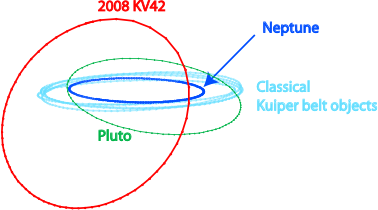
Why mention all that? Well, we run out of science terms to use when there is no previous explanation for an object, so we have to fall back on cultural ones in order to convey why something is important. In this instance, a team of scientists has found an unusual object whose backward and tilted orbit around the Sun is just baffling enough that it may tell us about the origins of some comets.

You heard me. Researchers from the Canada-France Ecliptic Plane Survey project have discovered an object that orbits around the Sun -- backwards. And it is tilted at an angle of 104 degrees, almost perpendicular to the orbits of the planets. Take a look:
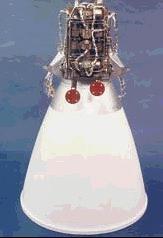
Engineers from NASA and Pratt & Whitney Rocketdyne successfully completed a series of hot-fire altitude tests using liquid methane on the RS-18 engine, which was last used to lift astronauts off the moon's surface 36 years ago and was originally flown with storable hypergolic propellants during the Apollo moon missions.

The tests, conducted at White Sands test facility in New Mexico, are part of the technology development for NASA's Constellation program, and gathered important data on ignition, performance measurement, and rapid start and stop.

The RS-18 engine has been modified to burn liquid oxygen and liquid methane, providing increased safety and performance to future space vehicles.

Almost 60% of British women use at least one herbal product during pregnancy, research launched at the British Pharmaceutical Conference (BPC) in Manchester has revealed.

In the first UK study of its kind, pharmacy researchers from the University of East Anglia found that despite the popularity of herbal products, almost half (49%) of the pregnant women were uncertain about the safety of the preparations and took them on the recommendation of family or friends rather than a healthcare professional.

Bats' ability to echolocate may have evolved more than once, according to research published this week by Queen Mary, University of London scientists.

Species of bat with the ability to echolocate do not all group together in the evolutionary tree of life - some are more related to their non-echolocating cousins, the fruit bats. This has raised the question of whether echolocation in bats has evolved more than once, or whether the fruit bats somehow lost their ability to echolocate.

Mammalian fatty acid synthase is one of the most complex molecular synthetic machines in human cells. It is also a promising target for the development of anti-cancer and anti-obesity drugs and the treatment of metabolic disorders. Now researchers at ETH Zurich have determined the atomic structure of a mammalian fatty acid synthase. Their results have just been published in Science magazine.

Synthesis of fatty acids is a central cellular process that has been studied for many decades. Fatty acids are used in the cell as energy storage compounds, messenger molecules and building blocks for the cellular envelope. Until now, individual steps of this process have been investigated using isolated bacterial enzymes. However, in higher organisms – except plants – fatty acid synthesis is catalyzed by large multifunctional proteins where many individual enzymes are brought together to form a "molecular assembly line".

Basil can protect against the harmful effects of ageing, according to research presented at the British Pharmaceutical Conference (BPC) in Manchester.

Holy basil, (Latin name Ocimum sanctum), is a close relative of the herb commonly used in Western cooking. Native to India, its extract has long been used in the ancient system of Ayurvedic medicine practiced in India and other parts of Asia as a rejuvenation drug, to promote a youthful state of physical and mental health.

In the first formal study of the herb, pharmacy researchers found that holy basil extract was effective at actively searching for and eliminating harmful molecules and protecting against damage caused by some free radicals in key organs such as the heart, liver and brain.

Ramadan is a Muslim religious observance in which participants do not eat or drink anything from dawn until sunset.

Researchers from the departments of Department of Nutrition and Bromatology and Department of Chemistry-Physics of the University of Granada have carried out a study in which they have revealed the need of counterbalancing the diet of the population who follow Ramadan.

According to the collected data, in this period of time macronutrient consumption levels are not appropriate if compared with the reference recommendations. The number of daily ingestions drops to 2 or 3, with regard to the 4 or 5 ingestions of the rest of the population in this period. In addition, scientists have established that, because of the diet, corporal fat increases and muscular mass falls.

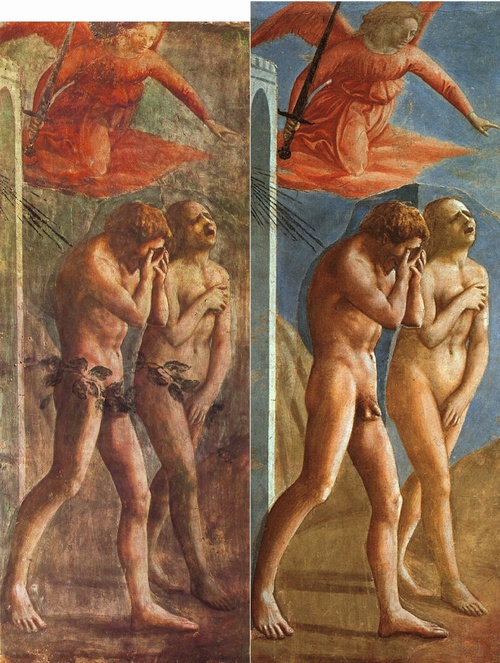
Tom Learner isn’t afraid of taking a scalpel to multi-million dollar Monets or Picassos. But he also knows his way around equipment that sounds pretty high tech: Scanning Electron Microscopes, Enzyme Linked Immunosorbent Assays, and Mass Spectrometers. He knows about Neo-Dada, he digs Degas, and he’s pretty handy when it comes to High Performance Liquid Chromatography. He loves science, but he’s doing it all in the name of art. Dr. Learner is a conservation scientist; as the Senior Scientist at the Getty Conservation Institute (GCI) in Los Angeles, he gets to combine his love for both art and science in an amazing way. He says he still gets a feeling of awe when he's standing nose-to-nose with an original van Gogh. The GCI's scientific department has about 25 scientists who feel the same way, with expertise in chemistry, geology, materials science, physics, and engineering. Is there a draft in here? Image of "The Expulsion from the Garden of Eden," before and after restoration.