




Since 1969 a U.S. patent has been registered on the process of turning alcohol into powder.

This year, products, such as gelatin shots and margaritas, based from alcohol powder are set to be released by Pulver Spirits and BPNC Distillery.

Though alcohol powder is regulated the same as other alcoholic beverages in the U.S., it is only sold as a food flavoring. However, in other countries such as the Netherlands, lack of regulations make obtaining powdered alcohol within reach to minors.

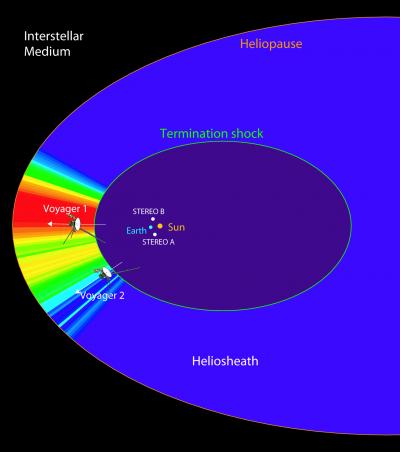
NASA's sun-focused STEREO spacecraft unexpectedly detected particles from the edge of the solar system last year, allowing University of California, Berkeley, scientists to map for the first time the energized particles in the region where the hot solar wind slams into the cold interstellar medium.

Mapping the region by means of neutral, or uncharged, atoms instead of light "heralds a new kind of astronomy using neutral atoms," said Robert Lin, UC Berkeley professor of physics and lead for the suprathermal electron sensor aboard STEREO. "You can't get a global picture of this region, one of the last unexplored regions of the heliosphere, any other way because it is too tenuous to be seen by normal optical telescopes."

The heliosphere is a volume over which the effects of the solar wind extend, stretching from the sun to more than twice the distance of Pluto. Beyond its edge, called the heliopause, lies the relative quiet of interstellar space, at about 100 astronomical units (AU) - 100 times the Earth-sun distance.

The world of geology changes rapidly - sometimes the Grand Canyon is one age and then it is found to be much older. But even in geology it's not often a date gets revised by 500 million years.

University of Florida geologists say they have evidence that a half-dozen major basins in India were formed a billion or more years ago, making them at least 500 million years older than commonly thought. If so, it might remove one of the major obstacles to the 'Snowball Earth' theory that says a frozen Earth was once entirely covered in snow and ice. It might even lend some weight to a controversial claim that complex life originated hundreds of million years earlier than most scientists currently believe.

The Purana basins – which include the subject of the study, the Vindhyan basin – are located south of New Delhi in the northern and central regions of India. They are slight, mostly flat depressions in the Earth's crust that span thousands of square miles. For decades, Meert said, most geologists have believed the basins formed 500 million to 700 million years ago when the Earth's crust stretched, thinned and then subsided.

Human emissions of carbon dioxide are loading the atmosphere with heat-trapping greenhouse gases and have also begun to alter the chemistry of the ocean, according to a team of chemical researchers.

The ecological and economic consequences are difficult to predict but possibly calamitous, they say in the July 4 issue of Science, and halting the changes already underway will likely require even steeper cuts in carbon emissions than those currently proposed to curb climate change.

Ken Caldeira of the Carnegie Institution's Department of Global Ecology, writing with lead author Richard Zeebe of the University of Hawaii and two co-authors*, note that the oceans have absorbed about 40% of the carbon dioxide (CO2) emitted by humans over the past two centuries. This has slowed global warming, but at a serious cost: the extra carbon dioxide has caused the ocean's average surface pH (a measure of water's acidity) to shift by about 0.1 unit from pre-industrial levels. Depending on the rate and magnitude of future emissions, the ocean's pH could drop by as much as 0.35 units by the mid-21st century.

Scientists have long anguished over how little is known about Mercury, the innermost of the four terrestrial planetary bodies in our solar system. The gaps in knowledge covered such basic information as the planet's geology, how it was formed and evolved and whether its interior was still active.

In 1975, the Mariner 10 spacecraft returned intriguing images that showed smooth plains covering large swaths of Mercury's surface. But scientists could not determine whether the plains had been created by volcanic activity or by material ejected from below the surface when objects had collided into it. Thus, they could not reach a consensus over Mercury's geologic past.

Commercial flower and plant growers know all too well that invasive, ubiquitous weeds cause trouble by lowering the value and deterring healthy growth of potted ornamental plants. To control weeds, many commercial nursery owners resort to the expensive practice of paying workers to hand-weed containers. Some growers use herbicides, but efficacy of herbicides is questionable on the wide range of plant species produced in nurseries, and many herbicides are not registered for use in greenhouses.

Enter "dried distillers grains with solubles", or DDGS. DDGS, a byproduct of converting corn to fuel ethanol, is typically used as livestock feed. Rick A. Boydston, Harold P. Collins, and Steve Vaughn, of the U.S. Department of Agriculture, undertook a research study on the use of DDGS as a weed deterrent on potted ornamentals. The study results, published in the February 2008 issue of HortScience, evaluated the use of DDGS as a soil amendment to suppress weeds in container-grown ornamentals.

'Hello, climate? We're from the government and we're here to help you.'

A group of former senior federal officials have called for the establishment of an independent Earth Systems Science Agency (ESSA) that would be created by merging the National Oceanic and Atmospheric Administration (NOAA) and the U.S. Geological Survey (USGS) into something even larger.

Charles Kennel, former Associate Administrator of the National Aeronautics and Space Administration and Director of Mission to Planet Earth, says, "Earth system science focuses on understanding current processes and predicting changes that will take place over the next hundred years. It merges earth, atmospheric, and ocean science into a panorama of the earth system as it is today and as it will be tomorrow. We need it to predict climate change and its impacts, and to help us mitigate and adapt to other changes that have the potential to affect our quality of life and economic well-being."

A normal-sized, black coffee cup with a handle, of course, sitting in the middle of a wooden picnic table, is filled with hazelnut coffee. While one many view this simply as a cup on a table, it is possible that another will view the cup as a metaphor for the fresh beginning of a new day. In the cyber world, Kine Dorum, a PhD Student at the University of Leicester, in Great Britain, analyzes the way humans use images from past experiences as a guide when using the computer rather then directly associating computer images to real-life. Dorum hopes to develop a set of common attributes in predicting individuals’ behaviors and performances while on the computer through her notion that the universe on screen is similar to perceptions of “real life” based on past experiences.

LSU associate professor of sociology Troy C. Blanchard recently found that a community's religious environment – the type of religious congregations within a locale – affects mortality rates, often in a positive manner. These results were published in the June issue of Social Forces.

This result, he says, is particularly timely in the context of presidential candidate Barack Obama's recent call for expanding the roles of such religious groups.

Along with co-author John Bartkowski from the University of Texas at San Antonio and other researchers from the University of West Georgia and the University of Alabama at Birmingham, Blanchard found that people live longer in areas with a large number of Catholic and Mainline Protestant churches. He offers two key reasons for these findings.

It is well known that a powerful perceptual experience can change the way a person sees things later. If you are startled to discover a mouse in your kitchen, you may suddenly you see mice in every dark corner - or at least think you do. Is it possible that imagining something, just once, might also change how you perceive things?

To test how imagery affects perception, the researchers had subjects imagine simple patterns of vertical or horizontal stripes, which are strongly represented in the primary visual areas of the brain. They then presented a green horizontal grated pattern to one eye and a red vertical grated pattern to the other to induce what is called binocular rivalry.

During binocular rivalry, an individual will often alternately perceive each stimulus, with the images appearing to switch back and forth before their eyes. The subjects generally reported they had seen the image they had been imagining, proving the researcher's hypothesis that imagery would influence the binocular rivalry battle.

