




Chemical engineering researchers at the University of Arkansas have investigated supercritical methanol as a method of converting chicken fat into biodiesel fuel. The new study also successfully converted tall oil fatty acid, a major by-product of the wood-pulping process, into biodiesel at a yield of greater than 90 percent, significantly advancing efforts to develop commercially viable fuel out of plentiful, accessible and low-cost feedstocks and other agricultural by-products.

“Major oil companies are already examining biodiesel as an alternative to petroleum,” said R.E. “Buddy” Babcock, professor of chemical engineering.

Mathematicians from the University of Exeter say they have solved the mystery of traffic jams by developing a model to show how major delays occur on our roads, with no apparent cause.

Many traffic jams leave drivers baffled as they finally reach the end of a delay only to find no visible cause for their delay. Now, a team of mathematicians state they have found the answer and published their findings in the journal Proceedings of the Royal Society.

The team developed a mathematical model to show the impact of unexpected events. Their model revealed that slowing down below a critical speed when reacting to such an event, a driver would force the car behind to slow down further and the next car back to reduce its speed further still.

A new study of twins indicates that the genetic foundation for the brain’s ability to recognize faces and places is much stronger than for other objects, such as words. The results, which appear in the December 19 issue of the Journal of Neuroscience, are some of the first evidence demonstrating the role of genetics in assigning these functions to specific regions of the brain.

“We are social animals who have specialized circuitry for faces and places,” says Arthur W. Toga, PhD, director of the Laboratory of NeuroImaging at UCLA School of Medicine. “Some people are better at recognizing faces and places, and this study provides evidence that it is partially determined by genetics.”

A research team at Maryland's A. James Clark School of Engineering comprised of Professor Christopher Davis, Research Scientist Igor Smolyaninov, and graduate student Yu-Ju Hung, has used plasmon technology to create the world's first invisibility cloak for visible light. The engineers have applied the same technology to build a revolutionary superlens microscope that allows scientists to see details of previously undetectable nanoscale objects.

Generally speaking, when we see an object, we see the visible light that strikes the object and is reflected. The Clark School team's invisibility cloak refracts (or bends) the light that strikes it, so that the light moves around and past the cloak, reflecting nothing, leaving the cloak and its contents "invisible."

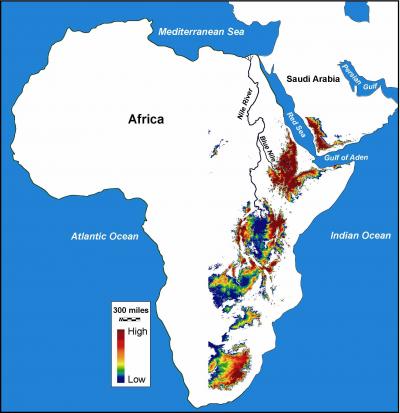
Scientists long have focused on how climate and vegetation allowed human ancestors to evolve in Africa.

A Virginia Commonwealth University Life Sciences Survey is the first poll to reflect the discovery reported internationally in November that human skin cells can be used to create stem cells or their near equivalents.

When asked about the implications of this development, more than six in 10, or 63 percent, say that both embryonic and non-embryonic stem cell research is still needed, 22 percent say this development means embryonic stem cell research is no longer necessary. Thirty-eight percent of Americans report hearing about this research.

Three-quarters of the U.S. public supports stem cell research that does not involve human embryos.

Viticulture, the growing of grapes Vitis vinifera, chiefly to make wine, is an ancient form of agriculture, dating as far back as the Neolithic and Early Bronze Ages.

We have a detailed understanding of how nurture affects the qualities of a grape harvest leading to the concept of terroir (the range of local influences that carry over into a wine). The nature of the grapes themselves has been less well understood but the publication of a high quality draft genome sequence of a Pinot Noir grape by an Italian-based multinational consortium may change that.

In the world of commercial materials, lighter and cheaper is better - especially when coupled with superior strength and special properties such as a material's ability to remember its original shape after it's been deformed by a physical or magnetic force.

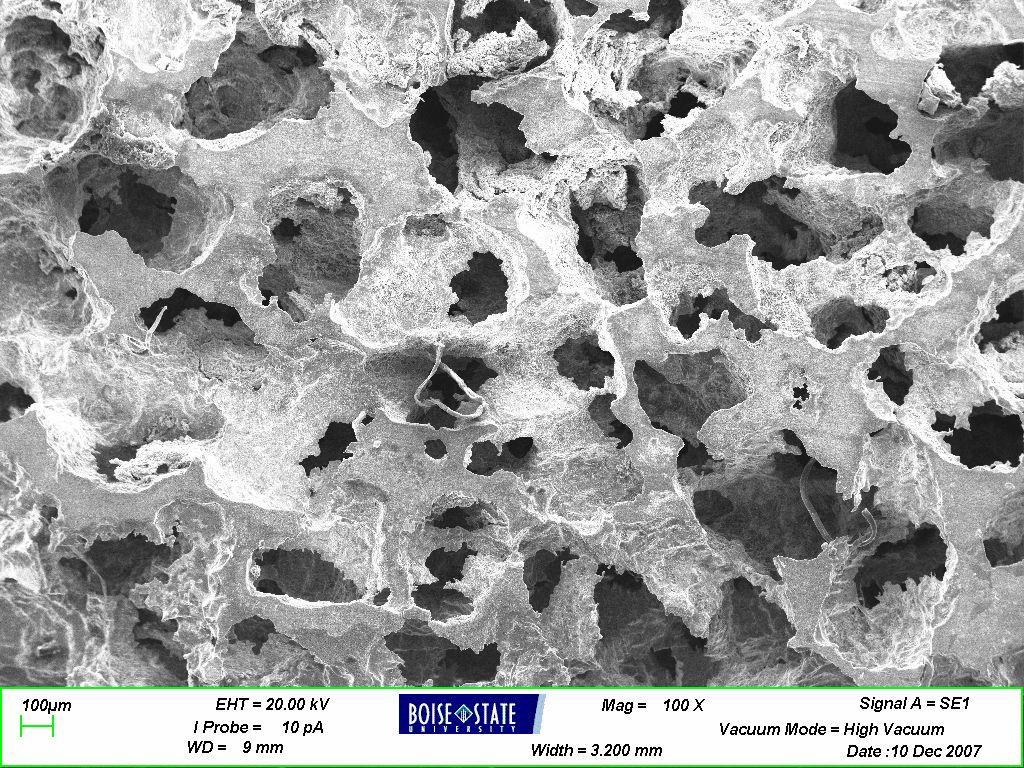
A new class of materials known as "magnetic shape-memory foams" has been developed by two research teams headed by Peter Müllner at Boise State University and David Dunand at Northwestern University.

The foam consists of a nickel-manganese-gallium alloy whose structure resembles a piece of Swiss cheese with small voids of space between thin, curvy "struts" of material. The struts have a bamboo-like grain structure that can lengthen, or strain, up to 10 percent when a magnetic field is applied.

Do polls reflect who people will vote for or who they would like to be perceived as voting for? A new national study of voters who say they might vote in Democratic primaries (participants were not a representative sample of Democrats but were self-selected volunteers who took an experimental test over the Web) and caucuses shows a striking disconnect between their explicit and implicit preferences, according to Bethany Albertson, a University of Washington assistant political science professor and Anthony Greenwald, a UW psychology professor and inventor of the Implicit Association Test.

When asked who they would vote for, Sen. Barack Obama held a 42 percent to 34 percent margin over Sen. Hilary Clinton. Former senator John Edwards was in third place with 12 percent.

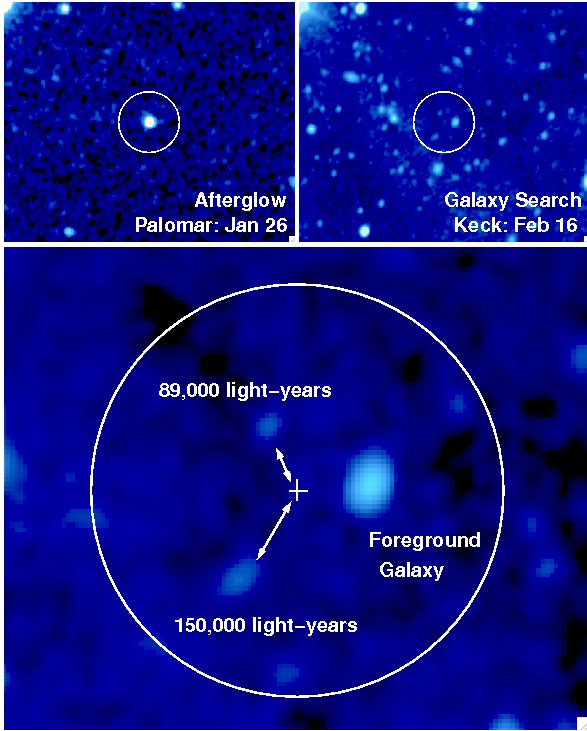
A cosmic explosion that seems to have occurred thousands of light-years from the nearest galaxy-sized collection of stars, gas, and dust has puzzled astronomers. This "shot in the dark" is surprising because the type of explosion, a long-duration gamma-ray burst (GRB), is thought to be powered by the death of a massive star.

"Here we have this very bright burst, yet it's surrounded by darkness on all sides," says Brad Cenko of the California Institute of Technology, Pasadena, Calif., lead author of the team’s paper, which has been accepted for publication in The Astrophysical Journal.


