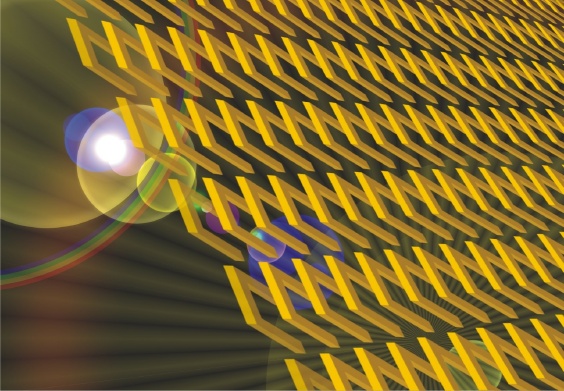

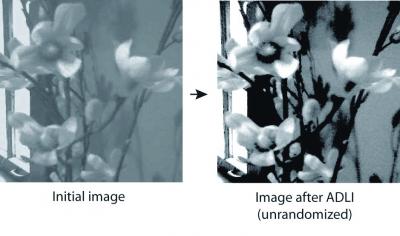



Researchers stunned the world when they announced a cloaking device for the microwave range. This device made use of metamaterials that had a negative refractive index for electromagnetic radiation. The metamaterials were carefully designed split-ring resonators with a structure size much smaller than the wavelength. Only 10 stacked layers of metamaterials were necessary to achieve the desired invisibility effect.

Now, researchers from the group of Harald Giessen at the University of Stuttgart have succeeded in manufacturing a stacked split-ring metamaterial for the optical wavelength range (Na Liu et al., Nature Materials Jan. 2008 issue).

New research published today in the Journal of Cell Biology illuminates the mechanical factors that play a critical role in the differentiation and function of fibroblasts, connective tissue cells that play a role in wound healing and scar tissue formation.

When we are injured, the body launches a complex rescue operation. Specialized cells called fibroblasts lurking just beneath the surface of the skin jump into action, enter the provisional wound matrix (the clot) and start secreting collagen to close the wound as fast as possible. This matrix is initially soft and loaded with growth factors.

The fibroblasts "crawl" around the matrix, pulling and reorganizing the fibers.

This term, the students in my organic chemistry class were presented with an opportunity to do an extra credit assignment using Second Life to represent concepts they learned in the course. When I was an undergraduate, finding molecules in articles was mainly done using the Chemical Abstracts books. A convenient way to find a specific molecule would be to look up the molecular formula and find the corresponding IUPAC name. Theoretically, one could figure out the IUPAC name from scratch but this can be very tricky for complex molecules and prone to error.

The brain remains a complicated machine but researchers from the Center for the Neural Basis of Cognition (CNBC), a joint project of Carnegie Mellon University and the University of Pittsburgh have made progress in explaining why, when we notice a scent, the brain can quickly sort through input and determine exactly what that smell is.

To do it, they created a biologically inspired algorithm for analyzing the brain at work and they have described a mechanism called “dynamic connectivity,” in which neuronal circuits are rewired “on the fly” allowing stimuli to be more keenly sensed.

“If you think of the brain like a computer, then the connections between neurons are like the software that the brain is running.

About 10 years ago, a UC San Diego psychology professor named Ben Williams, who is in my area of psychology (animal learning), managed to successfully cure his own terminal cancer by self-experimentation. He wrote a book about it called Surviving Terminal Cancer. As this WSJ story shows, his approach — which can be summed up think for yourself — is spreading.

Researchers of the Institute of Molecular Biology, Russian Academy of Sciences, have been working for more than 20 years on designing biological microchips for efficient and quick diagnostics of tuberculosis and other diseases.

The BIOCHIP-IMB company was set up at the Institute for production of domestic microchips. During the press-tour on November 15, 2007, the researchers told journalists about progress and achievements. The project of the laboratory of biological microchips at the Institute of Molecular Biology (Russian Academy of Sciences ) is one of the winners at the contest of projects on the “Living Systems” priority direction of the Federal Target Program guided by the Federal Agency for Science and Innovations (Rosnauka).

Today, people from all over the world are insufficiently aware about their daily food consumption. Most like to eat organic food and reduce GM (Genetically Modified) crops. So farmers of both modern and developing countries are trying to produce organic crops. But at this time there are lots of pests and insects which decrease the yield of crops and losses total yields. For this reason farmers are interested in cultivating their crops under Integrated Pest Management and other control management systems. If they want to produce crops without the help of synthetic insecticides, they can use organic pesticides such as neem (Azadirachta indica) plant extract.

Time-lapse videos and computer simulations provide the first concrete molecular explanation of how a cell flexes tiny muscle-like structures to pinch itself into two daughter cells at the end of each cell division, according to a report in Science Express.

Cell biologists at Yale and physicists at Columbia teamed up to model and then observe the way a cell assembles the “contractile ring,” the short-lived force-producing structure that physically divides cells and is always located precisely between the two daughter cell nuclei.

“This contractile ring is thought to operate like an old-fashioned purse string,” said senior author Thomas D. Pollard, Sterling Professor and Chair of the Department of Molecular, Cellular & Developmental Biology at Yale.

If you do a search here on the LHC, you find all kinds of news articles.

The LHC was completed in April, except it wasn't, and parts broke, or were still being designed and testing will be delayed, except it's unimportant and it will still be the greatest thing ever. Maybe it will be. Or it will be another Hubble.

After yesterday's statements by CERN Director General Robert Aymar it's still unclear when it will be done or how it will work but, he says, 'good progress has been made on all fronts.'

So here's the latest:

The LHC is now fully installed in its 27 km tunnel.

Levels of cholesterol in the membranes of hair cells in the inner ear can affect your hearing, said a consortium of researchers from Baylor College of Medicine, Rice University and Purdue University in a report in today’s print edition of The Journal of Biological Chemistry.

Dr. William Brownell, professor of otolaryngology at BCM and his colleagues, said that the amount of cholesterol in the outer hair cell membrane found in the inner ear can affect hearing.

“We’ve known for a long time that cholesterol is lower in the outer hair cell membranes than in the other cells of the body,” said Brownell, senior author of the report “What we didn’t know was the relationship it had to hearing.”


