






The press release had a curious title: “Omega-3 fatty acids protect against Parkinson’s.” The certainty suggested an experiment, but Parkinson’s is too rare to study prevention experimentally. The press release turned out to be about a rat study that used a drug called MDPT to cause brain damage that resembles Parkinson’s. Rats given a high-omega-3 diet suffered much less damage — apparently none — from the drug.

This is one of my undergraduate assignment under department of Agronomy, Sher-e-Bangla Agricultural University, Dhaka-1207, Bangladesh.

Abstract


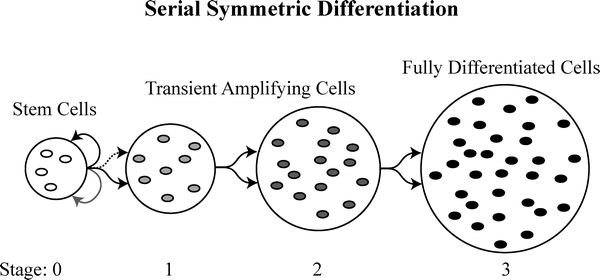
Natural selection can occur at the cellular level, where it is detrimental to health. Fortunately it is normally controlled by a well-known pattern of ongoing cell differentiation in the mature tissues of animals, according to a new study published December 14 in PLoS Computational Biology.

The failure of normal cell differentiation patterns may explain cancer and senescent decline with aging, say researchers at the University of Arizona, the Santa Fe Institute, the University of Pennsylvania, and the Wistar Institute.

Darwinian natural selection and evolution is usually studied in populations of organisms, but it also applies to cellular populations; this is called “somatic” evolution.

It's been revealed that what Santa needs is a comfortable armchair and a fast finger to turn a 24,902 mile(a) shopping trip around the world into just 1 hour(b) spent in front of a computer, leaving Santa all rested up to do his Christmas Eve deliveries.

150 clicks are all it would take for Santa Claus to buy all the presents from across the world for a typical UK family(c). Santa need not spend £3370 on sleigh fares(d) nor travel 56 hours(e) on his famous sleigh to purchase the presents either, as he would in years past.

Another FDA-approved targeted cancer drug, sunitinib (SutentTM, Pfizer), may be associated with cardiac toxicity, report researchers at Children’s Hospital Boston, Dana-Farber Cancer Institute (Boston), and Thomas Jefferson University (Philadelphia).

Their collaborative study, led by Ming Hui Chen, MD, MMSc, a cardiologist at Children’s who specializes in the cardiac health of cancer patients, appears in the December 15 issue of The Lancet, accompanied by an editorial.

Sunitinib is one of several new “smart” cancer drugs called tyrosine kinase inhibitors that targets specific signaling molecules inside cancer cells that aid cancer spread.

Single-cell organisms were already in existence 500 million years ago, with several thousand genes providing different cellular functions. Further developments seemed dependent on producing even more genes.

If so, a highly developed organism like a human should have resulted in several million genes yet the publication of the human genome showed us that a human only has around 25,000 genes – not many more than a fruit fly or a worm with approximately 15,000 to 20,000 genes.

It would appear that, over the last 500 million years, other ways to produce highly complex organisms have evolved. Evolution has simply found more efficient ways to use the genes already there.

But what could have made this possible?

A team led by a Cardiff University archaeologist has reconstructed a 3,000-year-old glass furnace, showing that Ancient Egyptian glassmaking methods were much more advanced than previously thought.

Dr Paul Nicholson, of the University’s School of History and Archaeology, is leader of an Egypt Exploration Society team working on the earliest fully excavated glassmaking site in the world. The site, at Amarna, on the banks of the Nile, dates back to the reign of Akhanaten (1352 - 1336 B.C.), just a few years before the rule of Tutankhamun.

It was previously thought that the Ancient Egyptians may have imported their glass from the Near East at around this time.

New observations by NASA's Cassini spacecraft indicate the rings of Saturn, once thought to have formed during the age of the dinosaurs, instead may have been created roughly 4.5 billion years ago when the solar system was still under construction.

Professor Larry Esposito, principal investigator for Cassini's Ultraviolet Imaging Spectrograph at CU-Boulder, said data from NASA's Voyager spacecraft in the 1970s and later NASA's Hubble Space Telescope had led scientists to believe Saturn's rings were relatively youthful and likely created by a comet that shattered a large moon, perhaps 100 million years ago.

When humans began to migrate out of Africa about 100,000 years ago, their skin color gradually changed to adapt to their new environments. And when the last Ice Age ended about 10,000 years ago, marine ancestors of ocean-dwelling stickleback fish experienced dramatic changes in skin coloring as they colonized newly formed lakes and streams.

New research shows that despite the vast evolutionary gulf between humans and the three-spined stickleback fish, the two species have adopted a common genetic strategy to acquire the skin pigmentation that would help each species thrive in their new environments.

Researchers at the University of Massachusetts Medical School, gained new insights into autophagy -- a cellular degradation process associated with a form of programmed cell death -- by studying the salivary gland cells of the fruit fly.

Since its initial discovery in the 1960s, programmed cell death has been a primary focus of studies for investigators across a wide array of scientific disciplines.

An essential mechanism in development and homeostasis, programmed cell death allows for the clean intracellular destruction of unnecessary or damaged cells. While apoptosis is the most understood type of programmed cell death, recently scientists have begun to take a closer look at autophagy— a highly regulated, catabolic process that essentially allows a cell to eat itself.

