Like that your child's modern baby seat can't erupt in flame? Thank the Roman military of almost 2,000 years ago. Like heating up your recyclable pouch of avocado toast points in the microwave? Thank the American military of World War II,(1) when Raytheon engineer Percy Spencer discovered their culinary benefit while working on RADAR.(2)
This is running as a scary story in the news today. I’m asked if it means we are all going to die. No, it does not. That was a 10 °C rise and we are headed towards 3.6 °C at maximum with the Paris pledges already. With the Paris agreement if they continue to ramp up the pledges they should get within 2 °C, many countries have already got to that point in their pledges and a fair number to within 1.5 °C. Others, especially China and Russia, face huge challenges but are rising to them especially China. We aren’t currently headed for anything like 10 °C.
Short
summary - the risk from larger asteroids of 1 km upwards, large enough
to have some global effects is more or less retired as a result of
astronomical searches for the last few decades. There is still a risk
from smaller asteroids, but in most cases we’d be able to deflect them
if necessary, or evacuate the area. The chance of dying from an
asteroid is tiny, far less than the risk of dying of lighning.
20 - 40 METER ASTEROIDS ARE TINY - JUST
LARGE ENOUGH TO GET THROUGH THE EARTH’S ATMOSPHERE
An
asteroid 20 meters in diameter hits every 80 years or so. Since only 1%
of the Earth is urban that means around 8,000 years between impacts on
an urban area.
The Guardian, official newspaper of those in the anti-science left who still like to pretend they love science, knows what pays the bills...and it ain't science.
Yes, some real scientists write there, because it's mainstream media and scientists who do outreach want to be in as many publications as they can, but for the most part Guardian editors distrust science, because their audience does. And they love celebrities, for the same reason.
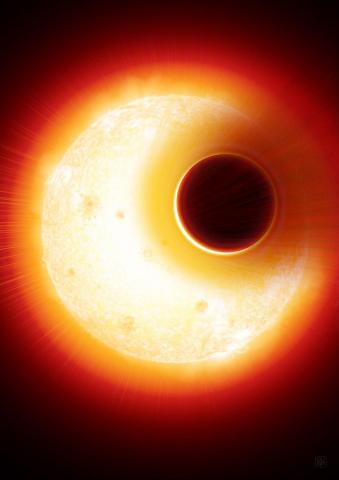
A distant planet has an abundance of helium in its atmosphere so great that it has swollen to resemble an inflated balloon.
The helium of HAT-P-11b, 124 light years from Earth and in the Cygnus constellation, is blown away from the day side of the planet to its night side at over 10,000 km an hour. Because it is such a light gas, it escapes easily from the attraction of the planet and forms an extended cloud all around it.
A new sewage treatment project in London discovered something in the mud of the Thames; the remains of a human, leg bones still covered by thigh-high leather boots.
When you say thigh-high leather boots it sounds much sexier than fishing waders, which are not made of leather any more because, let's face it, leather is useless in water and science improved fishing a lot. Archaeologists analyzing the remains say the grooves in his teeth were likely caused by rope, and that, plus his build, suggests his trade was fisherman. He was in his mid-30s, they estimate, so his death was not natural.
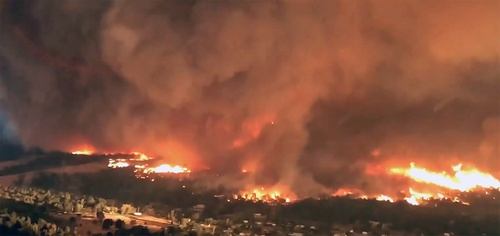
The Carr Fire in Shasta and Trinity Counties began July 23rd, 2018 after a tire blew out on a trailer and the rim made sparks on the pavement. setting dry vegetation in an area historically dry ablaze.
That's simple bad luck but it caused 359 square miles to burn, estimated to be the seventh largest fire in recorded California history. By the end of August it was contained but not before it led to eight fatalities and destroyed 1,079 residences.
In 2006, former Vice-President and global warming clarion Al Gore said we only had 10 years to stop CO2 emissions or it would be too late. More cynical people noted that he came up with that 10-year figure because it was two years from his rematch contest for U.S. President plus eight he expected to be in office. It's beyond me to know if that was ever his intent, but if it was, perhaps a Peace Prize and an Academy Award made political campaigning too petty. He never ran again.
Infertility affects about 10 percent of couples and among them are one in 500 women with congenital defects in their uterus or a medical issue that caused damage. In the past, that meant adoption but recently uterus transplants became possible.
In 2013, Sweden performed the first and since then there have been 39, resulting in 11 live births.
But those were living donors, and that is going to be rare because uterus donation is only available for women with friends or family members who will donate.
In Science Left Behind I showed that in America it was easy to accurately correlate beliefs about science to political viewpoints. If you believed in psychics, witchcraft, organic food or homeopathy, statistically I could be determine how you voted. If you believed in GMOs and vaccines I also knew how you voted.
But everyone hates the word "chemical."
That is why it is fertile ground for scaremongering. As soon as you use the word chemical, people are scared, and if you throw the word "toxic" in front of it, like activist academics and $2 billion per year in environmental groups do, dollar signs are sure to follow.