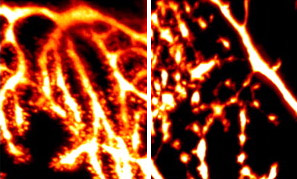





There are lots of things that brain cells need to survive. Add to that list microRNAs. New research from Rockefeller University shows that neurons that cannot produce microRNAs, tiny single strands of RNA that regulate the expression of genes, slowly die in a manner similar to what is seen in such human neurodegenerative disorders as Alzheimer’s and Parkinson’s diseases.

To many people, the scent of jasmine flowers suggests a romantic interlude in an exotic locale. But jasmonate, the main component of the lush scent, carries far different meanings for plants. It is a hormone they use to regulate reproductive development, immunity to pathogens, defense against insect herbivores and other critical aspects of their biology.

Despite jasmonate’s importance in plant development and function, the chemical steps that convert the hormonal signal into genetic and cellular action have remained elusive. Now researchers at Washington State University and Michigan State University have identified the family of proteins that allow a plant to perceive and respond to the hormone. They have also proposed a model for how the proteins, dubbed JAZ proteins, work.

Finding a decent, honest mate is challenging enough without the added problem of reduced visibility caused by human-induced changes to the aquatic environment.

Yet this is precisely the sort of dilemma female stickleback fish are facing in the Baltic Sea, according to a recent study published in the August issue of the American Naturalist by Dr. Bob Wong, an Australian researcher from Monash University, and his Scandinavian colleagues, Dr. Ulrika Candolin from the University of Uppsala and Dr. Kai Linstrom from the Åbo Akademi in Finland.

A team of scientists from the Institute of Human Genetics of the GSF Research Center, the Technical University of Munich and the Max Planck Institute for Psychiatry have now identified risk factors which are involved in the development of Restless Leg Syndrome.

The patients suffer from an urge to move and paresthesia in the legs in the evening and during the night which can only be relieved by moving or walking around. The consequence may be severe sleeping disorders and chronic sleep loss. The frequency of RLS increases with age: up to ten per cent of over 65 year olds are affected, albeit in very different forms though hildren can also contract the disease.

The cause of RLS has so far been completely unknown.

Fossils discovered in the oft-painted arroyos of northern New Mexico show for the first time that dinosaurs and their non-dinosaur ancestors lived side by side for tens of millions of years, disproving the notion that dinosaurs rapidly replaced their supposedly outmoded predecessors.

The fossils were excavated from the Hayden Quarry at Ghost Ranch, an area made famous through the paintings of Georgia O'Keefe, by a team of paleontologists from the University of California, Berkeley, the American Museum of Natural History and The Field Museum. The finds, including fossil bones of a new dinosaur predecessor the researchers have named Dromomeron romeri, are described in a cover story in the July 20 issue of Science.

MIT researchers have identified a critical link between two proteins found in brain tumors, a discovery that could eventually help treat a form of brain cancer that kills 99 percent of patients.

Glioblastoma multiforme (GBM), the most aggressive brain tumor in adults, strikes about 15,000 people in the United States each year. GBM is currently treated with a combination of surgery, radiation and chemotherapy, but those treatments have proven ineffective.

The synthesis of short protein chains (polypeptides) begins with the production of their components, the amino acids.

A group of Chinese researchers report a new method that is similar to olefin polymerization, which is used for the mass production of plastics such as polyethylene. The advantage of this reaction is that it uses inexpensive starting materials and would be ideal for industrial production.

Whether in the body or the factory, the backbone of polypeptide chains is usually formed by the linking of an amino group with the acid group of individual amino acids. Like pearls on a string, the amino acids then line up.

Between 2 to18 percent of American children are thought to be affected by ADHD, and Ritalin, a stimulant similar to amphetamine and cocaine, remains one of the most prescribed drugs for the behavioral disorder.

A new study says Ritalin use by young children may cause long-term changes in the developing brain. The study is among the first to probe the effects of Ritalin (methylphenidate) on the neurochemistry of the developing brain.

"The changes we saw in the brains of treated rats occurred in areas strongly linked to higher executive functioning, addiction and appetite, social relationships and stress. These alterations gradually disappeared over time once the rats no longer received the drug," notes the study's senior author Dr.

A NASA researcher has developed a new method to anticipate food shortages brought on by drought. Molly Brown of NASA’s Goddard Space Flight Center in Greenbelt, Md., and her colleagues created a model using data from satellite remote sensing of crop growth and food prices.

Brown conceived the idea while working with organizations in Niger, West Africa, that provide information regarding failed crops and help address local farmers' worries about feeding their families. Brown's new approach could improve the ability for government and humanitarian aid officials to plan and respond to drought-induced food price increases in Niger and elsewhere.

Our experiences –the things we see, hear, or do—can trigger long-term changes in the strength of the connections between nerve cells in our brain, and these persistent changes are how the brain encodes information as memory. Johns Hopkins researchers have discovered a new biochemical mechanism for memory storage, one that may have a connection with addictive behavior.

Previously, the long-term changes in connection were thought to only involve a fast form of electrical signaling in the brain, electrical blips lasting about one-hundredth of a second. Now, neuroscience professor David Linden, Ph.D., and his colleagues have shown another, much slower form of electrical signaling lasting about a second can also be persistently changed by experience.


