Do you like Thomas Pynchon, but are you stumped by the crazy turn-of-the-century science in his latest novel, Against The Day? You're not alone! I've put together a little guide for the perplexed, a three-part primer on special relativity, vector analysis and quaternions, and Riemann surfaces, just for Pynchon readers.
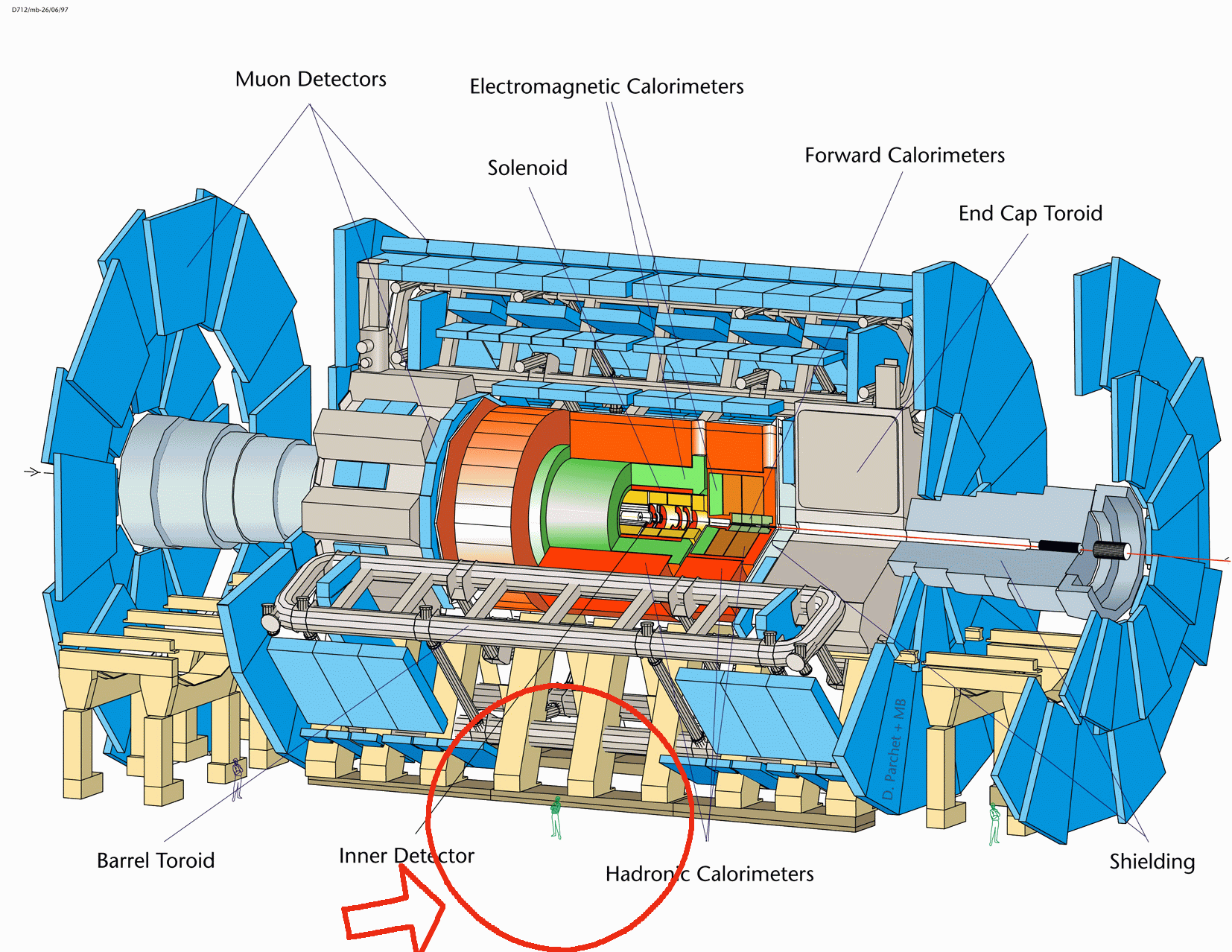


Today the ATLAS collaboration at CERN celebrates the lowering of its last large detector element. The ATLAS detector is the world’s largest general-purpose particle detector, measuring 46 metres long, 25 metres high and 25 metres wide; it weighs 7000 tonnes and consists of 100 million sensors that measure particles produced in proton-proton collisions in CERN’s Large Hadron Collider(LHC).

The first piece of ATLAS was installed in 2003 and since then many detector elements have journeyed down the 100 metre shaft into the ATLAS underground cavern. This last piece completes this gigantic puzzle.

“This is an exciting day for us,” said Marzio Nessi, ATLAS technical coordinator.

LONDON, February 29 /PRNewswire/ -- Europe's Largest XML Publishing and Component CMS (CCMS) Conference announces leading XML solutions provider JustSystems will be Gold Sponsor of X-Pubs 2008 and provide attendee reception and Sunday Content Workshop - June 22-24 London, UK

Naval warships are all-powerful vessels but they are also easy to spot.

Concerns about being detected have led the military to develop new stealth technologies that allow ships to be virtually invisible to the human eye, to dodge roaming radars, put heat-seeking missiles off the scent, disguise their own sound vibrations and even reduce the way they distort the Earth’s magnetic field, as senior lecture in remote sensing and sensors technology at Britannia Royal Navy College, Chris Lavers, explains in March’s Physics World.

Wars throughout the twentieth century prompted advances in stealth technologies. Some of the earliest but most significant strides towards invisibility involved covering ships with flamboyant cubist patterns – a technique known as “dazzle painting”.

Windmills and desalination installations are already commercially available. The windmills produce electricity from wind power, the electricity is stored and subsequently used to drive the high-pressure pump for the reverse osmosis installation.

It's not very efficient. The storage of electricity is expensive and energy is also lost during conversion. But Delft University of Technology (TU Delft) thinks the traditional windmill driving a pump directly can be more efficient and cheaper.

In the TU Delft installation, the high-pressure pump is driven directly by wind power. Water storage can be used to overcome calm periods. Plus, storing water is cheaper than storing electricity.

Museum archaeologists, conservation scientists, archivists and university researchers gathered at a one-day workshop at the Science and Technology Facilities Council (STFC) Daresbury Laboratory to discuss preservation of art and artefacts as well as immovable objects such as buildings and ships.

From how STFC is currently using its world leading light source facilities to help preserve the historic timbers of the Mary Rose, to why a bronze-age wooden shovel has survived so perfectly for over 4000 years in unfavourable soil conditions - delegates took part in discussions with STFC scientists involved to discover how cutting edge techniques can take heritage research into new and productive directions.

For countries without their own environmental monitoring systems, the Environmental Performance Index (EPI) can be useful for working out where there is a need for action in environmental policy making, but otherwise there are already better ways of getting results, says the conclusions of a study conducted by the Helmholtz Centre for Environmental Research (UFZ).

According to the study authors, Germany, for example, already has more accurate and appropriate instruments than the 2008 EPI – such as the European Environment Agency´s State of the Environment Report and the Federal Environmental Agency´s Umweltbarometer.

One difficulty is the legitimacy of the targets set for each indicator. The EPI employs a distance-to-target method which requires explicit target values, against which the countries are measured. According to the EPI 2008 report, only 5 out of 25 target values have been set in international agreements or guidelines, all others represent expert judgement taken from scientific literature. Augustin Berghöfer, one of the analysts at the UFZ says, "the EPI lacks crucial legitimacy as an instrument for benchmarking. Why should governments measure themselves against target values which they may not even have heard of so far?"

Charles Darwin maintained that the domesticated chicken derives from the red jungle fowl, but new research from Uppsala University now shows that the wild origins of the chicken are more complicated than that.

The researchers mapped the genes that give most domesticated chickens yellow legs and found to their surprise that this genetic heredity derives from a closely related species, the grey jungle fowl.

“Our studies show that even though most of the genes in domesticated fowls come from the red jungle fowl, at least one other species must have contributed, specifically the grey jungle fowl,” says Jonas Eriksson, a doctoral student at Uppsala University.

Many areas of research and medicine rely critically upon knowing a person’s individual immune system proteins, as they determine an individual’s ability to fight disease or mistakenly attack their own tissues. However, obtaining this information is costly and difficult.

In a new study, Listgarten et al demonstrated how statistical modeling can help researchers obtain this information more easily and cost effectively.

SAN MATEO, California, February 29 /PRNewswire/ --

NetSuite Inc. (NYSE: N), a leading vendor of on-demand, integrated business software suites that include Accounting / Enterprise Resource Planning (ERP) software, Customer Relationship Management (CRM) software and Ecommerce software for small and midsized businesses and divisions of large companies, today announced that its 2008 Annual Meeting of Stockholders has been scheduled for Thursday, May 29, 2008. The record date for determining eligibility to vote at the 2008 Annual Meeting will be March 31, 2008.

(Logo: http://www.newscom.com/cgi-bin/prnh/20021024/SFTH024LOGO)

About NetSuite