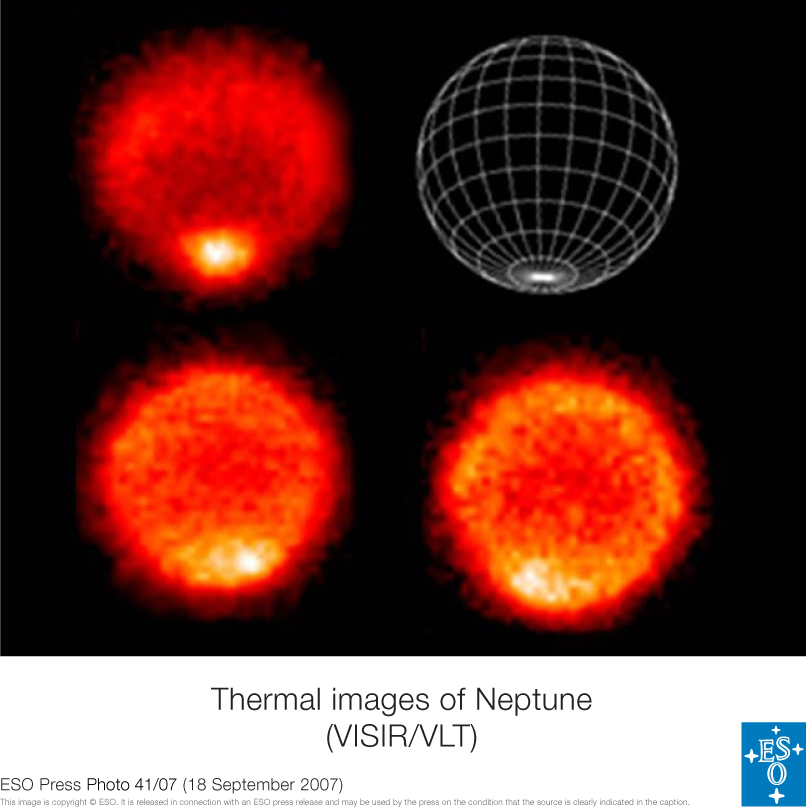



An international team of astronomers using ESO's Very Large Telescope has discovered that the south pole of Neptune is much hotter than the rest of the planet. This is consistent with the fact that it is late southern summer and this region has been in sunlight for about 40 years.

The scientists are publishing the first temperature maps of the lowest portion of Neptune's atmosphere, showing that this warm south pole is providing an avenue for methane to escape out of the deep atmosphere.

"The temperatures are so high that methane gas, which should be frozen out in the upper part of Neptune's atmosphere (the stratosphere), can leak out through this region," said Glenn Orton, lead author of the paper reporting the results.

Everyone knows that how you say something can be as important as what you say. "Framing" is the science buzzword for 2007 and, as discussed in Do scientists need to 'frame' the debate for non-scientists? framing can be used for good or evil.

Both sides of the global warming debate accuse each other of framing and even some science sites persistently use framing to advance whatever agenda they are promoting. This has led to a great deal of discussion and research.

It's been recognized that most scientists are quite ethical in their research but discussions with non-experts is more of a grey area.

The Georgia Institute of Technology and Emory University have received a $1.5 million grant from the National Science Foundation to establish "The Origins Project," a center for integrated research, education and public outreach focused on the chemistry that may have led to the origin of life.

Scientists at the Weizmann Institute of Science and the University of California at Berkeley have now discovered that knowing the molecular structure of a substance can help predict whether we will find its smell pleasant or distasteful.

In sight and hearing our perceptions are determined by the physical properties of waves – the length of light waves in sight, and the frequency of sound waves in hearing - yet there was no known physical factor that could explain how our brains sense odors. The new study, conducted by Prof. Noam Sobel and his colleagues, represents a first step in understanding the physical laws that underlie our perception of smell.

For orthopaedic implants to be successful, bone must meld to the metal that these artificial hips, knees and shoulders are made of. A team of Brown University engineers, led by Thomas Webster, has discovered a new material that could significantly increase this success rate.

The team took titanium – the most popular implant material around – and chemically treated it and applied an electrical current to it. This process, called anodization, creates a pitted coating in the surface of the titanium. Webster and his team packed those pits with a cobalt catalyst and then ran the samples through a chemical process that involved heating them to a scorching 700° C.

Nearly 2 million children, or approximately 3 percent to 5 percent of young children in the United States, are considered to have ADHD. This disorder affects a child’s ability to focus, concentrate and control impulsive behavior. This disorder is so common that most school classrooms have at least one child with clinically-diagnosed ADHD.

In an 18-year-study on attention-deficit hyperactivity disorder (ADHD), Mayo Clinic researchers found that treatment with prescription stimulants is associated with improved long-term academic success of children with ADHD. The Mayo Clinic results are the first population-based data to show stimulant drug therapy helps improve long-term school outcomes.

A paper published this week in the open access journal PLoS Medicine provides strong evidence that one specific part of the genome is associated with rheumatoid arthritis.

Rene Toes and colleagues from Leiden University Medical Center, the Karolinska Institute, and Celera studied four groups of patients and matched controls. They found a consistent association with one specific region of the genome -- a region on chromosome 9 that includes the two genes, complement component 5 (C5) of the complement system (a primitive system within the body that is involved in the defense against foreign molecules) and a gene involved in the inflammatory response, TNF receptor-associated factor 1(TRAF1).

A team led by biophysicist Jeremy Smith of the University of Tennessee and Oak Ridge National Laboratory (ORNL) has taken a significant step toward unraveling the mystery of how proteins fold into unique, three-dimensional shapes.

Using ORNL's Cray XT4 Jaguar supercomputer as well as computer systems in Italy and Germany, the team revealed a driving force behind protein folding involving the way its constituents interact with water. The team's results are being published in this week's edition of the Proceedings of the National Academy of Sciences.

Proteins are the workhorses of the body, taking on a wide variety of tasks. They fight infections, turn food into energy, copy DNA and catalyze chemical reactions. Insulin is a protein, as are antibodies and many hormones.

Whether a smoking-cessation drug will enable you to quit smoking may depend on your genes, according to new genotyping research from the Centre for Addiction and Mental Health (CAMH). The study, published in the September issue of the journal Biological Psychiatry, found that the enzyme known to metabolize both the smoking cessation drug bupropion and nicotine is highly genetically variable in all ethnicities and influences smoking cessation.

For two generations of physicists, it has been a standard belief that the neutron, an electrically neutral elementary particle and a primary component of an atom, actually carries a positive charge at its center and an offsetting negative charge at its outer edge.

The notion was first put forth in 1947 by Enrico Fermi, a Nobel laureate noted for his role in developing the first nuclear reactor. But new research by a University of Washington physicist shows the neutron's charge is not quite as simple as Fermi believed.

Using precise data recently gathered at three different laboratories and some new theoretical tools, Gerald A.

