




Haptics means “of or relating to the sense of touch”. Haptics Technolofy refers to the technology that connects the user to a computerized system via the sense of touch by applying forces, vibrations and/or motions to the user.

Perhaps people do not realize it, but haptic technology is already in our lives. Vibrating phones, gaming controllers and force-feedback control knobs in cars, like BMW’s iDrive, are examples of this technology. These days, you can turn your phone ring tone off, put it in your purse and still feel that someone is calling you when you get a vibration. On the other hand, the Nintendo Wii video game console has been a new revolution for game lovers. The controller, called Wii, provides vibrations (i.e.

Scientists at the Alaska Stable Isotope Facility can tell you whether marijuana came from Mexico or the Matanuska Valley. Soon they'll even be able to tell you whether it was grown indoors or out.

A few more years and enough samples and they hope to have something even more precise: an elemental fingerprint that could tell police where and under what conditions a sample of marijuana was grown.

"There are scientists already doing this for drugs like heroin and cocaine," said Matthew Wooller, Alaska Stable Isotope Facility director. "The potential is there for being able to do this for marijuana as well."

Human resistance to a retrovirus that infected chimpanzees and other nonhuman primates 4 million years ago ironically may be at least partially responsible for the susceptibility of humans to HIV infection today.

These findings, reported by a team of researchers at Fred Hutchinson Cancer Research Center in the June 22 issue of Science, provide a better understanding of this modern pandemic infection through the study of an ancient virus called Pan troglodytes endogenous retrovirus, or PtERV1.

"This ancient virus is a battle that humans have already won. Humans are not susceptible to it and have probably been resistant throughout millennia," said senior author Michael Emerman, Ph.D., a member of the Human Biology and Basic Sciences divisions at the Hutchinson Center.

Using mathematical theory, UC Irvine scientists have shed light on one of cancer’s most troubling puzzles -- how cancer cells can alter their own genetic makeup to accelerate tumor growth. The discovery shows for the first time why this change occurs, providing insight into how cancerous tumors thrive and a potential foundation for future cancer treatments.

UCI mathematicians Natalia Komarova, Alexander Sadovsky and Frederic Wan looked at cancer from the point of view of a tumor and asked: What can a tumor do to optimize its own growth" They focused on the phenomenon of genetic instability, a common feature of cancer in which cells mutate at an abnormally fast rate.

The extinction of many large mammals at the end of the Ice Age may have packed an even bigger punch than scientists have realized. To the list of victims such as woolly mammoths and saber-toothed cats, a Smithsonian-led team of scientists has added one more: a highly carnivorous form of wolf that lived in Alaska, north of the ice sheets.

Wolves were generally thought to have survived the end-Pleistocene extinction relatively unscathed. But this previously unrecognized type of wolf appears to have vanished without a trace some 12,000 years ago.

The study combined genetic and chemical analyses with more conventional paleontological study of the morphology, or form, of the fossilized skeletal remains.

By making careful observations of the growth of a layer of molecules as they gradually cover the surface of a small silicon rectangle, researchers from the National Institute of Standards and Technology (NIST) and North Carolina State University (NCSU) have gained basic insights into how self-propagating self-assembly wave fronts develop and have produced the first experimental verification of recently improved theoretical models of such systems.

There's a war that's brewing and you may not be aware of it. It's right under our noses but it has been kept out of the mainstream media due to a growing web of deniers and obfuscaters who regard misinformation and doubt as allies. Like many insurrections it has been funded quietly but it's effects can be devastating to people in the war zones, like the line that stretches out the door at Tully's.

That war, my friends, is the War On Coffee.

Coffee is good. Coffee is good for you. Science has proved this on numerous occasions yet time and again I see sources in the mainstream media trying to establish doubt about the total awesomeness of coffee.

In the first trial of its kind in the world, 60 patients who have recently suffered a major heart attack will be injected with selected stem cells from their own bone marrow during routine coronary bypass surgery.

The Bristol trial will test whether the stem cells will repair heart muscle cells damaged by the heart attack, by preventing late scar formation and hence impaired heart contraction.

Dr Raimondo Ascione from the University of Bristol and colleagues at the Bristol Heart Institute (BHI) have been awarded a grant of £210,000 from the British Heart Foundation (BHF) to conduct the clinical trial.

Satellite tracking software freely available on the Internet and a smattering of textbook physics could be used by any organisation that can get hold of an intermediate range rocket to mount an unsophisticated attack on military or civilian satellites. Such an attack would require modest engineering capability and only a limited budget.

A terrorist organisation or rogue state could threaten essential satellite systems, say Adrian Gheorghe of Old Dominion University Norfolk, in Virginia, USA and Dan Vamanu of "Horia Hulubei" National Institute of Physics and Nuclear Engineering, in Bucharest, Romania. Military satellites, global positioning systems, weather satellites and even satellite TV systems could all become victims of such a simple attack.

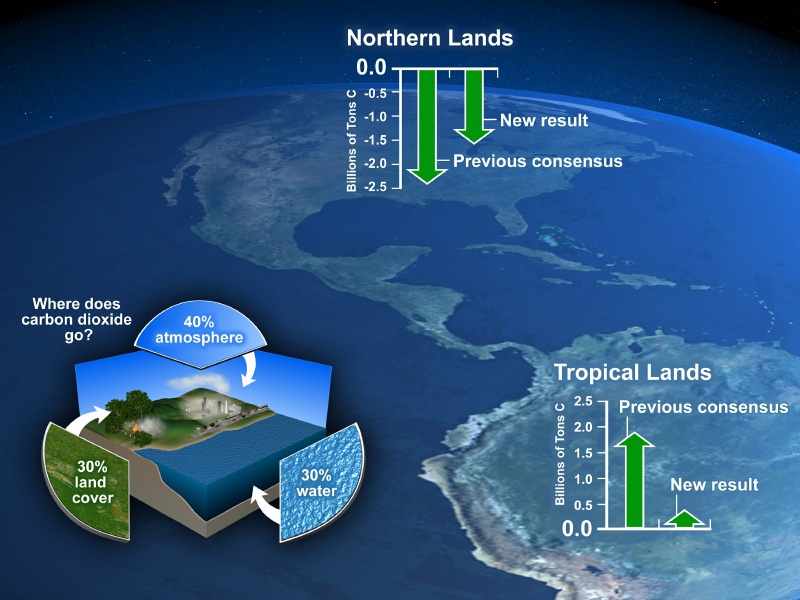
Forests in the United States and other northern mid- and upper-latitude regions are playing a smaller role in offsetting global warming than previously thought, according to a new study.

The study, which sheds light on the so-called missing carbon sink, concludes that intact tropical forests are removing an unexpectedly high proportion of carbon dioxide from the atmosphere, thereby partially offsetting carbon entering the air through industrial emissions and deforestation.

"This research fills in another piece of the complex puzzle on how the Earth system functions," said Cliff Jacobs of NSF's Division of Atmospheric Sciences.
