




Analyzing 30 years of data detailing a large rabies virus outbreak among North American raccoons, researchers at Emory University have revealed how initial demographic, ecological and genetic processes simultaneously shaped the virus's geographic spread over time. The study appears online in the Proceedings of The National Academy of Sciences.

"Our study demonstrates the combined evolutionary and population dynamic processes characterizing the spread of a pathogen after its introduction into a susceptible host population," says Leslie Real, PhD, Emory University Asa G. Candler professor of biology.

Illinois State University’s Board of Trustees today approved a new bachelor’s degree in renewable energy, which will include a technical sequence and an economics and public policy sequence.

The degree is a multi-disciplinary undergraduate major that provides a broad overview of renewable energy industries. Renewable energy is a fast-growing industry that will call for many new workers in the future.

About two months ago I was in Steamboat Springs, Colorado, attending the Keystone Symposium on Systems Biology and Regulatory Networks. I went hoping to hear about forward-looking research that deals with some of the most fundamental outstanding questions in biology - fundamental in the sense of being relevant not just to a particular cell type or organism, but to most cells, developmental systems, or biological systems in general.

Two astrophysicists at NASA’s Goddard Space Flight Center in Greenbelt, Md., Nikolai Shaposhnikov and Lev Titarchuk, have successfully tested a new method for determining the masses of black holes.

This elegant technique, which Titarchuk first suggested in 1998, shows that the black hole in a binary system known as Cygnus X-1 contains 8.7 times the mass of our sun, with a margin of error of only 0.8 solar mass.


CLICK IMAGE FOR LARGER VERSION.

Researchers at Rensselaer Polytechnic Institute have developed a new method to bond materials that don’t normally stick together. The team’s adhesive, which is based on self-assembling nanoscale chains, could impact everything from next-generation computer chip manufacturing to energy production.

Less than a nanometer – or one billionth of a meter – thick, the nanoglue is inexpensive to make and can withstand temperatures far higher than what was previously envisioned. In fact, the adhesive’s molecular bonds strengthen when exposed to heat.

The increase in the number of diagnosed cases of autism in recent years has sparked concern that environmental toxins may cause this complex disorder. A new study found, however, that exposure to Rh immune globulin preserved with mercury-containing thimerosal before birth was no higher for children with autism. The study was led by Judith Miles at the University of Missouri-Columbia.

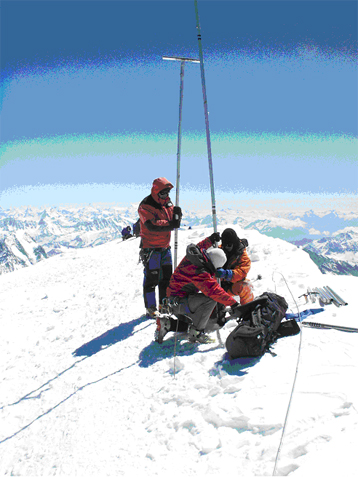
The small ice caps of Mont Blanc and the Dôme du Goûter are not melting, or at least, not yet. This is what CNRS researchers have announced in the Journal of Geophysical Research. At very high altitudes (above 4200 meters), the accumulation of snow and ice has varied very little since the beginning of the 20th century. But if summer temperatures increase by a few degrees during the 21st century, the melt could become more marked, and could affect the "permanent" ice fields.


Figure 1 – Researchers from the Glaciology Laboratory taking an ice core sample on top of Mont Blanc, in 2005. © C. Vincent, CNRS 2007.

When it comes to growing cells in a lab, technique matters. A new Brown University study shows that nerve cells grown in three-dimensional cultures use 1,766 genes differently compared to nerve cells grown in standard two-dimensional petri dishes.

The study, published in the May issue of Tissue Engineering, adds to a growing body of research showing that culture techniques can significantly affect cell growth and function.

The origin and movement of waves reaching up to 11 metres that devastated France's Reunion Island in the Indian Ocean on Saturday evening have been detected with ESA's Envisat satellite.

The waves that thrashed the southern port of Saint Pierre, leaving two fishermen missing, causing several piers to collapse and flooding several homes and businesses, originated south of Cape Town, South Africa, and travelled northeast for nearly 4000 km over a period of three days before slamming into Reunion Island.

If you have Mom's smile, Dad's eyes and Grandpa's laugh, you might wonder what other traits you picked up from the genealogic fabric of the ol' family tree.

Scientists at the Texas A&M University System Agricultural Research and Extension at Lubbock are studying the family tree of cotton for much the same reason.


Mark Arnold, Experiment Station research associate, looks for thrips damage on young cotton plants. Identifying resistant and non-resistant cotton lines (top right) will help breeders develop varieties that can withstand thrips feeding damage to the first four true seedling leaves. Credit: Texas Cooperative Extension photos by Tim W. McAlavy

