




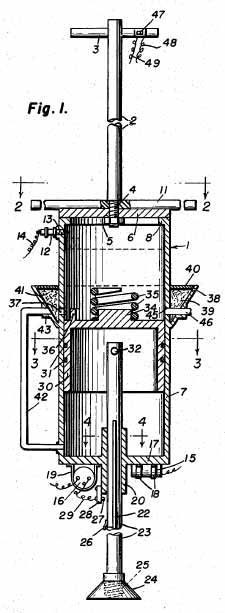
 It seems that the first US patent for an internal-combustion powered ‘Pogo’ stick was issued to inventor R.J. Mays
back in 1950. The jumping machine was intended to run on gasoline, and,
according its creator was “…highly efficient and amusing in operation.”
It’s not altogether clear whether May’s power-stick ever went into
production, but a similar(ish) device,
which was granted a US patent ten years later, did. According its
inventor Mr. G. Spitzmesser, the stick – known commercially as ‘The Hop
Rod’ was “…extremely safe and harmless and of tremendous entertainment
value.” Edwin Spitzmesser, son of the late inventor, gives details of
its R&D here (courtesy: bpmlegal.com )
It seems that the first US patent for an internal-combustion powered ‘Pogo’ stick was issued to inventor R.J. Mays
back in 1950. The jumping machine was intended to run on gasoline, and,
according its creator was “…highly efficient and amusing in operation.”
It’s not altogether clear whether May’s power-stick ever went into
production, but a similar(ish) device,
which was granted a US patent ten years later, did. According its
inventor Mr. G. Spitzmesser, the stick – known commercially as ‘The Hop
Rod’ was “…extremely safe and harmless and of tremendous entertainment
value.” Edwin Spitzmesser, son of the late inventor, gives details of
its R&D here (courtesy: bpmlegal.com )
“I would test it each time he tinkered with it. It ran on butane, but really jumped high when we once used a mixture of acetylene and oxygen! He used a model ‘A’ Ford spark coil which delivered quite a few volts to the unprotected spark plug – as I once found out when my zipper came in contact with it briefly. I haven’t had a thrill like that since!”
Sadly, the high-jumping ‘Hop Rod’ was eventually withdrawn from commercial production due to safety concerns.
Nonetheless, despite possible doubts regarding safety issues, research
and development of other alternatives for powered-pogo-sticks has not
stopped – work has progressed at at least three universities.
University of California, Berkeley, US – The Pogomatic
“A pneumatic cylinder was chosen as the actuator for the pogo stick. There has been much research on electric linear actuators and jumping machines,”
Carnegie Mellon University, US – The Bowgo
“…a new kind of pogo stick that bounces higher, farther and more efficiently than conventional devices.”
Université de Sherbrooke, Canada – PSEUS project (Pogo-Stick Extreme of the University of Sherbrooke)
“…we have built a powerful device which allow [sic] us to archive [sic] the initial idea: a higher leap of around 8 ft of [sic] the ground.”



Comments