Banner
Here's Where Your Backyard Was 300 Million Years Ago

We may use terms like "grounded" and terra firma to mean stability and consistency but geology...

Convergent Evolution Cheat Sheet Now 120 Million Years Old

One tenet of natural selection is a random walk of genes but nature may be more predictable than...

Synchrotron Could Shed Light On Exotic Dark Photons

There are many hypothetical particles proposed to explain dark matter and one idea to explore how...

The Pain Scale Is Broken But This May Fix It

Chronic pain is reported by over 20 percent of the global population but there is no scientific...

User picture.
News StaffRSS Feed of this column.

News Releases From All Over The World, Right To You... Read More »

Blogroll
Salt-loving, halophilic, microbes could donate proteins to clean up radioactive strontium and caesium ions from the Fukushima Dai-ichi Nuclear Power Plant incident in Japan.

The X-ray structure of a beta-lactamase enzyme from one such microbe, the halophile Chromohalobacter sp. 560, shows it has highly selective cesium binding sites.  A 1.8 to 2.9 angstrom resolution structure for this enzyme. Anomalous X-ray diffraction also revealed binding sites in the protein for Sr2+ and Cs+ ions, the team reports.

Baby it’s warm inside … we have 200 microbes for every human cell. Agricultural Research Service

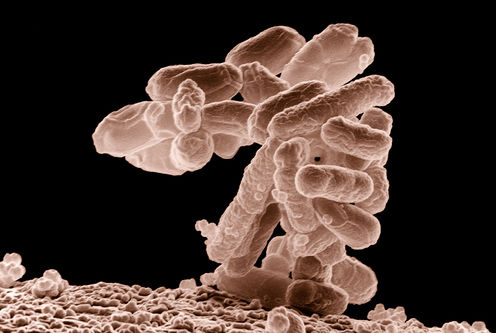
We are all populated by microbes – helpful or otherwise – which form a community known as a microbiome. Recent research by Ryan Newton and co-workers has shown that sewage-based analysis of the human microbiome can be used to diagnose health issues at a population level.

Statins are associated with increased risk for diabetes, though it is unclear why. One hypothesis is that statins increase expression of LDL receptors and increase cholesterol uptake into cells including the pancreas, which could cause pancreatic dysfunction. Familial hypercholesterolemia causes decreased LDL transport into cells and researchers have hypothesized that with familial hypercholesterolemia, decreased pancreatic LDL transport would lessen cell death and ultimately lead to lower rates of diabetes.  
 University of Southern Denmark
We may idealize the last century but natural forces have always caused climate on Earth to fluctuate - sometimes quite a bit. But science is about controlling nature and not letting random behavior control our destinies and since we know that some periods were good and some awful, we'd like to avoid the awful.

We can't control everything - the earth is still going to orbit the sun and such orbital forcing of climate change happens over thousands of years and brings ice ages and warming periods. 
mouse-tailed bat Rhinopoma microphyllum and R. Cystops hibernate at warm temperaturesMany mammals, and some birds, escape the winter by hibernating for three to nine months. This period of dormancy permits species which would otherwise perish from the cold and scarce food to survive to see another spring.

The Middle East, with temperate winters, was until recently considered an unlikely host for hibernating mammals.
 University of Southampton
Though every month we read about some new advance in artificial intelligence, how much progress is really being made?  Neuromorphic computing has created software and electronic hardware that mimic brain functions and signal protocols but, like economic models that successfully predict the past, they have only slightly improved the efficiency and adaptability of conventional technology and are not really making bold advances.