Banner
Object-Based Processing: Numbers Confuse How We Perceive Spaces

Researchers recently studied the relationship between numerical information in our vision, and...

Males Are Genetically Wired To Beg Females For Food

Bees have the reputation of being incredibly organized and spending their days making sure our...

The Scorched Cherry Twig And Other Christmas Miracles Get A Science Look

Bleeding hosts and stigmatizations are the best-known medieval miracles but less known ones, like ...

$0.50 Pantoprazole For Stomach Bleeding In ICU Patients Could Save Families Thousands Of Dollars

The inexpensive medication pantoprazole prevents potentially serious stomach bleeding in critically...

User picture.
News StaffRSS Feed of this column.

News Releases From All Over The World, Right To You... Read More »

Blogroll

Gene therapy, a field of intense research for nearly 20 years, involves inserting new genes into patients' cells to fight diseases like cancer. It holds great promise but has yet to realize its full potential, in part because of safety concerns over the conventional technique of using viruses to carry the genes - more than 1,000 gene-therapy clinical trials have been conducted and most trials use viruses as carriers, or vectors, to deliver genes.

However, there are risks associated with using viruses. To date there are no FDA-approved gene therapies. As a result, many researchers have been working on developing non-viral methods to deliver therapeutic genes.

The standard approach in biology is to focus on identifying individual genes and proteins and pinpointing their role in the cell or the human body. But molecules almost never act alone. According to Lilia Alberghina from the University of Milano-Bicocca, Italy: “There is a growing awareness in medical science that biological entities are ‘systems’ – collections of interacting parts.”

A new report by the European Science Foundation (ESF) on systems biology is an attempt to identify how research in this area could be accelerated and developed further in Europe. The report concludes with a set of specific recommendations that aims at consolidating Systems Biology efforts in Europe.

Systems biology is data driven. Will it work without the same time spent on experimental data?

Weather forecasting and climate modelling for the notoriously unpredictable Sahel region of Africa could be made easier in the future, thanks to new research results coming from the African Monsoon Multidisciplinary Analysis study (AMMA).

A paper published in Geophysical Research Letters describes how the AMMA scientists gathered new atmospheric data by using satellite imagery to plot flight paths over areas where storms had produced very wet soils. Dropsondes (weather reconnaissance devices) were launched from a research aircraft above these wet areas to record data such as humidity, wind strength and temperature. The findings allowed the scientists to compare the atmospheric conditions above wet soils with those above adjacent dry soils.

Virological evidence cannot prove transmission in HIV criminal cases, warn experts in this week’s BMJ.

Viral phylogenetics provides a way of assessing the relations between viruses from different people. It allows us to estimate the probability that viruses from two particular people have a recent common origin. But there are serious limitations on what can and cannot be inferred using this technique.

The recent flurry of criminal cases brought against people in the United Kingdom accused of infecting their sexual partner(s) with HIV has resulted in several convictions, write Professor Deenan Pillay and colleagues in an editorial.

Apes bite and try to break a tube to retrieve the food inside while children follow the experimenter's example to get inside the tube to retrieve the prize, showing that even before preschool, toddlers are more sophisticated in their social learning skills than their closest primate relatives, according to a new report.

This innate proficiency allows them to excel in both physical and social skills as they begin school and progress through life.

"We compared three species to determine which abilities and skills are distinctly human," explained Esther Herrmann of the Max Planck Institute for Evolutionary Anthropology in Leipzig, Germany and lead author of the research paper.

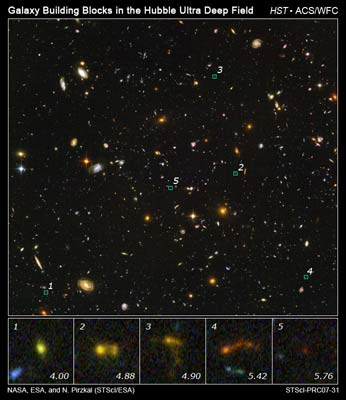
Here are nine of the smallest, faintest, most compact galaxies ever observed in the distant universe. Blazing with the brilliance of millions of stars, each of the newly discovered galaxies is a hundred to a thousand times smaller than our Milky Way Galaxy.

"These are among the lowest mass galaxies ever directly observed in the early universe," says Nor Pirzkal of the Space Telescope Science Institute and the European Space Agency in Baltimore, Md.

The conventional model for galaxy evolution predicts that small galaxies in the early universe evolved into the massive galaxies of today by coalescing.