Banner
The Scorched Cherry Twig And Other Christmas Miracles Get A Science Look

Bleeding hosts and stigmatizations are the best-known medieval miracles but less known ones, like ...

$0.50 Pantoprazole For Stomach Bleeding In ICU Patients Could Save Families Thousands Of Dollars

The inexpensive medication pantoprazole prevents potentially serious stomach bleeding in critically...

Metformin Diabetes Drug Used Off-Label Also Reduces Irregular Heartbeats

Adults with atrial fibrillation (AFib) who are not diabetic but are overweight and took the diabetes...

Your Predator: Badlands Future - Optical Camouflage, Now Made By Bacteria

In the various 'Predator' films, the alien hunter can see across various spectra while enabling...

User picture.
News StaffRSS Feed of this column.

News Releases From All Over The World, Right To You... Read More »

Blogroll

Forsyth Institute scientists have discovered an important mechanism for controlling the behavior of adult stem cells.

Research with the flatworm, planaria, found a novel role for the proteins involved in cell-to-cell communication. This work has the potential to help scientists understand the nature of the messages that control stem cell regulation ¯ such as the message that maintain and tells a stem cell to specialize and to become part of an organ e.g.: liver or skin.

In recent years, planarians have been recognized as a great model system to molecularly dissect conserved stem cell regulatory mechanisms in vivo. Planarians have powerful regeneration capability that makes them ideal for studying this process.

Stars don’t shine forever. How long a star lives depends on how big and heavy it is. The bigger the star, the shorter its life.

When a star significantly heavier than our sun runs out of fuel, it collapses and blows itself apart in a catastrophic supernova explosion. A supernova releases so much light that it can outshine a whole galaxy of stars put together. The exploding star sweeps out a huge bubble in its surroundings, fringed with actual stellar debris along with material swept up by the blast wave. This glowing, brightly-coloured shell of gas forms a nebula that astronomers call a ‘supernova remnant’.

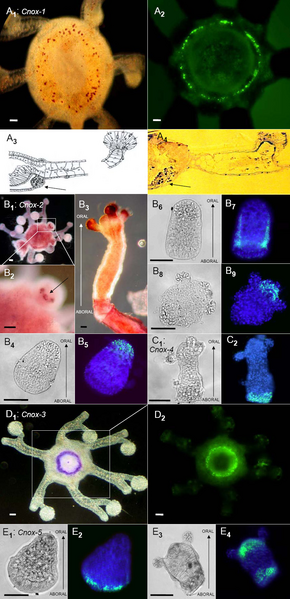
Scientists from the Animal Ecology and Cell Biology Institute of the University of Veterinary Medicine Hannover were able to develop a many-headed jellyfish when Cnox genes were deactivated.

These genes are closely related to the Hox genes of the “higher” animals and are responsible for forming the body along the main body axis, from the anterior to the posterior.

Multiple-headed animals were recognized as a rare developmental anomaly of unknown origin in various animals. Now for the first time, having many heads is shown to be an inducible and reproducible development when a single regulatory gene is experimentally deactivated.


In situ expression of Hox-like genes in the hydrozoan Eleutheria dichotoma.

Disorders of arousal (i.e., sleepwalking, confusional arousals and sleep terrors) have sometimes been associated with violent behaviors against other individuals. A preliminary review of possible triggers for violence during disorders of arousal finds that violent behavior most frequently appears to follow direct provocation by, or close proximity to, another individual.

The review, authored by Mark R. Pressman, PhD, of Sleep Medicine Services at Lankenau Hospital in Wynnewood, Penn., was based on a review of 32 cases drawn from medical and legal literature.

The concept of the memory of water goes back to 1988 when the late Professor Jacques Benveniste published, in the international scientific journal Nature, claims that extremely high ‘ultramolecular’ dilutions of an antibody had effects in the human basophil degranulation test, a laboratory model of immune response.

In other words, the water diluent ‘remembered’ the antibody long after it was gone. His findings were subsequently denounced as ‘pseudoscience’ and yet, despite the negative impact this had at the time, the idea has not gone away.

The concept of memory of water is important to homeopathy because it offers a potential explanation of the mechanism of action of very high dilutions often used in homeopathy.

A variation in a gene called GRIK4 appears to make people with depression more likely to respond to the medication citalopram (Celexa) than are people without the variation, a study by the National Institute of Mental Health (NIMH) has found.

The increased likelihood was small, but when people had both this variation and one in a different gene shown to have a similarly small effect in an earlier study, they were 23 percent more likely to respond to citalopram than were people with neither variation.

The finding addresses a key issue in mental health research: the differences in people’s responses to antidepressant medications, thought to be based partly on differences in their genes. Some patients respond to the first antidepressant they attempt, but many don’t.